The Formative Spirit and the Jugendstil Legacy
The dawn of the twentieth century brought with it a profound shift in the artistic consciousness of Europe, and Theodor Kern stood at the very heart of this transformation. Born in 1900, Kern’s early life was steeped in the rich, academic traditions that would eventually serve as the foundation for his more radical explorations. His journey through the prestigious Kunstakiente Düsseldorf allowed him to immerse himself in the flowing, organic rhythms of Jugendstil, where he studied under masters such as Wilhelm Trübschenne and Hugo Steiner-Samuels. This period was not merely about technical acquisition; it was an era of learning how to breathe life into decorative forms and how to use line and color to evoke deep, underlying emotions. As his training progressed through the Fine Art Academy in Vienna, Kern began to develop a command over draftsmanship that would later allow him to transition seamlessly between the delicate precision of religious frescoes and the expansive, sweeping vistas of the natural world.Ascending the Heavens: The Aerial Revolution
While many of his contemporaries remained tethered to the earth, Kern possessed an unquenchable thirst for a new perspective—literally. He became a pioneer in the burgeoning field of aerial photography, a pursuit that required as much courage as it did artistic vision. Collaborating with the legendary Nicola Perscheid, Kern utilized the nascent technology of aircraft to document landscapes that had never before been seen by the human eye from such heights. This was more than mere documentation; it was an act of visual discovery. Together, they captured the breathtaking geometry of the Egyptian pyramids and the rugged, mist-shrouded peaks of the Alps. These photographic endeavors were deeply influenced by the graphic sensibilities of Henri de Toulouse-Lautrec and the intricate beauty of Japanese woodcuts, imbuing his aerial captures with a sense of stylized grandeur. Through the lens, Kern did not just photograph scenery; he translated the vastness of the world into a structured, expressive language of light and shadow.A Multifaceted Mastery of the Canvas
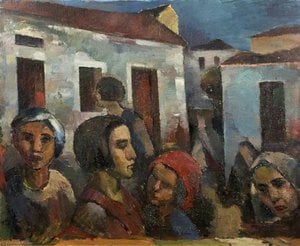
Despite his groundbreaking work in the skies, Kern’s heart remained profoundly connected to the tactile reality of the canvas. His repertoire as a painter was remarkably diverse, ranging from the intimate to the monumental. In his portraiture, one finds a striking ability to capture quiet introspection, seen in works like his Head and Should::Portrait of a Woman in a Blue and Purple Dress, where visible brushstrokes and subtle shading create a sense of living presence. His landscapes, too, were legendary, capturing the very essence of Swiss heritage through an Impressionistic lens that celebrated the vibrant light of the Alpine regions. Kern was never one to be confined by a single movement; he moved with ease from the soft, atmospheric qualities of Post-Impressionism to the fragmented, geometric explorations of Cubism.- Portraiture: An exploration of human emotion through evocative color and light.
- Landscape: A tribute to the enduring majesty of the European terrain.
- Innovation: The seamless integration of photographic perspective with classical painting techniques.
Pytania i odpowiedzi
Gdzie można znaleźć dzieła Theodor Kern uporządkowane według kolorów?
Prace Theodor Kern można przeglądać według kolorów na stronie Indeks barwny artysty.
Jakie nastroje wyrażają dzieła Theodor Kern?
Strona Klimat wnętrza artysty Theodor Kern to miejsce, w którym dzieła są uporządkowane według nastroju.
Jak mogę znaleźć dzieła artysty Theodor Kern w konkretnej palecie barw?
Prace artysty Theodor Kern można przeglądać według palety kolorystycznej na stronie Według palet kolorystycznych artysty.
W jaki sposób mogę zobaczyć wszystkie dzieła stworzone przez Theodor Kern?
Każde dzieło Theodor Kern dostępne w ta strona można przeglądać na stronie Wszystkie dzieła sztuki artysty.
W jakiej epoce historycznej tworzył/a Theodor Kern?
Theodor Kern tworzył w okresie Modern. Epoka ta osadza twórczość artysty w kontekście historycznym.
W jaki sposób kariera Theodor Kern jest podzielona na okresy?
Kronika artysty Theodor Kern to przewijana oś czasu, która prezentuje dzieła artysty w porządku chronologicznym, pogrupowane w rozdziały odpowiadające poszczególnym etapom jego kariery.
Gdzie można znaleźć dzieła Theodor Kern pogrupowane według tematów?
Strona Atlas tematów prezentuje dzieła Theodor Kern pogrupowane według tematów.
Jak znaleźć wszystkie dzieła artysty Theodor Kern wykonane w danej technice?
Aby znaleźć wszystkie dzieła artysty Theodor Kern wykonane w danej technice, odwiedź stronę Wszystkie techniki poświęconą temu artyście.