Biografia artysty
A Dream Weaver: The Life and Art of Paul Delvaux
Paul Delvaux, a name synonymous with haunting beauty and unsettling mystery, was born in 1897 in the small Belgian village of Wanze – a place that would profoundly shape his artistic vision. His early life, steeped in both rigorous academic training and the fantastical worlds conjured by literature and myth, laid the foundation for his unique approach to Surrealism. Initially destined for a career in architecture by his parents, Delvaux’s passion for painting ultimately prevailed, leading him to enroll at the prestigious Académie Royale des Beaux-Arts in Brussels. While he struggled with the demanding structure of architectural design, the artistic training instilled within him a remarkable command of perspective and form – skills that would later be brilliantly employed in crafting his dreamlike landscapes. Early works, primarily landscapes painted in a post-impressionist style, hinted at the peculiar atmosphere that would become his signature, yet they also reflected a grounding in classical techniques.
The Seeds of Surrealism: De Chirico and Early Influences
A pivotal moment arrived with Delvaux’s encounter with the paintings of Giorgio de Chirico. The Italian artist's metaphysical landscapes – stark, enigmatic scenes populated by shadows, classical architecture, and unsettling figures – resonated deeply within Delvaux’s soul, unlocking a new realm of possibilities. De Chirico’s ability to evoke a sense of unease and psychological depth profoundly influenced Delvaux’s artistic direction. He wasn't merely copying de Chirico; he was absorbing the *spirit* of his work, adapting it to his own unique sensibility. Alongside de Chirico, Delvaux also found inspiration in the works of Flemish Expressionists like Constant Permeke and Gustave De Smet, whose somber palettes and emotionally charged brushwork added another layer of complexity to his artistic vocabulary. The influence of Homer’s *Odyssey* and Jules Verne's adventurous tales further fueled his imagination, imbuing his paintings with a sense of timelessness and the allure of the unknown. This confluence of influences – classical precision, psychological depth, and fantastical imagery – began to coalesce into Delvaux’s distinctive style.
The Language of Dreams: Recurring Motifs and Symbolism
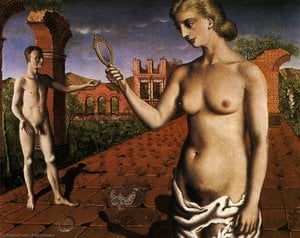
Delvaux's artistic language is characterized by a rich tapestry of symbolism, though he consistently resisted attempts at reductive psychoanalytic interpretations. The female nude, a recurring motif in his work, rarely embodies simple sensuality; instead, she often appears passive, melancholic, or even haunted – embodying both desire and vulnerability. Trains and railway stations frequently serve as potent symbols of transition, displacement, and the anxieties inherent in modern life. Skeletons, far from being morbid reminders of death, are presented as spectral presences, subtly reminding us of our mortality while existing within idyllic scenes. Classical architecture provides a backdrop of order and permanence, yet it is often rendered strangely distorted or incomplete, suggesting a fragility beneath its imposing facade. These elements aren’t merely decorative; they are integral to the emotional and psychological impact of his paintings. Consider *Night Train*, for example – the anonymous figures, the looming architecture, and the palpable sense of impending doom create an unforgettable image that speaks to our deepest anxieties. The artist himself emphasized that his imagery stemmed from deeply personal memories and impressions, rather than deliberate attempts at decoding the subconscious.
From Neo-Impressionism to Surrealist Recognition
Delvaux’s artistic journey wasn't a straightforward progression; he navigated various stylistic influences before fully embracing Surrealism. Initially working in a neo-impressionist style, characterized by meticulous detail and vibrant colors, his early landscapes reflected this academic grounding. However, after encountering the works of de Chirico and Magritte, Delvaux began to experiment with more irrational and dreamlike imagery. He traveled through Italy during World War II, immersing himself in the classical architecture and artistic traditions of that country, which further informed his style. He officially joined the Surrealist movement in 1934, participating in an exhibition organized by André Breton, though he maintained a degree of independence from the group’s rigid ideological framework. His paintings – such as *Sleeping Venus*, *The Summer*, and *Grise City* – became instantly recognizable for their haunting beauty and unsettling atmosphere. Major works like *Sleeping Venus* are now held in prestigious museums worldwide, cementing his place as one of the most important artists of the 20th century.
Legacy and Enduring Influence
Paul Delvaux’s legacy extends far beyond his own lifetime. His paintings continue to captivate audiences with their haunting beauty and enigmatic atmosphere, prompting viewers to confront unsettling questions about reality, desire, and mortality. He demonstrated that Surrealism could exist beyond the confines of automatic writing and dream analysis, embracing instead a meticulous technique and a deeply personal vision. The Paul Delvaux Museum in Saint-Idesbald, Belgium, stands as a testament to his lasting impact, housing the world’s largest collection of his work and offering visitors an intimate glimpse into the captivating realm of his imagination. His influence can be seen in the works of countless contemporary artists who continue to explore themes of memory, desire, and the subconscious – ensuring that Delvaux's dreamlike visions will endure for generations to come.



 Podgląd w skali
 Przełącz na wydruki
 Wyślij jako kartkę
 Udostępnij
 Szczegóły dzieła

 Pobierz
 Podobne obiekty
 RTG
RTG Pokaz slajdów
 Statystyki


 Rozwiń treść