A Dreamscape Frozen in Time
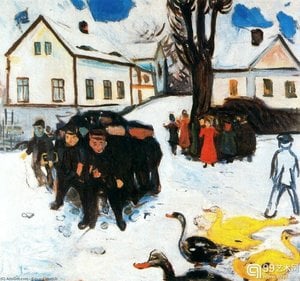
In the quiet, monochromatic depths of Marc Chagall’s “Russian Village,” we encounter a world that exists at the intersection of memory and myth. Completed in 1929 during his period of Parisian exile, this oil on canvas masterpiece serves as a profound distillation of the artist's connection to his Vitebsk homeland. Rather than a literal depiction of a landscape, the painting functions as a dreamscape, where the wintry Russian countryside is rendered with an ethereal quality that defies rational explanation. The absence of color does not diminish the work; instead, it strips away the distractions of the physical world, leaving behind a skeletal, hauntingly beautiful vision of a life etched in frost and nostalgia.
The composition invites the viewer to wander through a stylized, snow-covered landscape where reality feels delightfully unmoored. A horse-drawn carriage, a quintessential symbol of rural tradition, moves across the left side of the canvas, traversing over rooftops and buildings as if gravity were merely a suggestion. This sense of spatial ambiguity is a hallmark of the Naïve Art movement, a style Chagall embraced to recapture the uninhibited spirit of childhood and folklore. By rejecting the rigid academic conventions of perspective and anatomical precision, Chagall creates a flattened, layered world where buildings overlap in a charmingly chaotic arrangement, suggesting a village that is as much a mental construct as it is a physical place.
Symbolism and the Texture of Memory
Every element within this wintry scene carries a weight of quiet symbolism. The presence of two clocks—one positioned in the upper right and another in the lower left—serves as a poignant reminder of the passage of time, perhaps suggesting that this village is a moment frozen eternally in the artist's mind. The figures scattered throughout the landscape, including a man riding atop the carriage and others standing near the center, add a pulse of everyday life to the stillness of the snow. These simplified, geometric forms contribute to the painting's primitive charm, evoking a sense of timelessness that resonates deeply with those who find beauty in simplicity.
Technically, the work is a masterclass in using texture and tone to evoke atmosphere. Through the application of oil pigments, Chagall creates a tactile experience where snowy surfaces appear rough and uneven, contrasting with the smoother, more solid feel of the village structures. The lighting is diffused and even, casting minimal shadows and enveloping the entire scene in a soft, melancholic glow. For the collector or interior designer, this piece offers a sophisticated monochromatic palette that brings a sense of calm, quiet beauty and intellectual depth to any space. It is not merely a painting of a place, but an invitation to inhabit a memory, making it a profound addition to any collection dedicated to the transformative power of the human imagination.
Pytania i odpowiedzi
Jaki to rodzaj dzieła sztuki: „Russian village” – Marc Chagall?
"Russian village" to WallArt.
Gdzie mogę znaleźć przewodnik do "Russian village"?
Strona Karta informacyjna dla uczniów dzieła „Russian village” – Marc Chagall oferuje dwustronicową kartę informacyjną w formacie do druku: samo dzieło wraz z tabelą identyfikacyjną, oś czasu umieszczającą je w latach życia artysty, inne prace tego twórcy, zmierzoną paletę kolorystyczną oraz gotowe do skopiowania cytaty w czterech stylach.
Czy mogę użyć rozszerzonej rzeczywistości, aby zobaczyć „Russian village” – Marc Chagall w swoim pokoju?
Strona Podgląd w AR dzieła „Russian village” – Marc Chagall wykorzystuje rozszerzoną rzeczywistość, aby dzięki kompatybilnemu urządzeniu pokazać obraz w Twojej własnej przestrzeni.



 Podgląd w skali 1:1
 Zamów ręcznie malowaną reprodukcję
 Wyślij jako kartkę
 Udostępnij
 Szczegóły dzieła
 Przewodnik

 Pobierz obraz
 Podobne obiekty
 RTG
RTG Pokaz slajdów
 Statystyki


 Rozwiń treść






































 Opcja ze szkłem jest dostępna wyłącznie w rozmiarach poniżej 110 cm