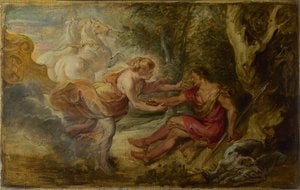
François Boucher: A Master of Rococo’s Delicate Embrace
François Boucher (1703-1770) stands as a cornerstone of 18th-century French art, an artist inextricably linked to the opulent and sensual world of the Rococo. More than simply a painter, he was a decorator, a designer, and a master of capturing the fleeting beauty and playful spirit that defined this era’s artistic sensibilities. His legacy isn't one of grand historical narratives but rather of exquisitely rendered scenes brimming with charm, eroticism, and an undeniable sense of delight – a testament to his profound understanding of aristocratic taste and the pursuit of pleasure.
Early Years and Artistic Foundations
Born on September 29th, 1703, in the heart of Paris, François Boucher’s artistic journey began within a family steeped in craftsmanship. His father, Jean Boucher, was himself a painter, primarily engaged in creating decorative elements for embroidery – a lineage that instilled in young François an appreciation for detail and refined aesthetics. Initially, he received instruction from his father, but at the age of seventeen, he caught the discerning eye of François Lemoyne, a prominent sculptor and painter. This brief apprenticeship proved invaluable, introducing him to the fundamentals of technique and artistic principles. A subsequent period spent assisting the engraver, Jean-François Cars, honed his skills in composition and draughtsmanship. However, it was his victory at the prestigious Grand Prix de Rome in 1720 that truly launched his career, providing him with a coveted scholarship to study in Italy – a pivotal experience that exposed him to the masterpieces of the Renaissance and Baroque periods.
The Rise to Prominence: Courtly Patronage and Artistic Flourishing
Returning to France in 1731, Boucher was immediately admitted to the Académie Royale de Peinture et de Sculpture. His debut work, “Rinaldo and Armida” (1734), instantly established him as a rising star within the Parisian art scene. This painting showcased his burgeoning talent for capturing dramatic emotion and dynamic movement – hallmarks of the Rococo style. Boucher’s artistic voice quickly solidified, characterized by delicate brushwork, pastel palettes, and an emphasis on mythological and pastoral themes. He became increasingly sought after by wealthy patrons, including Madame de Pompadour, the influential mistress of King Louis XV, who recognized his exceptional talent and commissioned numerous works from him. Her patronage, in particular, cemented his position at the pinnacle of French artistic society.
A World of Myth, Leisure, and Eroticism
Boucher’s oeuvre is remarkably diverse, encompassing a wide range of subjects – mythology, portraiture, genre scenes, and landscape. However, he is perhaps most celebrated for his depictions of mythological figures, particularly Venus and Cupid, rendered with an exquisite blend of sensuality and grace. Paintings like “The Triumph of Venus” (1740-1751) are prime examples of this style, showcasing Boucher’s mastery of composition and color. He frequently depicted scenes of domestic tranquility – such as “The Breakfast” (1739), a charming portrayal of his wife and children – offering a glimpse into the refined pleasures enjoyed by the French aristocracy. Yet, beneath the surface of these idyllic settings often lay an undercurrent of playful eroticism, reflecting the era’s fascination with beauty and desire.
Legacy and Influence
François Boucher's influence extended far beyond his own paintings. He served as a sought-after designer for the theater, creating elaborate costumes and sets that contributed to the spectacle of Parisian productions. He also played a significant role in the decoration of the Beauvais and Gobelins workshops, designing tapestries that adorned royal palaces and aristocratic residences. His appointment as *Premier Peintre du Roi* in 1765 – the highest artistic honor bestowed by the French monarchy – solidified his status as the leading artist of the Rococo era. While later critics questioned the perceived superficiality of Rococo art, Boucher’s technical skill, innovative compositions, and enduring appeal have ensured his place as a pivotal figure in the history of Western art. His work continues to captivate viewers with its delicate beauty, playful charm, and timeless elegance.



 Podgląd w skali
 Zamów ręcznie malowaną reprodukcję
 Wyślij jako kartkę
 Udostępnij
 Szczegóły dzieła

 Pobierz
 Podobne obiekty
 RTG
RTG Pokaz slajdów
 Statystyki


 Rozwiń treść






































 Opcja ze szkłem jest dostępna wyłącznie w rozmiarach poniżej 110 cm