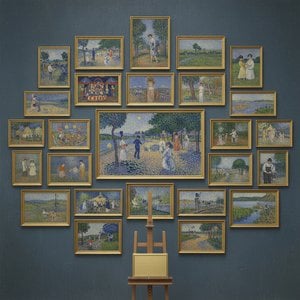
Georges Seurat: Bridging Science and Beauty
Georges Seurat’s “La Grenouillère” – literally “The Pond” – stands as an emblem of Impressionism's audacious embrace of scientific inquiry. Painted in 1876, this monumental canvas depicts a Parisian café scene brimming with life, yet it’s far from merely capturing a snapshot of everyday existence. Instead, Seurat meticulously constructed his artwork using a revolutionary technique known as Pointillisme, pioneered alongside Paul Signac.
- The Technique: Pointillisme wasn't about blending colors; it was about applying tiny dots of pure pigment onto the canvas surface. These dots, individually colored and strategically positioned, refract light and blend optically in the viewer’s eye—a process meticulously documented by Seurat himself.
- Scientific Foundations: Seurat’s approach drew heavily from Chevreul's Color Theory, which posits that complementary colors stimulate each other, creating vibrancy and enhancing visual perception. He painstakingly calculated the chromatic coordinates of each dot to achieve optimal color harmony.
- Historical Context: Impressionism emerged as a reaction against the academic tradition dominating French art academies. Artists like Seurat sought to liberate painting from rigid conventions, prioritizing subjective experience and capturing fleeting moments of light and atmosphere.
The scene itself is deceptively simple—a café terrace populated by men and women enjoying drinks and conversation. However, beneath the surface lies a profound exploration of color and perception. Seurat’s palette utilizes bold hues – reds, blues, yellows – arranged in discrete patches that shimmer with reflected light. This deliberate fragmentation contributes to an unsettling yet captivating effect; it invites viewers to actively participate in constructing the image.
Symbolism:
The pond itself—a recurring motif in Seurat’s oeuvre—represents both physical space and psychological depth. It symbolizes tranquility amidst urban bustle, mirroring the artist's own quest for intellectual clarity and artistic innovation. The figures within the café are rendered with meticulous detail, yet their faces remain largely obscured, emphasizing the importance of emotion and intuition over precise representation.
- Emotional Impact: “La Grenouillère” evokes a sense of immediacy and dynamism—a feeling that captures the vibrant energy of Parisian life. Yet, there’s also an underlying tension created by Seurat's technique; it compels viewers to confront the complexities of visual perception.
“La Grenouillère” remains a cornerstone of Impressionist art history and continues to inspire artists and collectors alike. Its enduring appeal lies not only in its aesthetic beauty but also in its audacious intellectual ambition—a testament to Seurat’s unwavering belief that art could illuminate the mysteries of human consciousness.


 Zobacz w skali 1:1
 Kup ręcznie malowany obraz
 Wyślij
 Udostępnij
 Szczegóły
 Przewodnik

 Pobierz plik obrazu
 Podobne obiekty
 RTG
RTG Pokaz slajdów
 Statystyki

 Czytaj więcej






































 Opcja ze szkłem jest dostępna wyłącznie w rozmiarach poniżej 110 cm