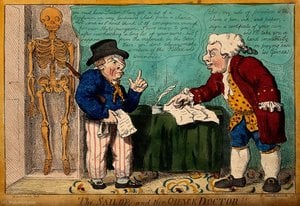
Isaac Robert Cruikshank: A Pioneer of Victorian Satire
Isaac Robert Cruikshank (1764-1811) stands as a pivotal figure in the annals of British art history, particularly renowned for his groundbreaking contributions to satirical printmaking during the Victorian era. Born in Edinburgh, Scotland, to Elizabeth Davidson and Andrew Crookshanks—a former customs inspector dispossessed for his involvement in the Jacobite uprising—Cruikshank’s early life fostered an appreciation for diverse pursuits including sports and music. His artistic education commenced with a local instructor, possibly John Kay (1742–1826), shaping him into a skilled engraver and illustrator whose work would profoundly impact Victorian society.- Early Life & Education: Cruikshank’s upbringing instilled in him a broad intellectual curiosity, evident in his engagement with various hobbies beyond art. His formative years were marked by exposure to influential artistic mentors like John Kay, laying the groundwork for his future career path.
- Marriage & Family: In 1788, Cruikshank married Mary Macnaughton, establishing a family that included five children—two tragically succumbed to tuberculosis in infancy. Notably, their daughter Margaret Eliza (1808–1825), possessed considerable artistic talent herself, embodying the legacy of Cruikshank’s creative lineage.
The Rise of Victorian Printmaking & Cruikshank's Artistic Style
Cruikshank swiftly transitioned to London in 1783 alongside his mentor, embarking on a journey that would solidify his position as one of the era’s foremost printmakers. His artistic style was characterized by meticulous detail and dramatic composition—traits honed through observation and technical mastery—resulting in prints that captured both the grandeur and grotesqueness of Victorian life. Cruikshank's initial publications focused on Edinburgh “types,” demonstrating an early fascination with documenting social realities. He quickly gained recognition for his caricatures, notably "Scotch Eloquence," which satirized Edinburgh’s prominent figures with sharp wit and precision.- Early Engravings: Cruikshank's debut etchings of Edinburgh characters established him as a keen observer of social dynamics and showcased his burgeoning artistic talent.
- Illustrative Achievements: He excelled in illustrating theatrical productions, contributing to George Shaw’s monumental zoology series (1800–26), and notably collaborated with Charles Dickens on iconic novels like “Oliver Twist,” cementing his reputation as a masterful storyteller through visual mediums.
Themes of Critique & Social Commentary
Cruikshank's artistic output consistently interrogated societal norms and political ideologies, reflecting the spirit of his time—a period marked by fervent debates surrounding reform and revolution. His prints frequently confronted issues of poverty, injustice, and hypocrisy, utilizing biting satire to expose flaws within institutions and provoke critical reflection. Works like “The Radical’s Arms” powerfully symbolized the violent excesses of the French Terror, employing the guillotine as a potent visual metaphor for political repression. Furthermore, Cruikshank's unwavering stance against Napoleon and British radicalism underscored his commitment to artistic integrity and moral conviction.Legacy & Influence
Isaac Robert Cruikshank’s enduring legacy resides in his pioneering role as one of the earliest practitioners of comic art—a genre that would flourish throughout the Victorian era and beyond. His meticulous draughtsmanship, combined with his astute understanding of human psychology, established him as a formative influence on subsequent generations of illustrators and artists. Cruikshank's contribution to British visual culture remains invaluable, ensuring his place among the most celebrated figures of 18th-century art and cementing his reputation as “the modern Hogarth,” mirroring William Hogarth’s satirical prowess in capturing social realities with unflinching honesty. His brother George Cruikshank continued his artistic endeavors, achieving considerable fame as an illustrator and caricaturist—a testament to the enduring impact of their shared creative vision.Spørsmål og svar
Hvor populære er kunstverkene til Isaac Robert Cruikshank?
Siden Statistikk for Isaac Robert Cruikshank presenterer statistikk beregnet ut fra kunstverkene til kunstneren som er oppført på denne nettsiden.
Kan jeg utforske verkene til Isaac Robert Cruikshank etter nøkkelord?
For å finne verk av Isaac Robert Cruikshank innen et spesifikt tema, kan du bruke kunstnerens Etter nøkkelord-side, som grupperer kunstverkene etter nøkkelord.
Finnes det en oversikt over alle motivene Isaac Robert Cruikshank malte?
Motivatlas til Isaac Robert Cruikshank er en side som kartlegger kunstnerens verk etter motiv.