Se i rommet Se i AR Bytt til trykkversjon Gå til digitalt bilde Del som digitalt kort
Detaljer Studentguide Legg til i favoritter Last ned Liknende objekter Røntgen Lysbildefremvisning Besøksstatistikk

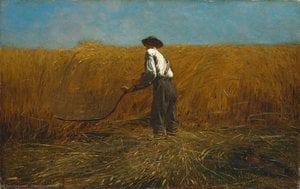
The Pumpkin Patch

Experience Winslow Homer's 'The Pumpkin Patch' (1878), a captivating watercolor depicting rural American life. Admire its warm tones & community spirit – a timeless masterpiece by an American art icon.

Winslow Homer (1836-1910): Amerikansk realistisk kunstner kjent for sine kraftfulle bilder av hav og landskap! Opplev klassiske verk som Breezing Up og Gulf Stream.

Håndlaget oljereproduksjon

Håndmalt olje på lerret i din valgte størrelse og ramme, laget på bestilling av våre kunstnere. ( Bytt til trykkversjon Gå til digitalt bilde)

Corner sample of the P118B picture frame: støpt polystyren, 5 cm wide and 3 cm thick
P118B Nkr10
Corner sample of the P118H picture frame: støpt polystyren, 5 cm wide and 3 cm thick
P118H Nkr10
Corner sample of the P118W picture frame: støpt polystyren, 5 cm wide and 3 cm thick
P118W Nkr10
Corner sample of the P438Z picture frame: støpt polystyren, 5.5 cm wide and 3.5 cm thick
P438Z Nkr10
Corner sample of the P508JH picture frame: støpt polystyren, 7 cm wide and 3.5 cm thick
P508JH Nkr12
Corner sample of the P508YH picture frame: støpt polystyren, 7 cm wide and 3.5 cm thick
P508YH Nkr12
Corner sample of the P805H picture frame: støpt polystyren, 5 cm wide and 3.5 cm thick
P805H Nkr10
Corner sample of the P805Z picture frame: støpt polystyren, 5 cm wide and 3.5 cm thick
P805Z Nkr10
Corner sample of the P919BZ picture frame: støpt polystyren, 7 cm wide and 3.5 cm thick
P919BZ Nkr10
Corner sample of the P919G picture frame: støpt polystyren, 7 cm wide and 3.5 cm thick
P919G Nkr10
Corner sample of the P919XJ picture frame: støpt polystyren, 7 cm wide and 3.5 cm thick
P919XJ Nkr10
Corner sample of the P959ZH picture frame: støpt polystyren, 5 cm wide and 3 cm thick
P959ZH Nkr10
Corner sample of the P968JZ picture frame: støpt polystyren, 6 cm wide and 4 cm thick
P968JZ Nkr12
Corner sample of the W106C picture frame: massivt tre, 5 cm wide and 3 cm thick
W106C Nkr8
Corner sample of the W218G picture frame: massivt tre, 5 cm wide and 3 cm thick
W218G Nkr10
Corner sample of the W218JH picture frame: massivt tre, 5 cm wide and 3 cm thick
W218JH Nkr8
Corner sample of the W218Y picture frame: massivt tre, 5 cm wide and 3 cm thick
W218Y Nkr10
Corner sample of the W307PJ picture frame: massivt tre, 6 cm wide and 3 cm thick
W307PJ Nkr10
Corner sample of the W316G picture frame: massivt tre, 6 cm wide and 3 cm thick
W316G Nkr10
Corner sample of the W316PJ picture frame: massivt tre, 6 cm wide and 3 cm thick
W316PJ Nkr8
Corner sample of the W316Y picture frame: massivt tre, 6 cm wide and 3 cm thick
W316Y Nkr10
Corner sample of the W398PJ picture frame: massivt tre, 5 cm wide and 3 cm thick
W398PJ Nkr8
Corner sample of the W4111J picture frame: massivt tre, 6.5 cm wide and 3.5 cm thick
W4111J Nkr10
Corner sample of the W500HY picture frame: massivt tre, 7 cm wide and 5 cm thick
W500HY Nkr15
Corner sample of the W500JH picture frame: massivt tre, 7 cm wide and 5 cm thick
W500JH Nkr15
Corner sample of the W692G picture frame: massivt tre, 8 cm wide and 4 cm thick
W692G Nkr12
Corner sample of the W849H picture frame: massivt tre, 5 cm wide and 3 cm thick
W849H Nkr8
Corner sample of the W940BG picture frame: massivt tre, 7.5 cm wide and 4.5 cm thick
W940BG Nkr15
Corner sample of the W953PJ picture frame: massivt tre, 6 cm wide and 3.5 cm thick
W953PJ Nkr8

Standardformat
tilpasset
CM
INCH

Velg mellom våre forhåndsdefinerte størrelser som bevarer kunstverkets opprinnelige proporsjoner.

bredde
høyde

Skriv inn bredden og høyden du trenger, slik at den passer til din ramme eller vegg. Dette er håndmalt, så for en størrelse med en annen form kan kunstneren male litt mer rundt bildet, eller beskjære det noe — du velger selv. Vi sender deg en digital mockup for godkjenning før maleriet påbegynnes. Bildet som vises på denne siden viser ikke det faktiske resultatet — kun mockuppen gjør det.

Eksempler på hva som kan endres: Erstatt ansikt med bilde av kunden; Legg til kjæledyr (f.eks. bytt ut katt med hund); Inkluder en skjult melding i bakgrunnen; Endre bakgrunnslandskap eller elementer.
Etter bestilling vil WahooArt.com-teamet sende e-post til kunden for instruksjoner og sende et utkast (mockup) som forhåndsvisning.

Verdensomspennende levering () på 3–4 uker i stedet for standard 5 uker. (27 October). Ingen kompromisser med kvaliteten.

Gratis ekspressfrakt over hele verden
Lerretsduk av høykvalitets lin
Full transportforsikring
Garanti for refusjon av toll og importavgifter
Garantert fargeekthet
100 dagers returrett ved fabrikasjonsfeil
100% pengene tilbake-garanti
Mengderabatt

Totalpris

Nkr 2591

The Pumpkin Patch

Reproduksjonsmetode

Format på reproduksjon

-

Totalpris

Nkr 2591

A Moment Frozen in Time: The Significance of Winslow Homer’s “The Pumpkin Patch”

Winslow Homer's "The Pumpkin Patch," painted in 1878, isn’t merely a depiction of autumnal labor; it’s a poignant snapshot of rural America at the cusp of profound change. This watercolor masterpiece, currently residing within the Canajoharie Library and Art Gallery, invites us into a scene brimming with quiet industry, community spirit, and a subtle undercurrent of nostalgia for a disappearing way of life. Homer, a master of capturing the essence of everyday American experience, skillfully employs his signature technique—a delicate balance between observation and expressive brushwork—to create an atmosphere both warm and deeply resonant.

The painting immediately draws the eye to the group of figures engaged in the harvest – men and women working together with a shared purpose. Their postures, rendered with remarkable sensitivity, suggest not just physical exertion but also a sense of camaraderie and mutual respect. Homer’s use of earthy tones—russets, ochres, and deep greens—dominates the palette, mirroring the landscape itself and grounding the scene in the tangible realities of rural life. The soft, diffused light, characteristic of his watercolor style, lends an almost dreamlike quality to the composition, softening the edges and creating a sense of intimacy.

The Artist’s Approach: Watercolor as a Vehicle for Emotion

Homer's choice of watercolor is crucial to understanding the painting’s impact. Unlike the bolder strokes of oil paint, watercolor allows for a remarkable degree of transparency and luminosity. This technique perfectly suits Homer’s aim—to capture not just the appearance of the scene but also its emotional atmosphere. The subtle gradations of color, achieved through layering washes and delicate brushstrokes, evoke a sense of warmth and comfort, while simultaneously hinting at the hard work involved in the harvest.

Furthermore, Homer’s meticulous attention to detail—the individual pumpkins scattered across the field, the worn clothing of the workers, the subtle expressions on their faces—adds layers of complexity to the scene. He doesn't shy away from depicting the realities of rural labor, yet he does so with a remarkable degree of empathy and respect for his subjects.

A Window into 19th-Century America

"The Pumpkin Patch" offers a valuable glimpse into American life during the late 19th century. It reflects a period of rapid industrialization and urbanization, which were fundamentally altering the social fabric of the nation. The painting celebrates the enduring values of community, hard work, and self-sufficiency—qualities that were increasingly threatened by these changes. The scene speaks to a time when agriculture remained central to American identity, and families relied on each other for support and sustenance.

Beyond its immediate depiction of rural labor, the painting also carries symbolic weight. The abundance of pumpkins – a symbol of harvest, prosperity, and gratitude – suggests a celebration of the bounty of the land. The collective effort of the workers underscores the importance of community and shared responsibility. It’s a quiet testament to the dignity of honest work and the beauty of simple living.

Bringing Homer's Vision Home: High-Quality Reproductions

WahooArt offers meticulously crafted, handmade oil paintings reproductions of “The Pumpkin Patch,” allowing art lovers to experience the artistry and emotional depth of this iconic American painting in their own homes. Our skilled artists utilize only the finest materials—traditional oils on canvas—to faithfully recreate every detail of Homer’s original work. We strive to preserve not just the visual appearance but also the spirit and atmosphere of the painting, ensuring that it remains a timeless treasure for generations to come.

Explore the full beauty of “The Pumpkin Patch” – and discover other exceptional reproductions by Winslow Homer – at WahooArt.com. Let this evocative image transport you back to a simpler time, reminding us of the enduring values that shaped American culture.

Spørsmål og svar

Hvordan er fargekomposisjonen i "The Pumpkin Patch" av Winslow Homer bygget opp?

Fargekomposisjonen i "The Pumpkin Patch" av Winslow Homer kombinerer en Uttalelse kontrast med en Balansert harmoni harmoni.

Hvilken palett og hvilken følelse forener "The Pumpkin Patch"?

"The Pumpkin Patch" av Winslow Homer kombinerer en Nøytrale toner fargepalett med en Nostalgi preget tone.

Hvor populær er "The Pumpkin Patch" innenfor American Realism?

Innenfor American Realism-retningen har "The Pumpkin Patch" et Ikonisk popularitetsnivå.


Kunstnerbiografi

A Brush with the American Spirit: The Life and Art of Winslow Homer

Winslow Homer, born in Boston in 1836, wasn’t sculpted by the traditional European art academies that shaped so many of his contemporaries. Instead, he emerged from a distinctly American experience, one rooted in practicality and observation. His journey began not with grand historical canvases, but as a commercial illustrator at the tender age of twelve for Harper's Weekly. This early apprenticeship was formative, honing an exceptional ability to capture scenes with clarity and detail – skills that would become hallmarks of his mature work. He wasn’t learning perspective in Paris; he was learning to *see* America, its people, and its unfolding story. The bustling streets of Boston, the quiet dignity of rural New England life, these were his first subjects, rendered with a precision born of necessity for the demands of print media. This foundation allowed him to transition into painting, initially in watercolor, before fully embracing the expressive potential of oil paints.

From Pastoral Scenes to the Raw Power of Nature

Homer’s early paintings often depicted idyllic scenes – children playing, farmers tending their fields, quiet moments of domesticity. These works, while charming, hinted at a deeper artistic sensibility waiting to be unleashed. The catalyst for this transformation was undoubtedly the Civil War. As a war correspondent for Harper's Weekly, Homer witnessed firsthand the brutal realities of conflict. He didn’t focus on heroic battles or grand strategies; instead, he documented the everyday lives of soldiers and civilians, the quiet moments of grief and resilience amidst chaos. This experience profoundly altered his artistic vision. The pastoral scenes gave way to more challenging subjects: veterans grappling with trauma, freed slaves navigating a new world, and the stark beauty of landscapes touched by hardship. He began to explore themes of struggle, isolation, and humanity’s precar He wasn't interested in imitating European styles; he wanted to create an art that was uniquely American, reflecting its landscapes, its people, and its challenges. His style also evolved, becoming bolder and more direct, reflecting the raw emotional impact of what he had witnessed. Breezing Up (A Fair Wind), painted in 1876, exemplifies this skill – a quintessential depiction of American maritime life, brimming with energy and movement. The Gulf Stream, created decades later, is perhaps his most iconic work, a powerful and symbolic portrayal of a lone man battling the forces of nature, a metaphor for human struggle against overwhelming odds. He wasn’t simply painting what he saw; he was conveying a feeling, an emotional truth about the human condition.

Mastering Light, Texture, and the American Landscape

Winslow Homer's artistic technique is immediately recognizable for its solidity and texture. He wasn’t interested in fleeting impressions; he wanted to build up a sense of tangible reality on the canvas. His oil paintings are characterized by a direct painting approach – layers of paint applied with confidence, creating depth and luminosity. He possessed an extraordinary ability to capture light, whether it was the dazzling glare of the sun on the ocean or the soft glow of twilight over a rural landscape. This mastery extended to his watercolors, where he achieved remarkable atmospheric effects through vibrant colors and delicate washes. He admired European artists like those of the Barbizon school – known for their realistic depictions of rural life – and acknowledged influences from Courbet and Millet, but he ultimately forged his own distinctly American path.

A Legacy Forged in American Realism

Winslow Homer's art offers a profound window into 19th-century America, providing invaluable insights into the social, political, and cultural landscape of his time. His paintings are not merely beautiful representations; they are powerful statements about human resilience, the beauty and power of nature, and the complexities of the American experience. He died in 1910, leaving behind a prolific body of work that continues to resonate with audiences today. His ability to depict America with honesty and authenticity – without romanticizing or idealizing it – ensures his place as one of America’s most important and enduring artists. His influence can be seen in the work of later American painters who sought to depict their own country with similar directness and emotional depth.
  • His work continues to inspire contemporary artists.
  • Homer remains a pivotal figure in the development of American Realism.
Winslow Homer

Winslow Homer

1836 - 1910 , USA

Kort om kunstneren

  • Artistic Movement Or Style: Amerikansk Realisme
  • Artists Or Movements Influenced By This Artist: ['Amerikanske malere']
  • Artists Who Influenced This Artist:
    • Barbizon skole
    • Courbet
    • Millet
  • Date Of Birth: 24. februar 1836
  • Date Of Death: 29. september 1910
  • Full Name: Winslow Homer
  • Nationality: Amerikaner
  • Notable Artworks:
    • Breezing Up
    • Gulfstrømmen
    • Usinn
    • Vitenskapsmann
  • Place Of Birth: Boston, USA
Utforsk kunstverk organisert etter temaer, stiler og kjennetegn.