A Dance of Chaos and Emotion: The Visceral World of Willem de Kooning
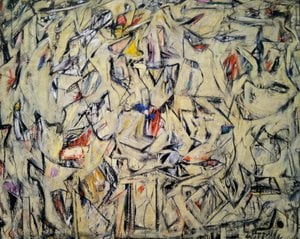
In the landscape of twentieth-century art, few works possess the raw, turbulent energy found in Willem de Kooning’s 1950 masterpiece, Untitled. As a cornerstone of the Abstract Expressionist movement, this canvas serves as more than just a visual arrangement; it is a profound psychological record of an era defined by postwar anxiety and a restless search for new meaning. De Kooning, a pioneer of the New York School, eschewed the comforts of traditional composition to embrace a style often described as action painting. In this work, the viewer is not merely observing a static image but witnessing a frozen moment of intense physical and emotional struggle, where every stroke carries the weight of the artist's direct engagement with the medium.
The technique employed in this piece is a masterclass in gestural freedom. De Kooning utilized oil paints on canvas to create a densely populated surface where thick, sweeping lines collide and intertwine with an almost violent spontaneity. There is a palpable sense of layering and reworking; evidence of scraping and heavy application suggests that the artist labored over the surface, building up textures that invite a tactile response. These lines are not precise or clinical; they bleed into one another, creating a network of amorphous shapes that seem to vibrate with movement. This restless dynamism defies easy categorization, pulling the eye across the canvas in a continuous loop of discovery and disorientation.
The Power of Restraint and Fragmented Humanity
While the energy of the work is explosive, de Kooning achieves a surprising sense of focus through an extraordinarily disciplined color palette. By limiting himself primarily to shades of cream and off-white, punctuated only by deep, dark brown accents, he strips away the distraction of complex color relationships. This deliberate restraint forces the viewer to confront the sheer materiality of the paint itself—the thickness of the impasto, the direction of the drips, and the interplay of light across the uneven surface. This monochromatic approach intensifies the painting's impact, turning the focus toward form and the raw essence of the artist's movement.
Beneath the layers of abstraction, there lies a haunting suggestion of the human condition. While the work is undeniably non-representational, the presence of fragmented facial features or limb-like shapes hints at de Kooning’s enduring fascination with figuration and portraiture. These distorted, ghostly remnants of humanity can be interpreted as symbols of psychological fragmentation, reflecting the internal turmoil and social shifts of the mid-century period. For the collector or interior designer, this piece offers a sophisticated balance: it provides the bold, commanding presence required for a statement wall, while its nuanced textures and muted tones allow it to integrate seamlessly into modern, minimalist, or even classical environments.
Owning a high-quality reproduction of this work means bringing a piece of art history into one's personal space. It is an invitation to contemplate the beauty found within chaos and to appreciate the profound emotional depth that can emerge when an artist dares to break all the rules. Untitled remains a timeless testament to the power of the human spirit to find expression in the most turbulent of forms.
Spørsmål og svar
Hvem har skapt "Untitled"?
Kunstneren bak "Untitled" er Willem de Kooning. Verket er katalogisert under Willem de Kooning sitt navn.
Hva er "Untitled" laget med?
Mediet i "Untitled" av Willem de Kooning er Oil On Canvas. Reproduksjonene har som mål å gjengi utseendet til denne teknikken.
Hvordan forenes kontrast og harmoni i "Untitled"?
Fargekomposisjonen i "Untitled" av Willem de Kooning kombinerer en Statement kontrast med en Strong Color Unity harmoni.



 Se i rommet
 Bestill håndmalt reproduksjon
 Del som digitalt kort
 Del
Del
 Detaljer
 Studentguide

 Last ned
 Liknende objekter
 Røntgen
 Lysbildefremvisning
 Besøksstatistikk

 Les mer






































 Glassalternativet er kun tilgjengelig i størrelser under 110 cm