Victor Vasarely’s ‘Jong’: A Dance of Perception
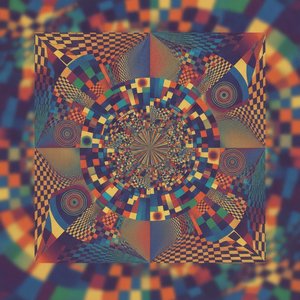
Victor Vasarely's 'Jong,' completed in 1968, is more than just an image; it’s an invitation to question the very nature of reality. This arresting work, a cornerstone of Op Art, immediately captivates with its seemingly impossible optical illusion – a distorted face emerging from a grid of meticulously crafted black and white lines, culminating in a central sphere that appears to both contain and disrupt the composition. Vasarely, born Károly Vaszary in 1906 in Pécs, Croatia, was a visionary who dedicated his life to exploring how our eyes perceive space and form. His journey began with an unexpected detour – initially pursuing medical studies before embracing the world of art in 1927 – a shift profoundly shaped by his education at the Podolini-Volkmann Academy and, crucially, Sándor Bortnyik’s ‘Műhely,’ where he absorbed the revolutionary ideas of the Bauhaus movement. This foundation laid the groundwork for his groundbreaking exploration of geometric abstraction, ultimately leading to the creation of 'Jong' – a testament to his mastery of visual deception.
- A Legacy of Op Art: Vasarely was a pivotal figure in the development of Op Art, a movement that sought to stimulate the viewer’s perception through controlled optical illusions. Unlike traditional representational art, Op Art deliberately manipulated visual elements to create dynamic and often unsettling effects.
- Precision and Illusion: The creation of ‘Jong’ exemplifies Vasarely's meticulous technique – precise drafting and manipulation of lines designed to trick the eye. This isn't simply a drawing; it's an engineered illusion, demanding careful observation and rewarding repeated viewing with its shifting forms.
The Geometry of Deception
'Jong’s' power lies in its masterful use of line. A dense grid of parallel lines forms the foundational structure, but these lines are deliberately warped, curved, and distorted – a technique central to Op Art. This manipulation creates an intense sense of movement and visual ambiguity, drawing the viewer into a complex interplay between perception and reality. The sphere at the heart of the composition acts as both a focal point and a destabilizing element, further amplifying the illusion. The stark monochrome palette—a deliberate choice by Vasarely—heightens the impact of this geometric play, stripping away any distractions and focusing solely on the dynamic relationship between form and space.
Symbolic Resonance: Identity and Fragmentation
Beyond its purely visual effect, ‘Jong’ carries a potent symbolic weight. The distorted face, rendered through abstract distortions within the grid, can be interpreted as representing hidden identities or fragmented perceptions – themes frequently explored by Vasarely. The work suggests that what we see isn't necessarily a faithful reflection of reality but rather a subjective interpretation shaped by our own biases and experiences. This resonates with broader philosophical questions about identity, consciousness, and the nature of truth. The implied movement within the composition evokes a sense of dynamism and instability, mirroring the fluid and often contradictory aspects of human experience.
A Timeless Masterpiece
'Jong' is more than just an artwork; it’s a captivating exploration of perception itself. Its enduring appeal lies in its ability to challenge our assumptions about reality and invite us to reconsider how we see the world. Reproduced with meticulous attention to detail, this piece offers a unique opportunity to bring a touch of Op Art's dynamism and intellectual depth into any interior space – a conversation starter, a visual puzzle, and a testament to Victor Vasarely’s visionary genius.
Spørsmål og svar
Hva er den dominerende fargen i "Jong" av Victor Vasarely?
Den dominerende fargen i "Jong" av Victor Vasarely er Rosy Brown (#adaca9).
Hvilken reproduksjonsstørrelse anbefales for "Jong" av Victor Vasarely?
Anbefalt trykkstørrelse for "Jong" av Victor Vasarely er Large.
Hvilken atmosfære tilfører "Jong" av Victor Vasarely et interiør?
Den Minimalist atmosfæren i "Jong" av Victor Vasarely passer perfekt til det anbefalte rommet: et Reception.



 Bestill håndmalt reproduksjon
 Del som digitalt kort
 Del
Del
 Detaljer
 Studentguide

 Last ned
 Liknende objekter
 Lysbildefremvisning
 Besøksstatistikk

 Les mer






































 Glassalternativet er kun tilgjengelig i størrelser under 110 cm