The Geometry of Perception: Exploring Axo 99
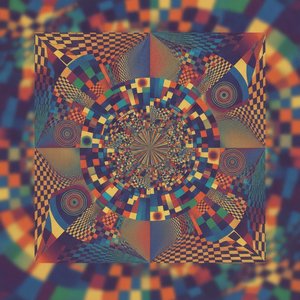
To stand before Victor Vasarely's Axo 99 is not merely to observe a painting; it is to engage in a visual dialogue with the very mechanics of sight itself. This vibrant composition, bursting with reds, blues, greens, yellows, purples, oranges, and pinks, immediately arrests the viewer with its sheer chromatic energy. It is a masterful deployment of geometric abstraction, a field where art transcends mere representation to become an intellectual exercise in pattern and form. Vasarely, the undisputed pioneer of Op Art, understood that color and shape possessed inherent vibrational qualities—qualities he harnessed here to create patterns that seem to shift, pulse, and breathe before your very eyes.
A Legacy Forged in Bauhaus Lines
The genesis of this dazzling work is deeply rooted in the intellectual currents of early 20th-century modernism. Vasarely’s journey from medical studies to the rigorous discipline of painting saw him immersed in environments influenced by the Bauhaus movement. This background instilled in his art a profound respect for structure, function, and pure geometry. Axo 99 is a direct descendant of that lineage—a celebration of order imposed upon the chaos of visual experience. The piece speaks to an era fascinated by scientific principles and the potential of man-made systems to organize beauty. It invites us to look beyond the decorative surface and contemplate the underlying mathematical harmony that governs both nature and human design.
The Allure of Op Art: Illusion as Subject
What makes Axo 99 so captivating is its commitment to optical illusion. The style, undeniably Op Art, plays a delightful trick on the retina. Vasarely utilizes precise repetition and contrasting adjacent colors—a technique that causes patterns to vibrate or appear three-dimensional when viewed from different angles. It’s an art that demands participation; you cannot simply look at it passively. You must move, you must adjust your focus, allowing your own vision to complete the circuit of perception. This dynamic quality ensures that the painting remains endlessly engaging, offering a new visual puzzle with every passing moment.
Integrating Vibrancy into Modern Interiors
For the collector or designer seeking a statement piece, Axo 99 offers unparalleled chromatic depth. Its riot of carefully controlled color means it functions as an electrifying focal point in any room. Whether placed against a muted, sophisticated backdrop to allow its intensity to sing, or incorporated into a maximalist space where pattern is celebrated, this reproduction brings an undeniable sense of intellectual vitality. It suggests a modern sensibility—one that values structure, boldness, and the exhilarating interplay between art and science.
A Touch of Timeless Craftsmanship
The richness visible in the colors suggests the depth achievable through traditional mediums like oil paint. Owning a reproduction of Axo 99 is acquiring more than just pigment on canvas; it is owning a piece of art history that bridges rigorous academic theory with pure, unadulterated visual joy. It serves as a conversation starter, an object of contemplation, and a vibrant testament to the enduring power of geometric thought.



 Se i rommet
 Bestill håndmalt reproduksjon
 Del som digitalt kort
 Del
Del
 Detaljer
 Studentguide

 Last ned
 Liknende objekter
 Røntgen
 Lysbildefremvisning
 Besøksstatistikk
 Les mer






































 Glassalternativet er kun tilgjengelig i størrelser under 110 cm