The Electric Pulse of Pop Art: Reimagining Brattata
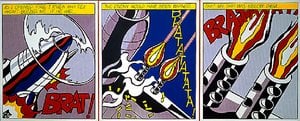
Brattata, a 1962 masterpiece by the visionary Roy Lichtenstein, serves as a thunderous declaration of the power inherent in popular culture. At first glance, the painting presents itself as a single, high-octle panel plucked from the pages of a mid-century comic book, specifically inspired by DC Comics’
All-American Men of War #89. Yet, to view it merely as a reproduction of pulp fiction is to miss its profound artistic rebellion. Lichtenstein takes the ephemeral, disposable imagery of mass media and elevates it to the status of high art, freezing a moment of intense aerial combat within the dignified confines of an oil on canvas. The composition centers on a pilot, his face etched with a grim, focused determination, surrounded by the mechanical chaos of a cockpit. Through this lens, Lichtenstein invites us to find beauty in the manufactured and significance in the mundane, making it an irresistible centerpiece for any collection that celebrates the intersection of fine art and modern iconography.
A Symphony of Dots and Primary Colors
The technical brilliance of
Brattata lies in Lichtenstein’s meticulous mimicry of commercial printing processes. He famously employed the Ben-Day dot technique—a method of using small, closely spaced colored dots to create shading and secondary colors—to replicate the halftone look of cheap newsprint. This deliberate choice creates a fascinating tension between the hand-painted nature of the work and its machine-made appearance. The color palette is strikingly bold, dominated by the primary triad of red, yellow, and blue. These vibrant blocks of color are delineated by thick, authoritative black outlines that lend the piece a graphic, almost architectural strength. For the interior designer, this high-contrast aesthetic offers a dynamic energy; the way the bright yellows and reds pop against the structured lines makes the artwork a commanding focal point in contemporary or minimalist spaces, injecting a sense of rhythmic movement and visual excitement into a room.
Narrative Tension and the Modern Icon
Beyond its striking surface,
Brattata pulsates with an underlying narrative intensity. The inclusion of a text balloon—bearing the words, "That was their mistake - because it gave me more targets than I could have shot at"—anchors the visual action in a specific moment of strategic calculation and wartime drama. This dialogue does more than just tell a story; it integrates language directly into the visual texture of the painting, blurring the line between reading and viewing. The subject matter reflects the cultural anxieties of the Cold War era, capturing the tension of military preparedness through a stylized, almost detached lens. There is an emotional duality at play: the visceral excitement of combat paired with the cool, calculated detachment of the Pop Art movement. For collectors, owning a piece like
Brattata means possessing a fragment of history that continues to challenge our perceptions of heroism, technology, and the very definition of artistic originality.
Spørsmål og svar
Hva handler "Brattata" om?
Temaene i "Brattata" av Roy Lichtenstein inkluderer comic book, aerial combat, pilot helmet, ben-day dots, dialogue balloon, neon colors, military imagery. Sammen oppsummerer de verkets motiv.
Hvordan relaterer stilen til "Brattata" seg til skaperens epoke?
"Brattata" av Roy Lichtenstein tilhører Pop Art-retningen, innenfor skaperens Moderne tid-epoke.
Hvilken atmosfære tilfører "Brattata" av Roy Lichtenstein et interiør?
Med sin Dramatic stemning, anbefales "Brattata" for et Living Room.
I hvilken periode ble "Brattata" av Roy Lichtenstein laget?
"Brattata" av Roy Lichtenstein stammer fra Modern-perioden. Denne perioden gir verkets historiske kontekst.
Hva er "Brattata" laget med?
Mediet i "Brattata" av Roy Lichtenstein er Oil On Canvas. Reproduksjonene har som mål å gjengi utseendet til denne teknikken.
Hva er produksjonsåret til "Brattata" av Roy Lichtenstein?
"Brattata" av Roy Lichtenstein ble skapt i 1962.
Hva er lysstyrken til "Brattata" av Roy Lichtenstein?
Luminansen som er registrert for "Brattata" av Roy Lichtenstein er Bright Balance.
Er "Brattata" fri for opphavsrett?
Når det gjelder opphavsrett, er "Brattata" fortsatt beskyttet av opphavsrett.



 Se i rommet
 Bytt til trykkversjon
 Del som digitalt kort
 Del
Del
 Detaljer
 Studentguide

 Last ned
 Liknende objekter
 Røntgen
 Lysbildefremvisning
 Besøksstatistikk


 Les mer






































 Glassalternativet er kun tilgjengelig i størrelser under 110 cm