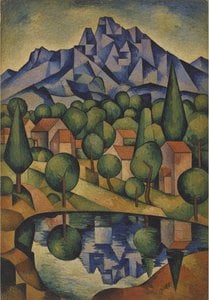
Paul Cézanne’s *Landscape*: A Window into Provençal Tranquility
Paul Cézanne's 1890 painting, often titled simply “Landscape,” isn’t merely a depiction of a rural scene; it’s an invitation to step into the heart of Provence and experience its quiet beauty. This work, housed within the National Gallery in London, represents a pivotal moment in Cézanne’s artistic journey – a bridge between the fleeting impressions of Impressionism and the groundbreaking explorations that would define his legacy as a pioneer of modern art. The painting captures a modest village nestled amongst rolling hills under an overcast sky, a scene imbued with a profound sense of stillness and connection to the land. It's a landscape not of dramatic vistas or heroic figures, but one that speaks volumes through its subtle details and carefully constructed forms.
Cézanne’s approach to painting was revolutionary for his time. He wasn’t interested in faithfully reproducing what he saw; instead, he sought to understand the underlying structure of nature – the geometric shapes beneath the surface. This is strikingly evident in *Landscape*. Notice how the hills are broken down into a series of interlocking cylinders and cones, simplified forms that suggest volume and depth without relying on traditional perspective. The village buildings, too, are rendered as basic blocks, their outlines defined by strong, assertive lines. This deliberate flattening of space, combined with his use of *impasto* – thick layers of paint applied directly to the canvas – creates a tactile quality, inviting the viewer to almost reach out and touch the scene. The brushstrokes themselves are loose and expressive, conveying movement and energy within the composition, a far cry from the smooth, blended surfaces favored by many Impressionists.
Deconstructing Form: Style & Technique
Cézanne’s artistic philosophy was deeply rooted in his lifelong fascination with the landscape of Provence. He spent much of his life observing and studying this region, attempting to capture its essence not just visually but conceptually. This painting is a testament to that dedication. The muted color palette – dominated by blues, greens, and browns – reflects the atmospheric conditions typical of the Provençal countryside, particularly during an overcast day. However, Cézanne doesn’t simply mimic these colors; he manipulates them, layering hues and varying their intensity to create depth and a sense of spatial recession. The use of light is equally deliberate, casting soft shadows that subtly define the forms and contribute to the overall mood of tranquility.
The influence of Post-Impressionism is undeniable in Cézanne’s work, but he transcends mere imitation. He builds upon the Impressionists' focus on capturing fleeting moments while simultaneously rejecting their emphasis on optical realism. There’s a hint of Seurat’s scientific approach to color—the careful observation and analysis of hues—but Cézanne uses these principles not to create photographic likenesses, but to construct a more enduring representation of his subject. The painting also foreshadows the developments of Cubism, with its fragmented forms and multiple viewpoints. Cézanne wasn't simply painting *what* he saw, but *how* he perceived it – a radical shift in artistic thinking that would profoundly impact generations of artists to come.
The Provençal Context & Cézanne’s Artistic Journey
Born and largely based in Aix-en-Provence, France, Cézanne held a lifelong fascination with his native landscape. This painting is deeply rooted in that connection. His early work was influenced by Romanticism and Realism, but he gradually moved towards a more subjective and expressive style, absorbing lessons from Neo-Impressionists like Georges Seurat and Post-Impressionist contemporaries such as Paul Gauguin. Cézanne’s dedication to capturing the essence of form over fleeting impressions set him apart. He wasn't simply painting *what* he saw, but *how* he perceived it – a radical shift in artistic thinking.
Cézanne’s journey was marked by periods of self-doubt and critical dismissal. Initially, his innovative techniques were met with incomprehension and ridicule. However, as the years passed, his work gained recognition, largely thanks to the support of art dealer Ambroise Vollard, who championed Cézanne's vision and organized a solo exhibition in 1895. This event marked a turning point, paving the way for a broader appreciation of Cézanne’s unique style and influence. His legacy is now firmly established as that of “the father of modern art,” having liberated painting from the constraints of strict representation and opening up new possibilities for artistic expression.
Considerations for Interior Design & A Lasting Legacy
Cézanne's *Landscape* offers a timeless appeal, making it an ideal addition to a wide range of interior styles. Its muted palette and serene composition create a sense of calm and sophistication, complementing both traditional and contemporary settings. The painting’s size (81 x 65 cm) makes it suitable as a focal point in a living room, dining room, or study – a space where contemplation and appreciation of beauty are valued. The landscape's natural tones harmonize beautifully with neutral color schemes, adding warmth and depth to cooler palettes. Consider pairing it with rustic wood furniture or textured textiles—perhaps linen curtains or woven rugs—to further enhance the painting’s Provençal charm.
Owning a reproduction of *Landscape* isn’t just acquiring a beautiful artwork; it's embracing a piece of art history – a testament to Cézanne’s vision and his profound impact on the course of modern art. It’s an invitation to bring a touch of Provençal tranquility into your home, reminding you of the enduring power of observation and the beauty found in the simplest of scenes.



 Se i rommet
 Bytt til trykkversjon
 Del som digitalt kort
 Del
Del
 Detaljer
 Studentguide

 Last ned
 Liknende objekter
 Røntgen
 Lysbildefremvisning
 Besøksstatistikk


 Les mer






































 Glassalternativet er kun tilgjengelig i størrelser under 110 cm