Kunstnerbiografi
A Life Bridging Renaissance and Baroque: The World of Otto van Veen
Otto van Veen, a name resonating with the echoes of late 16th and early 17th-century artistry, occupies a fascinating position in art history. Born around 1556 in Leiden, Netherlands, into a family of prominence—his father served as burgomaster—Van Veen’s life was one of shifting allegiances and artistic evolution. The religious tensions gripping the Low Countries during his youth profoundly shaped his trajectory. The relocation of his family to Antwerp in 1572, driven by their Catholic faith amidst a rising tide of Protestantism, marked not just a geographical shift but also a turning point in his intellectual and artistic formation. This move brought him into contact with influential figures like Dominicus Lampsonius and Jean Ramée, laying the groundwork for a career steeped in humanist ideals and classical learning. His subsequent journey to Rome around 1574 or 1575 proved pivotal; immersing himself in the heart of the Italian Renaissance, he absorbed the stylistic nuances that would define his mature work—the elegance, the refined compositions, and the emphasis on idealized forms characteristic of Mannerism. The precise extent of his Roman tutelage remains debated, with some scholars suggesting a period under Federico Zuccari, but its impact is undeniable.
Patronage, Pedagogy, and the Shaping of a Master
Upon returning from Italy, Van Veen swiftly established himself as a sought-after artist. His talent secured him a position as court painter to Alexander Farnese, Duke of Parma, governor of the Southern Netherlands, in Brussels. This patronage provided not only financial stability but also access to a sophisticated artistic milieu and opportunities for large-scale commissions. He became a master within Antwerp’s Guild of St. Luke in 1593, solidifying his professional standing. However, Van Veen's legacy extends far beyond his own paintings; it is inextricably linked to the career of one of art history’s most celebrated masters: Peter Paul Rubens. From approximately 1594 or 1595 until 1598, Van Veen served as Rubens’ teacher, instilling in the young artist a rigorous classical education and a deep appreciation for humanist principles. This mentorship was crucial in shaping Rubens' intellectual framework and artistic sensibilities, laying the foundation for his future triumphs. Van Veen didn’t merely impart technical skills; he cultivated a worldview that emphasized the integration of art, literature, and philosophy—a hallmark of Rubens’ own prolific output. During this period, Van Veen also undertook numerous religious commissions, adorning churches with altarpieces and chapels, demonstrating his versatility and growing reputation as a skilled and reliable artist.
Mannerist Sensibility and the Language of Emblems
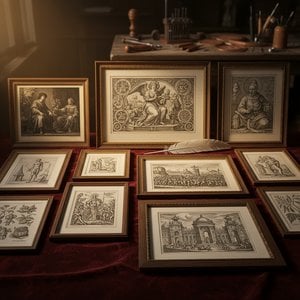
Van Veen’s artistic style is firmly rooted in Mannerism, an aesthetic characterized by elongated figures, graceful poses, sophisticated compositions, and a refined palette. His paintings often exude an air of elegance and intellectual contemplation. He was known as a *pictor doctus* – a learned painter – and this designation reflects his commitment to incorporating humanist themes into his work. Beyond painting, Van Veen made significant contributions to the burgeoning field of emblem books—a popular genre that combined images with text to convey moral and philosophical messages. His *Quinti Horatii Flacci Emblemata* (1607), *Amorum Emblemata* (1608), and *Amoris Divini Emblemata* (1615) are prime examples of this form, showcasing his skill as both an artist and a scholar. The *Amorum Emblemata*, in particular, achieved widespread influence, serving as a model for subsequent emblem books and inspiring artists across various disciplines. Its depictions of putti enacting scenes from classical literature and mythology, accompanied by witty mottos, captured the spirit of Renaissance humanism and its fascination with love—both earthly and divine.
Major Works and Artistic Themes
Van Veen’s oeuvre encompasses a diverse range of subjects, reflecting his versatility as an artist. He produced numerous religious paintings, often characterized by their meticulous detail and refined compositions. His depictions of the Virgin Mary are particularly noteworthy, showcasing her serene beauty and embodying the ideals of Christian piety. Furthermore, he excelled in allegorical works, exploring themes of virtue, vice, and human nature through symbolic imagery. The *Batavians Defeating Romans* (circa 1605-1607), a monumental painting commissioned by the Dutch States General, exemplifies his ability to synthesize classical mythology with contemporary political concerns. His work also includes portraits—both formal and informal—that capture the likenesses of prominent figures from the Low Countries. The *Brinno Raised upon Shield* (circa 1590) is a prime example of his skill in portraying human emotion and psychological depth. Throughout his career, Van Veen consistently demonstrated an ability to blend technical mastery with intellectual sophistication, creating works that are both visually stunning and conceptually rich.
Later Years and Enduring Influence
Even as artistic tastes began to shift towards the dynamism of the Baroque, Van Veen continued to thrive. He maintained connections with the Archdukes Albert and Isabella, though without holding a formal court appointment. A significant undertaking during this period was a series of twelve paintings depicting battles between Romans and Batavians, commissioned by the Dutch States General based on earlier engravings he had produced. This project demonstrates his ability to adapt to changing political landscapes and cater to diverse artistic demands. Throughout his career, Van Veen remained actively involved in Antwerp’s artistic community, serving as dean of both the Guild of St. Luke (1602) and the Romanists (1606). He came from a family with considerable artistic talent; his brother Gijsbert was an accomplished engraver, his daughter Gertruid also pursued painting, and several nephews worked as pastel artists. Otto van Veen died in Brussels in 1629, leaving behind a legacy that extended far beyond his own oeuvre. Arnold Houbraken, the renowned Dutch art historian, recognized him as the most impressive artist and scholar of his time, even featuring his portrait on the title page of his influential *De Groote Schouburgh der Nederlantsche Konstschilders en Schildersessen*. His enduring significance lies not only in his own artistic achievements but also in his pivotal role as a teacher and mentor—most notably to Peter Paul Rubens—and his contribution to the intellectual and artistic currents of his era. He stands as a compelling figure, bridging the gap between the Renaissance and Baroque periods, embodying the ideals of the humanist artist, and leaving an indelible mark on the history of Flemish painting.



 Se i rommet
 Bestill håndmalt reproduksjon
 Del som digitalt kort
 Del
Del
 Detaljer
 Studentguide

 Last ned
 Liknende objekter
 Røntgen
 Lysbildefremvisning
 Besøksstatistikk


 Les mer






































 Glassalternativet er kun tilgjengelig i størrelser under 110 cm