Nicolas Poussin’s Monumental Vision: A Journey into Myth and Light
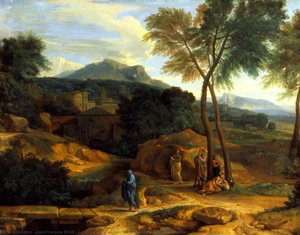
Nicolas Poussin’s Landscape with Polyphemus, painted in 1648, isn't merely a depiction of a mythological scene; it’s an immersive experience, a carefully constructed dialogue between the classical ideals of antiquity and the burgeoning Baroque aesthetic. This monumental oil on canvas, currently residing within the hallowed halls of The Hermitage Museum in St. Petersburg, transcends its physical dimensions to offer a profound meditation on beauty, power, and the human condition. Poussin, a master of his craft, deliberately eschewed the dramatic flourishes favored by some of his contemporaries, opting instead for a harmonious balance achieved through meticulous observation and an intellectual rigor that’s immediately apparent.
The painting unfolds as a carefully orchestrated panorama – a rugged coastline punctuated by scattered shrubs leading the eye towards a distant, hazy horizon. Two magnificent horses, rendered with a striking sense of nobility and strength, dominate the right side of the composition, acting as anchors for the viewer’s gaze and contributing significantly to the overall feeling of balance and serenity. But it is the central figure – Polyphemus, the one-eyed giant – who commands immediate attention. Poussin's skill lies not just in capturing the monstrous physicality of this mythical being, but also in imbuing him with a surprising degree of melancholy contemplation. He’s poised, holding his bow and arrow, yet there’s an undeniable sadness in his posture, suggesting a loneliness that transcends his monstrous appearance.
The Language of Line and Light: Poussin's Technique
Poussin was a master of linear perspective, employing it not just to create depth but also to establish a clear visual hierarchy. The foreground elements – the rocky outcrop and the dense vegetation – are rendered with painstaking detail, grounding the viewer in the scene while simultaneously framing the expansive vista beyond. The artist’s use of light is equally masterful; it's diffused and atmospheric, bathing the landscape in a soft, golden glow that evokes both tranquility and a sense of timelessness. Notice how he uses subtle variations in tone to create volume and form, particularly in Polyphemus’s muscular body and the rough texture of the rocks.
The inclusion of Galatea and her attendants – figures rendered with an ethereal beauty and grace – underscores themes of innocence, divine harmony, and classical ideals. They represent a counterpoint to Polyphemus's raw power, suggesting a delicate balance between opposing forces. This juxtaposition is characteristic of Poussin’s style: he seamlessly blends the pagan mythology of Homer’s Odyssey with the philosophical underpinnings of classical thought.
Myth, Philosophy, and the Baroque Spirit
Landscape with Polyphemus speaks to a broader artistic and intellectual tradition. It embodies the core tenets of the Baroque period – a fascination with grand scale, dramatic lighting, and complex narratives – while simultaneously drawing upon the classical ideals of order, harmony, and proportion. Poussin’s unwavering devotion to these principles established him as one of the most influential artists of his time, shaping the course of European painting for generations to come. The painting isn't simply a retelling of a myth; it’s an exploration of fundamental human themes – strength versus vulnerability, beauty versus brutality, order versus chaos – presented within a visually stunning and intellectually stimulating framework.
The work invites contemplation on the nature of storytelling itself, how myths continue to resonate across centuries, and how artists can use visual language to convey profound ideas. It’s a testament to Poussin's ability to transform ancient narratives into timeless works of art that continue to captivate and inspire.
Spørsmål og svar
Hvor sterk er kontrasten i "Landskap med Polyphem" av Nicolas Poussin?
Lys-mørke-kontrasten i "Landskap med Polyphem" er registrert som Moderat kontrast. Kontrast beskriver hvor sterkt lyse og mørke områder skiller seg fra hverandre.
Hvilken atmosfære har "Landskap med Polyphem"?
"Landskap med Polyphem" har en Sofistikert atmosfære.
Hvilken bruk og hvilket rom anbefales for "Landskap med Polyphem" av Nicolas Poussin?
"Landskap med Polyphem" anbefales til Fargeaksent, og det anbefalte rommet er et Stue og oppholdsrom.



 Se i rommet
 Bestill håndmalt reproduksjon
 Del som digitalt kort
 Del
Del
 Detaljer
 Studentguide

 Last ned
 Liknende objekter
 Røntgen
 Lysbildefremvisning
 Besøksstatistikk


 Les mer






































 Glassalternativet er kun tilgjengelig i størrelser under 110 cm