A Window into the Soul: Exploring Hans Memling’s ‘Two Panels from a Triptych’
Hans Memling's “Two Panels from a Triptych” is more than just a depiction of two men; it’s a carefully constructed tableau brimming with Northern Renaissance artistry, spiritual contemplation, and the quiet dignity of everyday life. Created around 1470 in Bruges, Belgium – a city then at the heart of European trade and artistic innovation – this oil-on-panel work offers a captivating glimpse into the world of a wealthy merchant’s devotional space. The panels, part of a larger triptych now sadly fragmented, invite us to ponder themes of faith, social status, and the enduring human desire for connection.
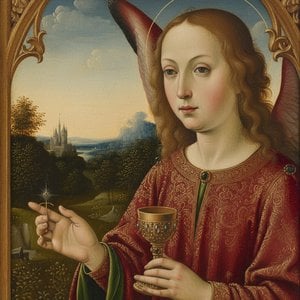
The immediate impact is one of serene formality. Two figures stand before a simple wall, their postures suggesting a moment of quiet reflection or perhaps even a brief exchange. The man in the crimson robe, holding a cat – an animal often associated with domesticity and good fortune – exudes a subtle authority, while his counterpart, clad in purple, appears more contemplative. Memling’s mastery lies not just in rendering realistic details—the texture of the fabrics, the sheen of the metal, the delicate folds of the drapery—but also in conveying an underlying sense of stillness and grace. The artist's meticulous attention to detail is a hallmark of Early Netherlandish painting, a style characterized by its hyperrealism and profound psychological depth.
The Renaissance Master: Hans Memling’s Artistic World
Hans Memling (c. 1430 – August 11, 1494) stands as a pivotal figure in the Early Netherlandish painting movement, a period defined by its exquisite realism and profound spiritual introspection. Born in Seligenstadt, Germany, he initially trained under Rogier van der Weyden, absorbing the master’s techniques of oil paint application and sculptural modeling. However, Memling quickly established his own distinctive style, characterized by an unparalleled sensitivity to light, color, and texture. He wasn't merely a painter; he was a meticulous observer of human nature and a skilled craftsman who elevated everyday scenes into works of art.
Memling’s workshop in Bruges became a renowned center for artistic production, disseminating his distinctive style across Europe. His commissions frequently included elaborate altarpieces and devotional panels, often incorporating donor portraits—individuals who supported the church or religious institutions—into the composition. These portraits weren't simply likenesses; they were carefully staged representations of piety and social standing, reflecting the values of the era.
Symbolism and Context: Unpacking the Details
The inclusion of the cat is particularly intriguing. While seemingly a simple detail, it’s likely imbued with symbolic meaning within the context of 15th-century Bruges. Cats were associated with domesticity, fertility, and even protection against evil spirits – qualities highly valued in a prosperous merchant community. The birds, subtly integrated into the scene, might represent hope, divine grace, or simply the beauty of nature. The triptych itself was a common format for altarpieces, allowing for greater visual impact and facilitating transportability. It served as a focal point for religious devotion, inviting contemplation and fostering a connection between the earthly and the spiritual.
Memling’s work reflects the broader cultural landscape of his time – a period marked by burgeoning trade, increasing wealth, and a renewed interest in classical art and philosophy. His paintings offer a window into the lives and beliefs of a society grappling with questions of faith, morality, and the human condition. The careful balance between realism and symbolism, combined with Memling’s technical brilliance, ensures that “Two Panels from a Triptych” remains a captivating masterpiece for art lovers today.
Bringing Memling to Your Space: A Hand-Painted Reproduction
WahooArt.com offers exquisite, hand-painted reproductions of Hans Memling's "Two Panels from a Triptych," meticulously crafted by our skilled artists using the same techniques and attention to detail as the original. Whether you’re seeking an authentic piece for your home or office, or a unique gift for an art enthusiast, our reproductions capture the essence of this iconic work while providing a stunning visual experience. Explore our collection today and bring the serenity and beauty of Memling's masterpiece into your world.
Spørsmål og svar
Er "Two Panels from a Triptych" et kjent kunstverk innen Early Netherlandish Painting?
Innenfor Early Netherlandish Painting-retningen har "Two Panels from a Triptych" et Iconic popularitetsnivå.
Hvordan passer "Two Panels from a Triptych" inn i Hans Memling sine temaer og stil?
I Hans Memling sitt kunstnerskap befinner "Two Panels from a Triptych" seg innenfor Early Netherlandish Painting-stilen, sammen med temaene rogier van der weyden’s realism, religious devotion, piety, symbolism, bruges civic patronage, wealth, workshop production, dissemination style.
Hva er formatet på "Two Panels from a Triptych"?
"Two Panels from a Triptych" av Hans Memling har et Portrait-format. Formatet beskriver komposisjonens proporsjoner.



 Se i rommet
 Bestill håndmalt reproduksjon
 Del som digitalt kort
 Del
Del
 Detaljer
 Studentguide

 Last ned
 Liknende objekter
 Røntgen
 Lysbildefremvisning
 Besøksstatistikk

 Les mer






































 Glassalternativet er kun tilgjengelig i størrelser under 110 cm