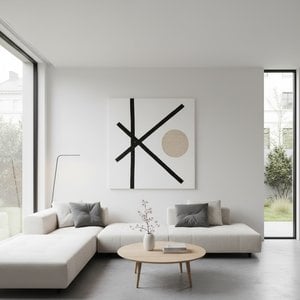
Se i rommet Se i AR Bytt til trykkversjon Gå til digitalt bilde Del som digitalt kort
Detaljer Studentguide Legg til i favoritter Last ned Liknende objekter Røntgen Lysbildefremvisning Besøksstatistikk

From Line

Experience the serene movement of vertical blue strokes reminiscent of a waterfall in this minimalist masterpiece From Line by Lee Ufan, a profound expression of Mono-ha art that invites you to bring tranquility home.

Lee Ufan (born 1936) is a Korean minimalist painter & sculptor, key founder of Mono-ha. Explore his serene 'From Point' & 'From Line' series, blending Eastern aesthetics with phenomenology. A major figure in postwar Japanese art.

Kunstverket som vises på denne siden er beskyttet av opphavsretten, noe som betyr at vi ikke har juridisk tillatelse til å lage eller selge identiske reproduksjoner. Denne beskyttelsen håndheves i henhold til internasjonale avtaler som for eksempel Bernerkonvensjonen og av nasjonale lover, inkludert de som er fastsatt i Amerikansk opphavsrettslov – Tittel 17.

Som et respektfullt og lovlig alternativ tilbyr vi skreddersydde, håndmalte kunstverk inspirert av originalen. Våre dyktige og profesjonelle kunstnere studerer nøye originalens stil, stemning og kunstneriske essens for å skape et nytt og unikt verk som vekker den samme følelsen – samtidig som det forblir en original skapelse i seg selv.

Denne metoden er i fullt samsvar med opphavsrettslige regler, da den ikke innebærer kopiering eller duplisering av det beskyttede kunstverket. I stedet er det snakk om en kreativ nytolkning – et nytt maleri som er inspirert av originalen, men ikke identisk med den.

Håndlaget oljereproduksjon

Håndmalt olje på lerret i din valgte størrelse og ramme, laget på bestilling av våre kunstnere. ( Bytt til trykkversjon Gå til digitalt bilde)

Corner sample of the P118B picture frame: støpt polystyren, 5 cm wide and 3 cm thick
P118B Nkr10
Corner sample of the P118H picture frame: støpt polystyren, 5 cm wide and 3 cm thick
P118H Nkr10
Corner sample of the P118W picture frame: støpt polystyren, 5 cm wide and 3 cm thick
P118W Nkr10
Corner sample of the P438Z picture frame: støpt polystyren, 5.5 cm wide and 3.5 cm thick
P438Z Nkr10
Corner sample of the P508JH picture frame: støpt polystyren, 7 cm wide and 3.5 cm thick
P508JH Nkr12
Corner sample of the P508YH picture frame: støpt polystyren, 7 cm wide and 3.5 cm thick
P508YH Nkr12
Corner sample of the P805H picture frame: støpt polystyren, 5 cm wide and 3.5 cm thick
P805H Nkr10
Corner sample of the P805Z picture frame: støpt polystyren, 5 cm wide and 3.5 cm thick
P805Z Nkr10
Corner sample of the P919BZ picture frame: støpt polystyren, 7 cm wide and 3.5 cm thick
P919BZ Nkr10
Corner sample of the P919G picture frame: støpt polystyren, 7 cm wide and 3.5 cm thick
P919G Nkr10
Corner sample of the P919XJ picture frame: støpt polystyren, 7 cm wide and 3.5 cm thick
P919XJ Nkr10
Corner sample of the P959ZH picture frame: støpt polystyren, 5 cm wide and 3 cm thick
P959ZH Nkr10
Corner sample of the P968JZ picture frame: støpt polystyren, 6 cm wide and 4 cm thick
P968JZ Nkr12
Corner sample of the W106C picture frame: massivt tre, 5 cm wide and 3 cm thick
W106C Nkr8
Corner sample of the W218G picture frame: massivt tre, 5 cm wide and 3 cm thick
W218G Nkr10
Corner sample of the W218JH picture frame: massivt tre, 5 cm wide and 3 cm thick
W218JH Nkr8
Corner sample of the W218Y picture frame: massivt tre, 5 cm wide and 3 cm thick
W218Y Nkr10
Corner sample of the W307PJ picture frame: massivt tre, 6 cm wide and 3 cm thick
W307PJ Nkr10
Corner sample of the W316G picture frame: massivt tre, 6 cm wide and 3 cm thick
W316G Nkr10
Corner sample of the W316PJ picture frame: massivt tre, 6 cm wide and 3 cm thick
W316PJ Nkr8
Corner sample of the W316Y picture frame: massivt tre, 6 cm wide and 3 cm thick
W316Y Nkr10
Corner sample of the W398PJ picture frame: massivt tre, 5 cm wide and 3 cm thick
W398PJ Nkr8
Corner sample of the W4111J picture frame: massivt tre, 6.5 cm wide and 3.5 cm thick
W4111J Nkr10
Corner sample of the W500HY picture frame: massivt tre, 7 cm wide and 5 cm thick
W500HY Nkr15
Corner sample of the W500JH picture frame: massivt tre, 7 cm wide and 5 cm thick
W500JH Nkr15
Corner sample of the W692G picture frame: massivt tre, 8 cm wide and 4 cm thick
W692G Nkr12
Corner sample of the W849H picture frame: massivt tre, 5 cm wide and 3 cm thick
W849H Nkr8
Corner sample of the W940BG picture frame: massivt tre, 7.5 cm wide and 4.5 cm thick
W940BG Nkr15
Corner sample of the W953PJ picture frame: massivt tre, 6 cm wide and 3.5 cm thick
W953PJ Nkr8

Standardformat
tilpasset
CM
INCH

Velg mellom våre forhåndsdefinerte størrelser som bevarer kunstverkets opprinnelige proporsjoner.

bredde
høyde

Skriv inn bredden og høyden du trenger, slik at den passer til din ramme eller vegg. Dette er håndmalt, så for en størrelse med en annen form kan kunstneren male litt mer rundt bildet, eller beskjære det noe — du velger selv. Vi sender deg en digital mockup for godkjenning før maleriet påbegynnes. Bildet som vises på denne siden viser ikke det faktiske resultatet — kun mockuppen gjør det.

Eksempler på hva som kan endres: Erstatt ansikt med bilde av kunden; Legg til kjæledyr (f.eks. bytt ut katt med hund); Inkluder en skjult melding i bakgrunnen; Endre bakgrunnslandskap eller elementer.
Etter bestilling vil WahooArt.com-teamet sende e-post til kunden for instruksjoner og sende et utkast (mockup) som forhåndsvisning.

Verdensomspennende levering () på 3–4 uker i stedet for standard 5 uker. (22 October). Ingen kompromisser med kvaliteten.

Gratis ekspressfrakt over hele verden
Lerretsduk av høykvalitets lin
Full transportforsikring
Garanti for refusjon av toll og importavgifter
Garantert fargeekthet
100 dagers returrett ved fabrikasjonsfeil
100% pengene tilbake-garanti
Mengderabatt

Totalpris

Nkr 2567

From Line

Reproduksjonsmetode

Format på reproduksjon

-

Totalpris

Nkr 2567

Kort om verket

  • Notable elements or techniques: Vertical lines, blue brush-strokes
  • Subject or theme: Flowing water, movement, space
  • Medium: Paint on canvas
  • Dimensions: 227 x 181 cm

The Poetics of Presence: A Meditation on Lee Ufan’s From Line

In the quiet intersection where Eastern philosophy meets Western minimalism, Lee Ufan’s From Line emerges as a profound meditation on existence and the passage of time. As a central figure of the Mono-ha movement, Lee does not merely paint; he orchestrates a delicate dialogue between the void and the mark. This particular work serves as a breathtaking example of his ability to transform a canvas into a living, breathing landscape of thought. The composition, characterized by its rhythmic verticality, invites the viewer into a space where the distinction between the painted stroke and the surrounding emptiness begins to dissolve, creating an atmosphere of deep contemplation.

The visual journey of From Line is one of mesmerizing movement. At first glance, the eye is drawn to the series of vertical lines that traverse the canvas, creating a sense of depth and dimension that defies the two-dimensional surface. These strokes, reminiscent of traditional Eastern brushwork, possess a weight and texture that suggest the relentless flow of a waterfall or the steady descent of rain through a misty forest. A subtle horizontal line cuts through the center, acting as a horizon of sorts, providing a structural anchor that balances the kinetic energy of the vertical elements. This careful arrangement creates a profound sense of harmony, where every interval and every void plays a vital role in the overall equilibrium of the piece.

Mastery of Materiality and Technique

Technically, the work is a masterclass in controlled spontaneity. Lee Ufan utilizes the relationship between color and space to evoke raw emotion, employing a palette that—while appearing simple—carries immense psychological weight. The interplay of light and shadow within the strokes suggests a physical presence, as if the paint itself is an organic material emerging from the canvas. In some iterations of this series, Lee has even paired Japanese powdered mineral pigments with Western canvas, dipping his brush in cobalt-blue paint and pulling it across the support in one continuous, decisive motion. This method ensures that each trace captures a moment of pure, unrepeatable action, making the painting a record of its own creation.

For the discerning collector or interior designer, this piece offers more than just aesthetic beauty; it provides a focal point of serenity. The way the lines move from fullness to near-invisibility allows the artwork to breathe within a room, interacting with the surrounding architecture and light. It is a work that demands a slow gaze, rewarding those who approach it with patience.

A Bridge Between Worlds

To understand From Line, one must look toward the artist's profound intellectual journey. Born in 1936, Lee’s early life was steeped in the disciplined rhythms of a traditional Confucian household, where calligraphy and inkbrush painting served as his first languages. His later immersion in Western phenomenology—engaging with thinkers like Heidegger and Merleau-Ponty—allowed him to bridge the gap between being and nothingness. This synthesis is palpable in the artwork; it is a piece that exists in the tension between the physical mark of the brush and the infinite potential of the empty space.

Owning a high-quality reproduction of such a masterpiece allows one to bring this sense of philosophical depth into a modern living space. Whether placed in a minimalist gallery-style lounge or a quiet study, From Line acts as an anchor of calm, reminding the viewer of the beauty found in simplicity and the profound resonance of a single, well-placed stroke.

Spørsmål og svar

Hvilken stemning og følelse forenes i "From Line"?

"From Line" av Lee Ufan formidler en Tranquil følelse innenfor en overordnet Minimalist stemning.

Hvem er "From Line" foreslått som gave til, og til hvilket bruk?

"From Line" av Lee Ufan anbefales som en gave til Corporate Gift, spesielt til Theme. En reproduksjon av kunstverket kan gis som en gave.

Er "From Line" overordnet sett mest lys eller mørk?

De registrerte verdiene for "From Line" av Lee Ufan er: brilliant lysstyrke, Bright Balance luminans.


Kunstnerbiografi

The Philosophy of Presence: The Life and Vision of Lee Ufan

In the quiet intersection where Eastern contemplative traditions meet the rigorous inquiries of Western phenomenology, the work of Lee Ufan resides. Born in 1936 in Haman-gun, Gyeongsangnam-do, Lee’s early life was steeped in the disciplined rhythms of a traditional Confucian household. His childhood was not merely an era of growth but one of profound cultural immersion, where the delicate strokes of calligraphy and the rhythmic beauty of inkbrush painting served as his first languages. This foundational training in the classical arts provided him with a deep-seated reverence for the materiality of ink and paper, a sensitivity that would later become the heartbeat of his minimalist masterpieces.

Lee’s journey took a transformative turn in 1956 when he moved to Yokohama, Japan, seeking new intellectual horizons. While his initial studies at Seoul National University focused on painting, it was his immersion in the study of philosophy at Nihon University that would ultimately redefine his artistic trajectory. By engaging with the profound works of thinkers like Martin Heidegger and Maurice Merleau-Ponty, Lee began to develop a theoretical framework that sought to bridge the gap between being and nothingness. He did not merely wish to paint objects; he sought to explore the very essence of existence through the interaction of space, matter, and perception.

The Architect of Mono-ha and Dansaekjo

As the late 1960s approached, Lee Ufan emerged as the preeminent theorist and driving force behind the Mono-ha, or "School of Things" movement. This was not a movement defined by the creation of new forms, but rather by a radical reconsideration of what already exists. Through his seminal essays, Lee advocated for an art that emphasized the relationship between natural and man-made materials—stones, steel, glass, and wood—allowing them to exist in their raw, unadulterated state. His philosophy was a deliberate antidote to the Eurocentric dominance of the era, proposing a methodology of de-westernization that favored the experiential engagement of the viewer with the site.

Parallel to his influence in Japan, Lee’s artistic spirit breathed life into the Dansaekjo movement in South Korea. This "monotone art" emphasized the meditative process of painting, where the repetitive application of pigment became a ritualistic act of connection between the artist's hand and the canvas. His work during this period moved away from expressive abstraction toward a more restrained, rhythmic aesthetic that celebrated the subtle nuances of texture and tone. In doing so, he helped establish a uniquely Korean modernism that resonated far beyond the borders of the peninsula.

A Legacy of Marks and Silence

The mature works of Lee Ufan, such as his celebrated From Point and From Line series, serve as breathtaking meditations on time and decay. In these pieces, a single brushstroke begins with intense saturation and gradually fades into nothingness, tracing the inevitable passage of time and the ephemeral nature of existence. Each mark is an event; each void is a presence. The viewer is invited to witness the dialogue between the painted trace and the untouched canvas, a relationship that mirrors the profound interconnectedness of all things in the natural world.

Throughout his storied career, Lee has navigated the complexities of history—from the political turbulence of post-war Korea to his life as a cultural wanderer between Kamakura and Paris. His achievements have been recognized with the highest honors, including the Legion of Honour and the Praemium Imperiale. Today, his legacy is physically anchored in the Lee Ufan Museum on Naoshima island, a collaborative marvel designed with architect Tadao Ando. This space, where light and shadow dance across concrete walls, stands as a testament to Lee’s lifelong pursuit: an art that does not demand attention through noise, but commands reverence through its profound, resonant silence.

Lee Ufan

Lee Ufan

1936 -

Kort om kunstneren

  • Artistic Movement Or Style: Minimalism, Mono-ha
  • Artists Or Movements Influenced By This Artist:
    • Mono-ha
    • Dansaekjo Yesul
  • Artists Who Influenced This Artist:
    • Martin Heidegger
    • Maurice Merleau-Ponty
  • Date Of Birth: 1936
  • Full Name: Lee Ufan
  • Nationality: Korean
  • Notable Artworks:
    • From Point series
    • From Line series
  • Place Of Birth: Haman-gun, Korea