Gratis kunstkonsultasjon

x
Bestill trykk Bestill trykkKjøp digitalt bilde Kjøp digitalt bilde SendSend
DetaljerDetaljer Legg til i favoritter Legg til i favoritter Last ned bildetLast ned bildet Liknende objekterLiknende objekter RøntgenRøntgen LysbildefremvisningLysbildefremvisning

Untitled

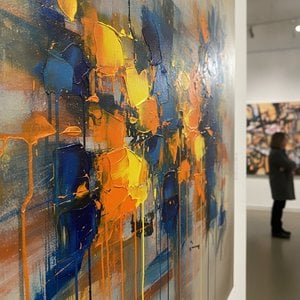
Experience the vibrant energy of Karel Appel's COBRA masterpiece; this abstract burst of color captures raw instinct from 1960—discover your own artistic freedom.

Karel Appel (1921-2006) var en nederlandsk kunstner kjent for sin fargerike og ekspressive CoBrA-stil. Hans verk utforsker barnlig kreativitet, spontanitet og den postkrigstidens utrygghet gjennom maleri og skulptur.

Håndlaget oljereproduksjon

Håndmalt olje på lerret i din valgte størrelse og ramme, laget på bestilling av våre kunstnere.

Standard
custom
CM
INCH

Velg mellom våre forhåndsdefinerte størrelser som bevarer kunstverkets opprinnelige proporsjoner.

bredde
høyde

Du kan angi egne mål for å tilpasse en spesifikk ramme eller plass. Dersom den valgte størrelsen ikke samsvarer med originalbildets proporsjoner, vil vi enten beskjære kunstverket eller utvide maleriet med ytterligere håndmalte elementer. En digital mockup vil bli sendt til din godkjenning før produksjonen starter.
Vennligst merk at forhåndsvisningen på skjermen ikke gjenspeiler den faktiske beskjæringen eller utvidelsen. Kun mockuppen vil vise den endelige komposisjonen nøyaktig.
Selv om tilpassede størrelser er tilgjengelige, anbefaler vi å velge et mål fra den forhåndsdefinerte listen for å bevare de originale proporsjonene.

Eksempler på hva som kan endres: Erstatt ansikt med bilde av kunden; Legg til kjæledyr (f.eks. bytt ut katt med hund); Inkluder en skjult melding i bakgrunnen; Endre bakgrunnslandskap eller elementer.
Etter bestilling vil WahooArt.com-teamet sende e-post til kunden for instruksjoner og sende et utkast (mockup) som forhåndsvisning.

Verdensomspennende levering () på 3–4 uker i stedet for standard 5 uker. (2 July). Ingen kompromisser med kvaliteten.

why_choose_icon
Gratis ekspressfrakt over hele verden
why_choose_icon
Lerretsduk av høykvalitets lin
why_choose_icon
Full forsikring under transport
why_choose_icon
Garanti for refusjon av toll og importavgifter
why_choose_icon
Garantert korrekt fargegjengivelse
why_choose_icon
60 dagers returrett (kun ved feil)
why_choose_icon
100% pengene tilbake-garanti
why_choose_icon
Rabatt ved flere kjøp

Totalpris for bestilling

-

reproduction

Untitled

Teknikk for reproduksjon

Størrelse på reproduksjon

-

Endelig pris

-

Kort om verket

  • Title: Untitled
  • Movement: COBRA
  • Notable elements or techniques: Gestural forms, Layered texture
  • Subject or theme: Organic shapes
  • Influences: European Avant-garde
  • Artistic style: Abstract Expressionism
  • Medium: Screenprint

Kunstighetsquiz

Det er kun ett riktig svar på hvert spørsmål.

Spørsmål 1:
What avant-garde movement is Karel Appel strongly associated with for this artwork?
Spørsmål 2:
Which element of the artwork's composition is described as eschewing traditional perspective?
Spørsmål 3:
According to the description, what emotion is often symbolized by the color yellow in Appel's work?
Spørsmål 4:
What type of forms populate the artwork, described as rounded and organic, reminiscent of natural elements?
Spørsmål 5:
What medium is the artwork most likely to be, given the visible layering and texture?

Beskrivelse av kunstverket

A Burst of Color and Instinct: Decoding Karel Appel’s Untitled

Karel Appel's "Untitled," a striking print or screenprint from 1960, embodies the rebellious spirit of COBRA – the Dutch avant-garde movement that shook the foundations of postwar European art. More than just pigment on paper, this artwork is an assertion of spontaneous expression and a deliberate rejection of academic formalism, reflecting Appel’s profound connection to the everyday experiences of working-class Holland during his formative years. The image immediately captivates with its bold palette – dominant yellows, blues, reds, and blacks punctuated by flashes of orange and white – applied in broad, gestural strokes that convey an undeniable sense of dynamism.
  • Composition & Rhythm: Appel eschews traditional perspective, opting instead for an asymmetrical arrangement where forms overlap and intersect. This seemingly chaotic composition subtly reveals underlying rhythmic patterns through repeated shapes and colors, guiding the viewer’s eye across the surface in a continuous exploration of visual elements.
  • Form & Texture: The artwork is populated by biomorphic forms – rounded, organic shapes reminiscent of natural elements or abstracted figures – creating a complex textural landscape. Visible brushstrokes contribute to an impression of immediacy and materiality, hinting at Appel’s hand application during the printmaking process.
  • Color Theory & Emotion: The color choices aren't merely decorative; they are deliberately emotive. Yellow symbolizes optimism and energy, while blue conveys tranquility and contemplation. Red injects passion and vitality into the composition, mirroring Appel’s fascination with primal forces and childlike wonder.
The COBRA movement itself was born from a desire to break free from the constraints of Surrealism and Cubism, prioritizing intuition and gesture over meticulous representation. Appel sought inspiration in primitive art forms – African masks and tribal sculptures – believing that these conveyed unfiltered emotion and challenged Western artistic conventions. This influence is palpable in “Untitled,” where the artist abandons rational thought for a visceral response to the world around him.
  • Technique & Medium: Likely produced through screenprinting, the artwork’s layered texture speaks volumes about Appel's meticulous approach to printmaking. The process itself – transferring ink onto paper – was chosen specifically to capture and amplify the artist’s spontaneous marks, ensuring that the energy of his initial gesture remained faithfully reproduced.
  • Symbolism & Interpretation: Beyond its aesthetic qualities, “Untitled” invites contemplation on themes of freedom and spontaneity. Appel's work consistently explores the intersection between human emotion and natural forms, suggesting a belief in the transformative power of unfiltered experience. The absence of recognizable imagery encourages viewers to engage with the artwork on an emotional level, prompting them to consider their own responses to color, shape, and texture.
Ultimately, Karel Appel’s “Untitled” transcends mere visual appeal; it stands as a testament to the enduring legacy of COBRA – a movement that championed artistic liberation and celebrated the beauty of imperfection. Its vibrant colors, dynamic forms, and textured surface continue to inspire artists and collectors alike, securing its place as an iconic exemplar of postwar abstraction.

Lignende kunstverk


Om kunstneren

A Life Painted in Bold Strokes: The World of Karel Appel

Christiaan Karel Appel, known affectionately as ‘Kik’ from childhood, burst onto the post-war art scene like a vibrant explosion of color and energy. Born in Amsterdam in 1921, his early life was steeped in the everyday rhythms of working-class Holland – his father a barber, his lineage tracing back to French Huguenots through his mother. This grounding, however, would soon be superseded by an irrepressible artistic drive that defied convention and ultimately reshaped the landscape of European art. A pivotal moment arrived at age fourteen with his first painting, a still life of fruit, followed shortly after by a paint set and easel gifted by his uncle Karel Chevalier, who also provided early instruction. These gifts weren’t merely tools; they were keys unlocking a world where imagination reigned supreme. The shadow of the Second World War loomed large over Appel’s formative years. Studying at the Rijksakademie van Beeldende Kunsten in Amsterdam during the German occupation proved challenging, yet it was there he forged lifelong bonds with fellow artists Corneille and Constant, friendships that would prove crucial to his artistic evolution. Facing opposition from his parents regarding his chosen path and fearing forced labor under Nazi rule, Appel bravely left home, choosing a life dedicated to art over conformity.

Early Life and Artistic Beginnings

Christiaan Karel Appel was born on April 25, 1921, in Amsterdam’s Dapperstraat 7, the son of Jan Appel, who ran a barbershop, and Johanna Chevallier, descended from Huguenot French immigrants. He had three brothers. From a young age, Appel demonstrated an innate fascination with art—a passion ignited at fourteen when he created his first painting: a depiction of fruit. This formative experience was profoundly shaped by the generosity of his uncle Karel Chevalier, who gifted him a paint set and easel, fostering his burgeoning talent. Chevalier’s encouragement extended beyond mere material provision; he imparted invaluable artistic guidance, nurturing Appel's developing vision. The influence of his family heritage—particularly his mother’s Huguenot lineage—provided a counterpoint to the prevailing societal expectations regarding masculinity and vocation during this period.

The CoBrA Revolution: Spontaneity and the Childlike Vision

Appel’s artistic trajectory truly gained momentum with the formation of the CoBrA group in 1948 – an acronym derived from Copenhagen, Brussels, and Amsterdam, representing the movement's core cities. Alongside Corneille Guillaume Beverloo and Constant Nieuwenhuys, Appel spearheaded a radical departure from established artistic norms. CoBrA wasn’t merely a style; it was a philosophy rooted in spontaneity, experimentation, and a profound embrace of the untamed creativity found in children's art and primitive cultures. Influenced by masters like Pablo Picasso and Henri Matisse, as well as the raw energy of Jean Dubuffet, Appel rejected formalism in favor of intuitive expression. He began sculpting in 1947, utilizing assemblage techniques – constructing works from found materials painted in a bold palette of white, red, yellow, blue, and black. This period saw him involved with the Experimentele Groep, further solidifying his commitment to artistic innovation. The controversial fresco “Questioning Children” (1949), commissioned for Amsterdam City Hall, exemplified CoBrA’s provocative spirit but also sparked public outcry, ultimately leading to its being covered up – a testament to the movement's challenging nature. Appel drew inspiration from Danish and Nordic mythology, weaving these ancient narratives into his increasingly abstract compositions.

International Horizons: From Paris to New York and Beyond

Facing resistance to CoBrA’s audacious vision in the Netherlands, Appel relocated to Paris in 1950 – a city that offered greater artistic freedom and recognition. This marked the beginning of an expansive period of international travel and exposure. He explored Mexico, the USA, Yugoslavia, and Brazil, absorbing diverse cultural influences that enriched his artistic vocabulary. His time in New York City and Florence further broadened his horizons, allowing him to connect with a wider network of artists and collectors. A breakthrough moment arrived in 1954 with his first American gallery exhibition at Martha Jackson Gallery, followed by the inclusion of “Child and Beast II” (1951) in the influential Museum of Modern Art exhibition “The New Decade” in 1955. Appel’s murals gained prominence during this era, demonstrating his ability to translate his dynamic style onto a larger scale. Despite initial hurdles, his work experienced a resurgence in popularity in the Netherlands after 1990, with major exhibitions organized by Rudy Fuchs in Amsterdam and Brussels, cementing his legacy within his homeland.

Legacy and Influence

Karel Appel’s contribution to post-war European art is undeniable. He established the Karel Appel Foundation to safeguard his artworks and promote public awareness of his oeuvre, ensuring that future generations could appreciate his singular artistic vision. The temporary loss of artwork in 2002 underscored the importance of this foundation, with the pieces thankfully recovered in 2012. The foundation now serves as his official estate and image archive, represented in the U.S. by The Artists Rights Society. Appel’s work continues to be exhibited internationally, a testament to its enduring appeal and relevance. He wasn't merely a painter or sculptor; he was a poet of form and color, a champion of spontaneity, and a fearless innovator who dared to challenge artistic conventions. His legacy resides not only in the vibrant canvases and sculptures he created but also in his unwavering belief in art’s capacity to convey the raw, untamed spirit of human experience—a conviction that continues to inspire contemporary artists striving for originality and rejecting restrictive stylistic boundaries.
Karel Appel

Karel Appel

1921 - 2006 , Nederland

Kort om kunstneren

  • Artistic Movement Or Style: CoBrA, Expressionisme
  • Artists Who Influenced This Artist:
    • Picasso
    • Matisse
    • Dubuffet
  • Date Of Birth: 25 april 1921
  • Date Of Death: 3 mai 2006
  • Full Name: Christiaan Karel Appel
  • Nationality: Nederlands
  • Notable Artworks:
    • Square Man
    • Parrot Woman with Bird
    • Hip, Hip, Hoorah
  • Place Of Birth: Amsterdam, Nederland