Se i rommet Se i AR Bytt til trykkversjon Gå til digitalt bilde Del som digitalt kort
Detaljer Studentguide Legg til i favoritter Last ned Liknende objekter Røntgen Lysbildefremvisning Besøksstatistikk

Violin and guitar - -

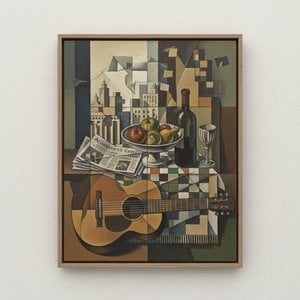
Explore Juan Gris’s Synthetic Cubism masterpiece – Violin and Guitar! This vibrant abstract depiction captures the essence of early 20th-century art with geometric shapes and fragmented forms, inviting you to discover a timeless classic.

Oppdag Juan Gris (1887-1927), den spanske kubistiske mesteren! Utforsk hans geometriske stil, syntetisk kubisme og varig innflytelse på moderne kunst. Se kunstverk nå.

Håndlaget oljereproduksjon

Håndmalt olje på lerret i din valgte størrelse og ramme, laget på bestilling av våre kunstnere. ( Bytt til trykkversjon Gå til digitalt bilde)

P118B $10
P118H $10
P118W $10
P438Z $10
P508JH $12
P508YH $12
P805H $10
P805Z $10
P919BZ $10
P919G $10
P919XJ $10
P959ZH $10
P968JZ $12
W106C $8
W218G $10
W218JH $8
W218Y $10
W307PJ $10
W316G $10
W316PJ $8
W316Y $10
W398PJ $8
W4111J $10
W500HY $15
W500JH $15
W692G $12
W849H $8
W940BG $15
W953PJ $8

Standardformat
tilpasset
CM
INCH

Velg mellom våre forhåndsdefinerte størrelser som bevarer kunstverkets opprinnelige proporsjoner.

bredde
høyde

Du kan angi egne mål for å tilpasse en spesifikk ramme eller plass. Dersom den valgte størrelsen ikke samsvarer med originalbildets proporsjoner, vil vi enten beskjære kunstverket eller utvide maleriet med ytterligere håndmalte elementer. En digital mockup vil bli sendt til din godkjenning før produksjonen starter.
Vennligst merk at forhåndsvisningen på skjermen ikke gjenspeiler den faktiske beskjæringen eller utvidelsen. Kun mockuppen vil vise den endelige komposisjonen nøyaktig.
Selv om tilpassede størrelser er tilgjengelige, anbefaler vi å velge et mål fra den forhåndsdefinerte listen for å bevare de originale proporsjonene.

Eksempler på hva som kan endres: Erstatt ansikt med bilde av kunden; Legg til kjæledyr (f.eks. bytt ut katt med hund); Inkluder en skjult melding i bakgrunnen; Endre bakgrunnslandskap eller elementer.
Etter bestilling vil WahooArt.com-teamet sende e-post til kunden for instruksjoner og sende et utkast (mockup) som forhåndsvisning.

Verdensomspennende levering () på 3–4 uker i stedet for standard 5 uker. (25 September). Ingen kompromisser med kvaliteten.

why_choose_icon
Gratis ekspressfrakt over hele verden
why_choose_icon
Lerretsduk av høykvalitets lin
why_choose_icon
Full transportforsikring
why_choose_icon
Garanti for refusjon av toll og importavgifter
why_choose_icon
Garantert fargeekthet
why_choose_icon
100 dagers returrett ved fabrikasjonsfeil
why_choose_icon
100% pengene tilbake-garanti
why_choose_icon
Mengderabatt

Totalpris

$ 272

reproduction

Violin and guitar - -

Reproduksjonsmetode

Format på reproduksjon

-

Totalpris

$ 272

Kort om verket

  • Location: Private Collection
  • Movement: Cubism
  • Year: 1913
  • Subject or theme: Musical instruments
  • Notable elements or techniques: Geometric abstraction
  • Influences: Picasso
  • Artist: Juan Gris

Kunstquiz

Det er kun ett riktig svar på hvert spørsmål.

Spørsmål 1:
What artistic movement is Violin and Guitar by Juan Gris primarily associated with?
Spørsmål 2:
In what year was Violin and Guitar created?
Spørsmål 3:
Which artist collaborated with Juan Gris on the development of Synthetic Cubism?
Spørsmål 4:
What is a key characteristic of Synthetic Cubism exemplified in Violin and Guitar?
Spørsmål 5:
Where was Juan Gris born?

A Symphony in Geometric Fragments

In the quiet intersection of melody and mathematics lies Juan Gris’s 1913 masterpiece, Violin and Guitar. This evocative work serves as a profound emblem of Synthetic Cubism, a movement that fundamentally redefined the visual language of the early twentieth century. Rather than offering a mere window into a room, Gris presents us with a meticulously constructed reality where the boundaries between object and space dissolve into a rhythmic dance of planes. The composition, measuring 100 x 66 cm, invites the viewer to look beyond the surface of the musical instruments and instead experience the structural harmony that binds them together. Through his expert use of geometric deconstruction, Gris transforms the familiar curves of a violin and the resonant body of a guitar into a complex tapestry of overlapping shapes, creating an illusion of depth that feels both intellectually stimulating and visually mesmerizing.

The technique employed in this piece is a testament to Gris’s unique ability to synthesize form and color. Unlike the more analytical approach of his contemporaries, which often stripped subjects down to monochromatic fragments, Gris embraced the richness of Synthetic Cubism. He utilized a palette that balances muted, earthy tones with sudden, vibrant accents, allowing each geometric shard to hold its own weight within the frame. The application of oil on canvas is deliberate and precise, reflecting his early training in engineering. This precision allows for a fascinating spatial ambiguity; one moment, a curve suggests the neck of a violin, and the next, it becomes part of a larger, abstract pattern. For the discerning collector or interior designer, this interplay of light and shadow offers a dynamic energy that can anchor a room, providing a sophisticated focal point that rewards prolonged contemplation.

The Resonance of Modernity and Memory

Beyond its formal brilliance, Violin and Guitar carries a deep emotional and historical resonance. Created during a period of intense artistic upheaval in Paris, the painting captures the spirit of an era caught between tradition and the radical unknown. The choice of musical instruments is far from accidental; the violin and guitar are symbols of harmony, culture, and the human voice, yet here they are fractured and reassembled. This fragmentation can be seen as a metaphor for the modern experience—a world being broken down by rapid technological advancement and reconstructed through new, multifaceted perspectives. There is a certain poignant nostalgia in the way these classical objects are presented, even as they are subjected to the radical deconstruction of the Cubist lens.

For those seeking to bring a piece of art history into a contemporary living space, this reproduction offers more than just aesthetic beauty; it offers a conversation. The artwork’s ability to blend abstract complexity with recognizable motifs makes it an ideal choice for modern interiors that value intellectual depth and stylistic versatility. Whether placed in a minimalist gallery-style setting or a richly textured study, the painting radiates a sense of structured elegance. It is a work that does not merely decorate a wall but enriches the atmosphere, inviting anyone who gazes upon it to find their own rhythm within its beautiful, fragmented symphony.


Kunstnerbiografi

A Spanish Visionary of Cubism: The Life and Art of Juan Gris

José Victoriano González-Pérez, born in Madrid in 1887, embarked on a remarkable artistic journey that would cement his place as one of the most significant figures of early 20th-century art. Initially pursuing an engineering degree at the School of Arts and Sciences, a keen analytical mind hinted at a future far removed from blueprints and calculations. Even during these formative years, a creative spark ignited – contributions to local periodicals showcased a burgeoning talent for visual observation. It was in 1905 that he adopted the evocative pseudonym Juan Gris, a name resonating with newfound identity and purpose as he began his formal studies in painting under José Moreno Carbonero. This pivotal shift marked the beginning of his dedicated pursuit of artistic innovation.

Parisian Awakening and the Embrace of Cubism

The year 1906 witnessed a transformative relocation to Paris, a city then brimming with an unparalleled energy of artistic expression. Gris immersed himself completely in this vibrant milieu, forging enduring friendships with luminaries such as Henri Matisse, Georges Braque, and Fernand Léger. Initially engaged in satirical illustration for publications like *L'Assiette au Beurre*, he honed his observational skills and developed a sharp wit – a foundation that would later inform the conceptual depth of his art. However, the profound influence of Pablo Picasso proved particularly compelling. Around 1910, Gris began to dedicate himself wholeheartedly to painting, deliberately moving away from caricature and embracing the burgeoning language of Cubism. This wasn’t mere imitation; it was a deliberate quest to distill the essence of form and space, seeking a new visual order – a radical departure from traditional representation.

The Geometry of Perception: Style and Key Works

Juan Gris's artistic output is characterized by an extraordinary clarity and intellectual rigor. He didn't simply deconstruct objects; he meticulously reconstructed them, emphasizing geometric forms and a carefully considered palette. This approach led to what became known as his “crystal period,” exemplified in masterpieces such as *Still Life Before an Open Window* (1912) and *Place Ravignan* (1915). These works showcase a remarkable interplay of planes and angles, creating a sense of depth and solidity while simultaneously challenging conventional notions of perspective. The use of muted colors and fragmented forms created a unique visual experience, inviting the viewer to actively engage with the artwork. After 1913, Gris wholeheartedly embraced Synthetic Cubism, pioneering the innovative technique of *papier collé* – collage – incorporating real-world materials like newspaper clippings and textured papers into his compositions. This added another layer of complexity and tactility to his work, blurring the boundaries between painting and sculpture. Notable examples include *Guitar in front of the sea* (1925), a testament to his simplified forms and adherence to cubist principles, and *Homage à Pablo Picasso* (1912), which signaled his growing recognition within the avant-garde art world.

Influences and Development

Gris’s artistic development was profoundly shaped by a confluence of influences. Initially captivated by Picasso's revolutionary approach, he quickly absorbed the core tenets of Cubism – fragmentation, multiple perspectives, and the rejection of traditional representation. However, Gris possessed a unique sensibility that distinguished his work from that of his contemporaries. He wasn’t merely replicating Picasso’s techniques; he was developing his own distinct style, characterized by an exceptional clarity and structural precision. The intellectual rigor of mathematicians like Henri Poincaré also exerted a subtle but significant influence on his approach to composition, leading him to seek geometric solutions for representing complex forms. Furthermore, his close friendships with artists like Matisse fostered a deep appreciation for color and harmony, which he skillfully integrated into his Cubist paintings.

Legacy and Lasting Influence

Juan Gris’s contribution to Cubism extends far beyond mere stylistic innovation; he brought a unique intellectual depth and structural clarity to the movement. He moved past the analytical phase, towards a more organized and synthetic approach, emphasizing order and precision. His work profoundly influenced the Purist style championed by Amédée Ozenfant and Charles Edouard Jeanneret (Le Corbusier), advocating for a return to classical principles of form and composition. Gris’s emphasis on geometric forms, harmonious color palettes, and the integration of everyday objects into his art established him as a pivotal figure in 20th-century art. His legacy continues to inspire artists today, demonstrating the enduring power of Cubism and the visionary genius of Juan Gris – a Spanish master who reshaped our understanding of perception and representation.
Juan Gris

Juan Gris

1887 - 1927 , Spania

Kort om kunstneren

  • Artistic Movement Or Style: Kubisme, Kubisme syntetisk
  • Artists Or Movements Influenced By This Artist:
    • Purisme
    • Amédée Ozenfant
  • Artists Who Influenced This Artist:
    • Pablo Picasso
    • Henri Matisse
    • Georges Braque
  • Date Of Birth: 23 mars 1887
  • Date Of Death: 11 mai 1927
  • Full Name: José Victoriano González-Pérez
  • Nationality: Spansk
  • Notable Artworks:
    • Still Life Before an Open Window
    • Place Ravignan
    • Guitar ved havet
  • Place Of Birth: Madrid, Spania
Utforsk kunstverk organisert etter temaer, stiler og kjennetegn.