Gratis kunstkonsultasjon

x
Bestill maleri Bestill maleriKjøp digitalt bilde Kjøp digitalt bilde SendSend
DetaljerDetaljer Legg til i favoritter Legg til i favoritter Last ned bildetLast ned bildet Liknende objekterLiknende objekter RøntgenRøntgen LysbildefremvisningLysbildefremvisning

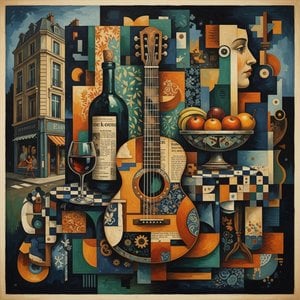
Guitar on a table

Juan Gris’s "Guitar on a Table" (1915) is a stunning example of Synthetic Cubism featuring a guitar and books arranged in geometric forms. Explore this iconic work by the Spanish visionary and bring home a piece of art history.

Oppdag Juan Gris (1887-1927), den spanske kubistiske mesteren! Utforsk hans geometriske stil, syntetisk kubisme og varig innflytelse på moderne kunst. Se kunstverk nå.

Giclée / Kunsttrykk

Giclée- eller lerretsprint av museumskvalitet med rask produksjon og fleksible valgmuligheter for etterbehandling.

P118B $10
P118H $10
P118W $10
P438Z $10
P508JH $12
P508YH $12
P805H $10
P805Z $10
P919BZ $10
P919G $10
P919XJ $10
P959ZH $10
P968JZ $12
W106C $8
W218G $10
W218JH $8
W218Y $10
W307PJ $10
W316G $10
W316PJ $8
W316Y $10
W398PJ $8
W4111J $10
W500HY $15
W500JH $15
W692G $12
W849H $8
W940BG $15
W953PJ $8

Standard
custom
CM
INCH

Velg mellom våre forhåndsdefinerte størrelser som bevarer kunstverkets opprinnelige proporsjoner.

bredde
høyde

Du kan oppgi egne mål for å tilpasse en spesifikk ramme eller et bestemt område. Dersom den valgte størrelsen ikke samsvarer med det originale bildets proporsjoner, vil vi enten beskjære kunstverket eller utvide bildet med en speilet eller ensfarget kant. En digital mockup vil bli sendt til din godkjenning før produksjonen starter.
Vennligst merk at forhåndsvisningen på skjermen ikke gjenspeiler den faktiske beskjæringen eller utvidelsen. Kun mockuppen vil vise den endelige komposisjonen nøyaktig.
Selv om tilpassede størrelser er tilgjengelige, anbefaler vi å velge et mål fra den forhåndsdefinerte listen for å bevare de originale proporsjonene.

Verdensomspennende levering () på 2 uker i stedet for standard 4/5 uker. (7 July)

why_choose_icon
Gratis ekspressfrakt over hele verden
why_choose_icon
Lerretsduk av høykvalitets lin
why_choose_icon
Full forsikring under transport
why_choose_icon
Garanti for refusjon av toll og importavgifter
why_choose_icon
Garantert korrekt fargegjengivelse
why_choose_icon
60 dagers returrett (kun ved feil)
why_choose_icon
100% pengene tilbake-garanti
why_choose_icon
Rabatt ved flere kjøp

Totalpris for bestilling

-

reproduction

Guitar on a table

Giclée / Kunsttrykk

Størrelse på reproduksjon

-

Endelig pris

-

Kort om verket

  • Artist: Juan Gris
  • Medium: Oil on canvas
  • Influences:
    • Picasso
    • Moreno Carbonero
  • Movement: Cubism
  • Title: Guitar on a Table
  • Artistic style: Synthetic Cubism
  • Dimensions: 92 x 73 cm

Beskrivelse av samleobjektet

A Symphony of Geometric Forms: Exploring Juan Gris’s “Guitar on a Table”

José Victoriano González-Pérez, later known as Juan Gris, emerged from Madrid in 1887—a young man driven by an inquisitive mind and a nascent artistic vision. His initial pursuits leaned toward engineering, demonstrating a methodical approach that would become foundational to his groundbreaking contribution to the art world. Even amidst these academic explorations, hints of creativity surfaced through drawings presented in local publications, foreshadowing the brilliance that would soon blossom on canvas. It was in 1905 that he adopted the moniker Juan Gris—a deliberate choice reflecting an evolving identity and a fervent dedication to artistic expression. This pivotal decision propelled him toward formal painting studies under José Moreno Carbonero, marking the commencement of his transformative journey into artistic innovation.

The Genesis of Synthetic Cubism

Paris welcomed Gris in 1906, establishing him within the vibrant circle of artists surrounding Picasso—a connection that cemented his position as a progenitor of Cubism’s revolutionary aesthetic. Unlike Analytic Cubism's dissection of objects into fragmented planes, Gris championed Deductive Painting—a method prioritizing visual elements like line, form, and color as starting points. This approach necessitated determining which figurative representations could be discerned within this carefully constructed geometric framework. Like his fellow Cubists, Gris possessed an undeniable fascination with musical motifs, perceiving instruments as embodying the very essence of artistic abstraction. The deliberate selection of musical imagery wasn’t merely stylistic; it represented a profound conceptual exploration—a desire to capture not just what was seen but also how it sounded.

Deconstructing Reality: Technique and Composition

“Guitar on a Table,” completed in 1915, exemplifies Gris's Synthetic Cubism style with remarkable precision. The painting’s composition is deliberately understated yet powerfully evocative. A guitar dominates the central space—its contours rendered as intersecting planes of color and geometric shapes—a visual echo of musical notation. Surrounding this focal point are books stacked horizontally and spread out on the tabletop, contributing to a sense of depth and layering. A simple bowl sits nestled near the lower left corner, anchoring the scene with organic form amidst the dominant abstraction. Gris’s meticulous technique involved applying thin layers of paint—often glazing—to build up tonal variations and achieve luminous effects. This painstaking process ensured that every element conveyed not only visual information but also a palpable sense of texture and materiality.

Symbolism Beyond Representation

Beyond its formal considerations, “Guitar on a Table” resonates with symbolic significance. The guitar itself serves as an emblem of artistic creation—a tangible representation of musical inspiration. Its fractured planes mirror the Cubist preoccupation with dismantling traditional perspective and challenging viewers’ perceptions of reality. Furthermore, the books symbolize knowledge and contemplation—suggesting that Gris intended to convey not just visual beauty but also intellectual depth. The muted palette—primarily browns, ochres, and blues—creates an atmosphere of quiet introspection, inviting viewers to contemplate the interplay between form and color.

Emotional Resonance: A Moment Frozen in Time

Ultimately, “Guitar on a Table” transcends mere depiction; it captures a fleeting moment imbued with emotional resonance. The stillness of the scene contrasts sharply with the dynamism inherent in musical performance—a juxtaposition that underscores Gris’s artistic ambition to distill complex ideas into simplified visual forms. The painting's understated elegance speaks to a humanist sensibility—reflecting Gris’s belief in art as a conduit for conveying profound truths about human experience. It remains a testament to his mastery of Synthetic Cubism and its enduring capacity to inspire contemplation and admiration.

Om kunstneren

A Spanish Visionary of Cubism: The Life and Art of Juan Gris

José Victoriano González-Pérez, born in Madrid in 1887, embarked on a remarkable artistic journey that would cement his place as one of the most significant figures of early 20th-century art. Initially pursuing an engineering degree at the School of Arts and Sciences, a keen analytical mind hinted at a future far removed from blueprints and calculations. Even during these formative years, a creative spark ignited – contributions to local periodicals showcased a burgeoning talent for visual observation. It was in 1905 that he adopted the evocative pseudonym Juan Gris, a name resonating with newfound identity and purpose as he began his formal studies in painting under José Moreno Carbonero. This pivotal shift marked the beginning of his dedicated pursuit of artistic innovation.

Parisian Awakening and the Embrace of Cubism

The year 1906 witnessed a transformative relocation to Paris, a city then brimming with an unparalleled energy of artistic expression. Gris immersed himself completely in this vibrant milieu, forging enduring friendships with luminaries such as Henri Matisse, Georges Braque, and Fernand Léger. Initially engaged in satirical illustration for publications like *L'Assiette au Beurre*, he honed his observational skills and developed a sharp wit – a foundation that would later inform the conceptual depth of his art. However, the profound influence of Pablo Picasso proved particularly compelling. Around 1910, Gris began to dedicate himself wholeheartedly to painting, deliberately moving away from caricature and embracing the burgeoning language of Cubism. This wasn’t mere imitation; it was a deliberate quest to distill the essence of form and space, seeking a new visual order – a radical departure from traditional representation.

The Geometry of Perception: Style and Key Works

Juan Gris's artistic output is characterized by an extraordinary clarity and intellectual rigor. He didn't simply deconstruct objects; he meticulously reconstructed them, emphasizing geometric forms and a carefully considered palette. This approach led to what became known as his “crystal period,” exemplified in masterpieces such as *Still Life Before an Open Window* (1912) and *Place Ravignan* (1915). These works showcase a remarkable interplay of planes and angles, creating a sense of depth and solidity while simultaneously challenging conventional notions of perspective. The use of muted colors and fragmented forms created a unique visual experience, inviting the viewer to actively engage with the artwork. After 1913, Gris wholeheartedly embraced Synthetic Cubism, pioneering the innovative technique of *papier collé* – collage – incorporating real-world materials like newspaper clippings and textured papers into his compositions. This added another layer of complexity and tactility to his work, blurring the boundaries between painting and sculpture. Notable examples include *Guitar in front of the sea* (1925), a testament to his simplified forms and adherence to cubist principles, and *Homage à Pablo Picasso* (1912), which signaled his growing recognition within the avant-garde art world.

Influences and Development

Gris’s artistic development was profoundly shaped by a confluence of influences. Initially captivated by Picasso's revolutionary approach, he quickly absorbed the core tenets of Cubism – fragmentation, multiple perspectives, and the rejection of traditional representation. However, Gris possessed a unique sensibility that distinguished his work from that of his contemporaries. He wasn’t merely replicating Picasso’s techniques; he was developing his own distinct style, characterized by an exceptional clarity and structural precision. The intellectual rigor of mathematicians like Henri Poincaré also exerted a subtle but significant influence on his approach to composition, leading him to seek geometric solutions for representing complex forms. Furthermore, his close friendships with artists like Matisse fostered a deep appreciation for color and harmony, which he skillfully integrated into his Cubist paintings.

Legacy and Lasting Influence

Juan Gris’s contribution to Cubism extends far beyond mere stylistic innovation; he brought a unique intellectual depth and structural clarity to the movement. He moved past the analytical phase, towards a more organized and synthetic approach, emphasizing order and precision. His work profoundly influenced the Purist style championed by Amédée Ozenfant and Charles Edouard Jeanneret (Le Corbusier), advocating for a return to classical principles of form and composition. Gris’s emphasis on geometric forms, harmonious color palettes, and the integration of everyday objects into his art established him as a pivotal figure in 20th-century art. His legacy continues to inspire artists today, demonstrating the enduring power of Cubism and the visionary genius of Juan Gris – a Spanish master who reshaped our understanding of perception and representation.
Juan Gris

Juan Gris

1887 - 1927 , Spania

Kort om kunstneren

  • Artistic Movement Or Style: Kubisme, Kubisme syntetisk
  • Artists Or Movements Influenced By This Artist:
    • Purisme
    • Amédée Ozenfant
  • Artists Who Influenced This Artist:
    • Pablo Picasso
    • Henri Matisse
    • Georges Braque
  • Date Of Birth: 23 mars 1887
  • Date Of Death: 11 mai 1927
  • Full Name: José Victoriano González-Pérez
  • Nationality: Spansk
  • Notable Artworks:
    • Still Life Before an Open Window
    • Place Ravignan
    • Guitar ved havet
  • Place Of Birth: Madrid, Spania
Utforsk kunstverk organisert etter temaer, stiler og kjennetegn.