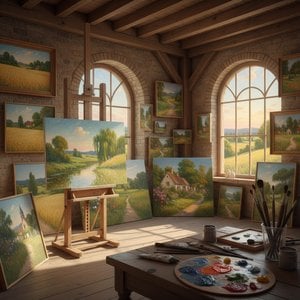
The Coastal Soul of Scotland: The Life and Art of Joseph Milne
In the soft, shifting light of the late Victorian era, few artists captured the rugged maritime spirit of Scotland as intimately as Joseph Milne. Born in Aberdeen in 1859, Milne’s early years were steeped in the industrial and natural rhythms of Scotland's northeast. This formative environment, characterized by the salt spray of the North Sea and the burgeoning energy of coastal trade, would become the heartbeat of his creative life. While history occasionally relegates him to a more obscure position compared to his contemporaries, his work serves as a vital, luminous window into the atmospheric beauty of the Scottish coastline during a period of profound transition.
Milne’s artistic journey was grounded in rigorous academic discipline. Moving to Edinburgh, he sought refinement within the prestigious Royal Scottish Academy (RSA) Life Class, where he studied from 1882 until 1886. This period of intense training provided him with a masterful command of form and observation, yet his heart remained tethered to the sea. His talent was recognized early by the establishment; in 1885, he was honored with both the Chalmer Prize and the Maclaine Watters Medal. These accolades were not merely personal triumphs but signals of a rising talent capable of blending classical precision with a modern, emotive sensibility.
A Symphony of Light and Water
As his career matured, Milne’s style began to dance on the edge of Impressionism. He moved away from rigid realism toward a more fluid, evocative technique that prioritized the sensation of light over the mere documentation of objects. His brushwork became increasingly loose and spirited, utilizing vibrant color palettes to capture the fleeting moods of the Firth of Forth and the tranquil waters of Buckhaven Harbour. To look upon a Milne seascape is to experience the humidity of a misty morning or the brilliant, sharp clarity of a sun-drenched afternoon on the coast.
His subject matter was deeply personal, often reflecting his familial ties to the very landscapes he painted. With a wife, Janet Thompson, hailing from Buckhaven, and a son, John Maclauchlan Milne, born there, the artist possessed an insider’s connection to the maritime life of Fife. This intimacy allowed him to depict more than just scenery; he captured the essence of maritime industry—the sturdy silhouettes of sailing ships, the rhythmic movement of fishing boats, and the quiet dignity of Thames barges. His work often features:
- Atmospheric Seascapes: Capturing the interplay of mist, tide, and light across the Scottish coast.
- Maritime Narratives: Detailed depictions of working boats, harbors, and the vessels that defined coastal commerce.
- Rural Tranquility: Landscapes such as his cattle grazing scenes that showcase the pastoral beauty of the Scottish countryside.
Legacy of a Scottish Impressionist
Though Joseph Milne passed away in 1911, his contribution to the Scottish landscape tradition remains profound. He did not merely paint what he saw; he painted how the Scottish landscape felt. By bridging the gap between the disciplined traditions of the Royal Scottish Academy and the emotive freedom of the Impressionist movement, he helped forge a unique visual identity for his nation. His ability to find grandeur in the humble harbor scene and poetry in a coastal fog continues to resonate with those who seek the soul of the Scottish landscape.
Today, his works stand as enduring testaments to a period when the natural world and human industry existed in a delicate, beautiful tension. Through his eyes, we are invited to revisit a lost era of maritime splendor, preserved forever in the vibrant, textured strokes of his masterful oils.



 Se i rommet
 Bestill håndmalt reproduksjon
 Del som digitalt kort
 Del
Del
 Detaljer
 Studentguide

 Last ned
 Liknende objekter
 Røntgen
 Lysbildefremvisning
 Besøksstatistikk

 Les mer






































 Glassalternativet er kun tilgjengelig i størrelser under 110 cm