Se i rommet Se i AR Bestill håndmalt reproduksjon Gå til digitalt bilde Del som digitalt kort
Detaljer Studentguide Legg til i favoritter Last ned Liknende objekter Røntgen Lysbildefremvisning Besøksstatistikk

Oran

Explore James Brooks’ ‘Oran’ (1969), a dynamic Abstract Expressionist painting featuring vibrant red & blue hues, textured surfaces, and rhythmic composition. Discover this iconic work at the Smithsonian!

James Brooks (1906-1992) was a pivotal Abstract Expressionist painter known for his innovative staining techniques, lyrical abstraction, & large-scale murals like "Flight" at LaGuardia Airport. Explore his calligraphy-infused works and legacy as a fi

Kunstverket som vises på denne siden er beskyttet av opphavsretten, noe som betyr at vi ikke har juridisk tillatelse til å lage eller selge identiske reproduksjoner. Denne beskyttelsen håndheves i henhold til internasjonale avtaler som for eksempel Bernerkonvensjonen og av nasjonale lover, inkludert de som er fastsatt i Amerikansk opphavsrettslov – Tittel 17.

Denne metoden er i fullt samsvar med opphavsrettslige regler, da den ikke innebærer kopiering eller duplisering av det beskyttede kunstverket. I stedet er det snakk om en kreativ nytolkning – et nytt maleri som er inspirert av originalen, men ikke identisk med den.

Giclée / Kunsttrykk

Giclée- eller lerretsprint av museumskvalitet med rask produksjon og fleksible valgmuligheter for etterbehandling. ( Bestill håndmalt reproduksjon Gå til digitalt bilde)

Standardformat
tilpasset
CM
INCH

Velg mellom våre forhåndsdefinerte størrelser som bevarer kunstverkets opprinnelige proporsjoner.

bredde
høyde

Skriv inn bredden og høyden du trenger, slik at den passer til din ramme eller vegg. Et trykk kan kun beskjæres, aldri gjøres større enn bildet, så et format med en annen form vil miste en del av motivet. Vi sender deg en digital mockup for godkjenning før vi trykker noe som helst. Bildet som vises på denne siden viser ikke den faktiske beskjæringen — det er kun mockuppen som gjør det.

Verdensomspennende levering () på 2 uker i stedet for standard 4/5 uker. (19 October)

Gratis ekspressfrakt over hele verden
Lerretsduk av høykvalitets lin
Full transportforsikring
Garanti for refusjon av toll og importavgifter
Garantert fargeekthet
100 dagers returrett ved fabrikasjonsfeil
100% pengene tilbake-garanti
Mengderabatt

Totalpris

Nkr 640

Oran

Giclée / Kunsttrykk

Format på reproduksjon

-

Totalpris

Nkr 640

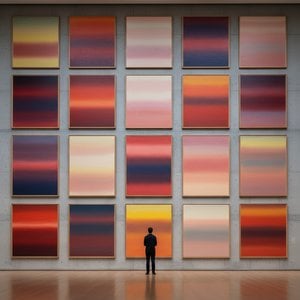
The Oran painting, created by James Brooks in 1969, is a remarkable piece of art that showcases the artist's unique style and technique. Measuring 270 x 233 cm, this acrylic on canvas painting is a prime example of Abstract Expressionism. The painting is currently housed at the Smithsonian American Art Museum in the United States.

Artistic Style and Technique

James Brooks was known for his innovative use of staining, dilution, and accidental deterioration of canvases to create uncontrolled abstraction. In Oran, he applied his mixtures of commercial products and paints directly from the tube to create thick, deep textures. This technique gives the painting a dynamic and expressive quality.

Composition and Color Scheme

The composition of Oran features rhythmic arrangements of color, space, and shape. The dominant colors used in the painting are red and blue, which add depth and interest to the overall composition. The central figure in the painting appears to be a black object, possibly a guitar or musical instrument, surrounded by smaller figures, including one that resembles a person's head.

Artist's Background and Influences

James Brooks was an American artist born in 1906. He studied at the Southern Methodist University in Dallas, Texas, and later attended the Arts Student League in New York. Brooks was influenced by other notable artists of his time, including Jackson Pollock and Lee Krasner. His work has been exhibited at various museums, including the Museum of Modern Art (MoMA) and the Tate Gallery.
The Oran painting by James Brooks is a significant piece of art that showcases the artist's unique style and technique. Its composition, color scheme, and texture make it a captivating work that continues to inspire art lovers today.

Spørsmål og svar

Hva forestiller "Oran" av James Brooks?

Motivene i "Oran" er abstract expressionism, color field painting, dynamic composition, textured surface”, “red and blue palette”, "gestural brushstrokes", american art”.

Hvordan relaterer motivet i "Oran" seg til James Brooks sine vanlige temaer?

James Brooks sine tilbakevendende temaer inkluderer pollock & krasner's impact, abstract exploration", post-war american art, emotional abstraction, "large-scale, dynamic forms", experimentation with texture, key to brooks' style; "Oran" fokuserer på abstract expressionism, color field painting, dynamic composition, textured surface”, “red and blue palette”, "gestural brushstrokes", american art”.

Finnes det en guide for "Oran" av James Brooks?

En Veiledning-side er tilgjengelig for "Oran" av James Brooks: et utskrivbart faktablad om kunstverket, designet for studenter og bruk i klasserommet.


Kunstnerbiografi

Early Life and Education

  • Born: October 18, 1906, St. Louis, Missouri
  • Family moved to Dallas, Texas in 1916
  • Studied art at Southern Methodist University (1922-1924)
  • Private lessons with James A. Waddell and Martha Simkins in Dallas
  • Moved to New York City in 1926
  • Studied at the Art Students League under Boardman Robinson and Kimon Nicolaides
  • Worked as a commercial artist to support himself

The WPA Years and Early Murals

  • Active in the Works Progress Administration (WPA) Federal Art Project from 1936-1942
  • Painted three murals for the WPA, demonstrating social realist style.
  • Flight (1940-1942): A significant mural at La Guardia Airport's Marine Air Terminal, depicting the history of aviation. It was the largest WPA mural and later restored after being painted over.
  • Friendships with Jackson Pollock and Philip Guston during this period

Abstract Expressionist Period: Style and Development

  • Served as a combat artist in the U.S. Army (1942-1945)
  • Returned to New York City in 1946, reconnected with Pollock and Krasner
  • Shifted towards Abstract Expressionism, influenced by Surrealist principles
  • Developed a unique staining technique: Experimenting with the bleed of paste through canvas.
  • Early works showed influences of Synthetic Cubism.
  • Palette initially featured browns, grays, blacks and vivid colors.
  • Later work incorporated larger forms, broader strokes, and simpler compositions using acrylics.
  • Often used numbers and letters to identify paintings, incorporating nonsense syllables as titles (e.g., *Pask*, *Burwak*, *Jondol*).

Major Exhibitions and Recognition

  • First solo exhibition at the Peridot Gallery in New York City (1949)
  • Participated in the historic Ninth Street Exhibition (1951) – a key event in Abstract Expressionism.
  • Featured in exhibitions such as Twelve Americans and New American Painting at the Museum of Modern Art.
  • Documenta, Kassel, West Germany (1959).
  • John Simon Guggenheim Memorial Foundation Fellowship (1969)

Legacy and Historical Significance

  • Considered a first-generation Abstract Expressionist painter.
  • Known for his innovative staining techniques and lyrical abstraction.
  • His work is held in prominent collections including the Art Institute of Chicago, The Museum of Modern Art, Tate Gallery, and National Gallery of Art.
  • Brooks's artistic journey reflects the evolution of Abstract Expressionism and his willingness to experiment with new approaches to painting.
  • Died on March 9, 1992, in East Hampton, New York.
James Brooks

James Brooks

1906 - 1992 , United States of America

Kort om kunstneren

  • Full Name: James Brooks
  • Nationality: American
  • Date Of Birth: 1906
  • Date Of Death: 1992
  • Place Of Birth: St. Louis, United States of America
  • Notable Artworks: ['Flight (LaGuardia Airport mural)']
  • Artistic Movement Or Style: Abstract Expressionism
  • Artists Who Influenced This Artist:
    • Jackson Pollock
    • Lee Krasner
    • Pablo Picasso
    • Georges Braque