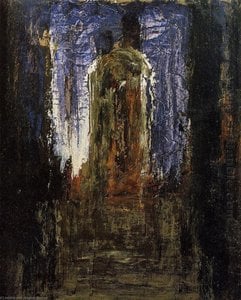
Kunstnerbiografi
A Dream Weaver of Symbolism: The Life and Art of Gustave Moreau
Gustave Moreau, et navn synonymt med den eteriske skjønnheten og de gåtefulle dybdene av symbolistisk maleri, dukket opp fra 1900-tallets Paris som en unik kunstnerisk stemme. Han ble født i 1826 inn i en borgerskapfamilie – faren hans var arkitekt og arkivar – og Moreaus tidlige liv var fylt med intellektuell nysgjerrighet og estetisk sanselighet. Fra ung alder viste han et bemerkelsesverdig talent for tegning, oppfostret gjennom tradisjonell akademisk utdanning ved École des Beaux-Arts under figurer som François-Édouard Picot. Likevel ville Moreaus kunstneriske vei avvike skarpt fra de dominerende realistiske og impresjonistiske strømningene i sin tid. Han var ikke interessert i å fange flyktige øyeblikk eller objektiv virkelighet; heller søkte han å låse opp skjulte riker, mytologi, religion og den menneskelige psyke gjennom et dypt personlig og symbolsk visuelt språk. Hans reise var en av indre utforskning, oversettende subjektive følelser og åndelige lengsler til lerretsmaleri med obsessiv detaljrikdom og en livlig, ofte overdådig palett.
The Forge of Imagination: Influences and Artistic Development
Moreaus kunstneriske utvikling ble ikke født i et vakuum. Selv om han avviste de dominerende trendene i sin tid, hentet han inspirasjon fra mangfoldige kilder. Den dramatiske bruken av farge og eksotisk motivmateriale funnet i verkene til Eugène Delacroix resonerte dypt med ham, og utløste en lidenskap for fortelling kunst som var innlemt med emosjonell intensitet. Han beundret også renessansemestere som Michelangelo og Leonardo da Vinci, og beundret deres mesterskap i komposisjon, anatomi og psykologisk innsikt. Likevel var Moreau ikke bare etterligner disse kunstnerne; han syntetiserte deres innflytelser til noe helt nytt. Hans reise til Italia på 1850-tallet viste seg å være avgjørende, og dykket ham ned i kunsten fra antikken og renessansen, og ga en rikdom av motiver og stilistiske ledetråder som ville befolke hans fremtidige verk. Han kopierte nøye gamle malerier, ikke som en øvelse i replikasjon, men som et middel til å absorbere deres teknikker og låse opp deres hemmeligheter. Denne dedikasjonen til håndverk, kombinert med hans voksende interesse for mytologi og litteratur, la grunnlaget for hans unike kunstneriske visjon.
A World of Symbols: Themes and Techniques
Moreaus malerier er ikke bare illustrasjoner av myter eller bibelske historier; de er komplekse allegorier som inviterer til refleksjon og tolkning. Han dykker ned i fortellinger som de om Salome, Orpheus, Jupiter og Semele og utallige andre, ikke for å fortelle dem bokstavelig talt, men for å utforske deres underliggende psykologiske og åndelige sannheter. Hans lerreter er fylt med symbolsk bildebruk – slanger som representerer fristelse, juveler som signaliserer jordiske ønsker og figurer som uttrykker abstrakte konsepter som sorg, tap eller forløsning. Han skapte mesterlig en drømmende atmosfære gjennom intrikate detaljer, rike teksturer og ofte en ubehagelig sammenstilling av lys og skygge. Moreaus teknikk var preget av omhyggelig lagdeling av maling, og skapte overflater som skimrer med iriserende farger og vekker en følelse av overjordisk skjønnhet. Hans bruk av gullfolie forsterket dette effekten ytterligere, og ga hans verk en bysantinsk kvalitet som understrekte deres åndelige dimensjon. Han var ikke opptatt av å fange realistiske teksturer eller perspektiver; heller prioriterte han den uttrykksfulle kraften til farge og form for å formidle stemning og mening.
Notable Works and Legacy
Moreaus kunst er kjent for sin overdådighet, detaljrikdom og symbolsk tyngde. Han var en mester i å skape et univers av referanser og antydninger, og hans verk inviterer til mange tolkninger. *Salome dansant foran Herodes* (1876) er kanskje hans mest berømte verk, som eksemplifiserer Moreaus overdådige stil og fascinasjon for bibelske fortellinger. *Jupiter og Semele* (1894-96) er et dramatisk bilde av den greske myten, som viser Moreaus mesterskap i komposisjon og fargebruk. Hans utforskning av Orpheus-myten resulterte i flere malerier, som reflekterer temaer om tap, sorg og kunstnerisk inspirasjon. *Apparition* (1887) demonstrerer hans ferdigheter i å skape eteriske og overjordiske scener. Og *Desdemona* (1890) er en hjerteskjærende fremstilling av Shakespeares tragiske heltinne.
Moreau ble anerkjent som en sentral figur i den voksende symbolistbevegelsen på 1890-tallet. I motsetning til noen av sine samtidige, som aktivt søkte offentlig oppmerksomhet, forble han noe tilbakeholden, og foretrakk å jobbe uavhengig og unngå kunstneriske debatter. Likevel var hans innflytelse ubestridelig. I 1893 aksepterte han en professur ved École des Beaux-Arts, hvor han dypt påvirket generasjoner av kunstnere, inkludert Henri Matisse og Georges Rouault. Han oppfordret sine studenter til å omfavne fantasi, symbolikk og individuell uttrykk, og oppmuntret dem til å bryte med konvensjonelle kunstneriske normer. Selv om Symbolismen endelig falt ut av popularitet etter Moreaus død i 1898, ble hans verk gjenstand for en betydelig omarbeidelse i den andre halvdelen av det 20. århundre. I dag betraktes han som en av de viktigste figurene i bevegelsen og en forkjemper for moderne kunst. Musée Gustave Moreau, beliggende i hans tidligere studio og hjem i Paris, står som et vitnesbyrd om hans vedvarende arv – et helligdom der besøkende kan fordype seg i den fengslende verdenen til denne ekstraordinære kunstneren. Hans malerier resonerer fortsatt med publikum i dag, og gir glimt inn i de skjulte dybdene av den menneskelige sjel og minner oss om kunstens kraft til å overskride grensene for virkeligheten.



 Se i rommet
 Bestill håndmalt reproduksjon
 Del som digitalt kort
 Del
Del
 Detaljer
 Studentguide

 Last ned
 Liknende objekter
 Røntgen
 Lysbildefremvisning
 Besøksstatistikk

 Les mer






































 Glassalternativet er kun tilgjengelig i størrelser under 110 cm