Se i rommet Se i AR Bestill håndmalt reproduksjon Gå til digitalt bilde Del som digitalt kort
Detaljer Studentguide Legg til i favoritter Last ned Liknende objekter Røntgen Lysbildefremvisning Besøksstatistikk

Patience

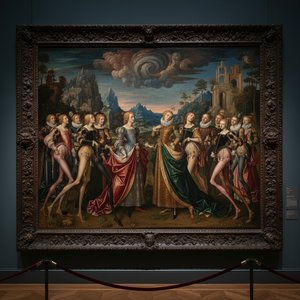
‘Patience,’ created in 1542 by Giorgio Vasari, embodies Renaissance humanist ideals with its depiction of virtue—a central female figure symbolizing tranquility amidst dramatic clouds. Admire this iconic piece at Casa Vasari and explore the artistic achievements of Properzia de' Rossi.

Giorgio Vasari (1511-1574): Italiensk maler, arkitekt og kunsthistoriker kjent for «Lives of Artists» og design av Uffizi-galleriet. En pioner som formet vår forståelse av renessansen.

Giclée / Kunsttrykk

Giclée- eller lerretsprint av museumskvalitet med rask produksjon og fleksible valgmuligheter for etterbehandling. ( Bestill håndmalt reproduksjon Gå til digitalt bilde)

P118B $10
P118H $10
P118W $10
P438Z $10
P508JH $12
P508YH $12
P805H $10
P805Z $10
P919BZ $10
P919G $10
P919XJ $10
P959ZH $10
P968JZ $12
W106C $8
W218G $10
W218JH $8
W218Y $10
W307PJ $10
W316G $10
W316PJ $8
W316Y $10
W398PJ $8
W4111J $10
W500HY $15
W500JH $15
W692G $12
W849H $8
W940BG $15
W953PJ $8

Standardformat
tilpasset
CM
INCH

Velg mellom våre forhåndsdefinerte størrelser som bevarer kunstverkets opprinnelige proporsjoner.

bredde
høyde

Du kan oppgi egne mål for å tilpasse en spesifikk ramme eller et bestemt område. Dersom den valgte størrelsen ikke samsvarer med det originale bildets proporsjoner, vil vi enten beskjære kunstverket eller utvide bildet med en speilet eller ensfarget kant. En digital mockup vil bli sendt til din godkjenning før produksjonen starter.
Vennligst merk at forhåndsvisningen på skjermen ikke gjenspeiler den faktiske beskjæringen eller utvidelsen. Kun mockuppen vil vise den endelige komposisjonen nøyaktig.
Selv om tilpassede størrelser er tilgjengelige, anbefaler vi å velge et mål fra den forhåndsdefinerte listen for å bevare de originale proporsjonene.

Verdensomspennende levering () på 2 uker i stedet for standard 4/5 uker. (27 September)

why_choose_icon
Gratis ekspressfrakt over hele verden
why_choose_icon
Lerretsduk av høykvalitets lin
why_choose_icon
Full transportforsikring
why_choose_icon
Garanti for refusjon av toll og importavgifter
why_choose_icon
Garantert fargeekthet
why_choose_icon
100 dagers returrett ved fabrikasjonsfeil
why_choose_icon
100% pengene tilbake-garanti
why_choose_icon
Mengderabatt

Totalpris

$ 68

reproduction

Patience

Giclée / Kunsttrykk

Format på reproduksjon

-

Totalpris

$ 68

Kort om verket

  • Subject or theme: Human emotion & interaction
  • Year: 1542
  • Influences: Allegorical themes
  • Title: Patience
  • Movement: Mannerism
  • Artist: Giorgio Vasari
  • Dimensions: 79 x 188 cm

Kunstquiz

Det er kun ett riktig svar på hvert spørsmål.

Spørsmål 1:
What artistic movement is Giorgio Vasari’s ‘Patience’ considered to be?
Spørsmål 2:
Where can you find the painting ‘Patience’?
Spørsmål 3:
What is a prominent characteristic of Vasari’s artistic style?
Spørsmål 4:
The painting depicts a central female figure representing what virtue?
Spørsmål 5:
What is the significance of Vasari’s signature on ‘Patience’?

A Renaissance Meditation on Virtue

In the quiet corridors of the Gallerie dell’Accademia in Venice, there exists a window into the soul of the High Renaissance—a masterpiece titled Patience. Painted in 1542 by the legendary Giorgio Vasari, this oil on panel work is far more than a mere portrait; it is a profound exploration of moral contemplation and human excellence. To gaze upon this piece is to enter a period of intense intellectual ferment, where the boundaries between art, philosophy, and divinity were beautifully blurred. Vasari, a man who would later become the definitive biographer of the Renaissance, captures here the very essence of the humanist ideal: the belief that through reasoned thought and steadfast virtue, the human spirit can ascend toward greatness.

The composition unfolds like a silent drama, drawing the viewer into a world of allegorical depth. At the heart of the work sits a woman, her presence radiating a serene, contemplative stillness that justifies her name. She holds a musical instrument—perhaps a lute—with a delicate grace, her hand resting near her chin in a gesture of deep introspection. Flanking her are figures that embody the tension between physical strength and spiritual devotion. To her left, a muscular, partially nude man gazes upon her with an expression of intense admiration or perhaps protective concern, his form sculpted by light to remind us of the classical ideals of antiquity. On the right, another figure sits in quiet prayer, creating a balanced dialogue between the external world of action and the internal world of faith.

The Mastery of Light and Mannerist Elegance

Vasari’s technical prowess is on full display through his sophisticated use of chiaroscuro. The dramatic interplay of light and shadow does not merely illuminate the scene; it sculpts the very anatomy of the figures, imbuing the drapery and flesh with a palpable, three-dimensional reality. This mastery of light serves to focus the viewer's eye on the central figure, casting her as a beacon of stability amidst the swirling, atmospheric clouds that populate the background. These dramatic skies add a sense of cosmic scale to the intimate human interaction occurring below, suggesting that the virtue of patience is a universal, celestial necessity.

While the foundation of the work rests in the naturalism of the High Renaissance, one can detect the emerging elegance of Mannerism. Vasari employs a certain stylized grace and expressive distortion that prioritizes emotional impact and aesthetic sophistication over strict realism. The elongated elegance of the figures and the nuanced gradations of color create a rhythmic, almost musical quality to the painting. For the discerning collector or interior designer, this piece offers a sophisticated blend of classical stability and dynamic movement, making it an extraordinary focal point for any space dedicated to culture and reflection.

A Timeless Legacy for the Modern Collector

Owning a reproduction of Patience is an invitation to bring the intellectual rigor of the 16th century into the contemporary home. This artwork transcends its historical origins, offering a sense of tranquility and moral weight that is increasingly rare in our fast-paced modern era. It serves as a visual anchor, a piece of history that commands attention through its subtle complexity rather than loud ornamentation.

Whether placed in a curated gallery, a stately library, or a thoughtfully designed living space, this painting provides:

  • Historical Depth: A direct connection to the era of the Medici and the birth of art history.
  • Aesthetic Versatility: The rich textures and dramatic lighting complement both classical and modern interior decors.
  • Emotional Resonance: A constant, quiet reminder of the virtues of stillness and endurance in an age of distraction.
To display Vasari’s Patience is to celebrate the enduring power of the human spirit and the timeless beauty of the Renaissance masters.


Kunstnerbiografi

A Life Woven into the Renaissance Fabric

Giorgio Vasari, born in Arezzo, Tuscany, on July 30, 1511, was more than simply a painter; he was a quintessential embodiment of the Italian Renaissance spirit. His life unfolded as a vibrant tapestry woven with threads of artistic creation, architectural innovation, insightful historical writing, and an unwavering dedication to celebrating the masters who came before him. From his earliest training under Guglielmo da Marsiglia, a skilled artisan in stained glass, young Giorgio’s path was steered towards visual artistry. However, it was his move to Florence at sixteen that truly ignited his potential. Immersing himself within the dynamic circle of Andrea del Sarto and absorbing the influences of Rosso Fiorentino and Jacopo Pontormo, Vasari began a journey that would see him become one of the most influential figures of his era. His formative years were also deeply marked by the patronage and friendship of the powerful Medici family, a relationship that would shape both his career and his perspective on art’s role in society.

The Artist's Hand and Eye

Vasari’s artistic style is often categorized as Mannerist, reflecting the prevailing aesthetic trends of the mid-16th century. His paintings are characterized by elongated figures, dynamic compositions, and a sophisticated use of color—qualities highly admired during his lifetime. While perhaps not achieving the same level of enduring fame as some of the artists he chronicled, Vasari’s skill was undeniable. Notable works such as *The Studio of the Painter*, a fresco housed in Casa Vasari in Arezzo, offer a fascinating glimpse into the artistic practices of the time. The sheer scale and ambition of his frescoes for the Palazzo Vecchio in Florence, undertaken between 1555 and 1572, demonstrate his mastery of large-scale decorative schemes. His final monumental undertaking, *The Last Judgement*, adorning the cupola of Florence Cathedral—completed after his death by Federico Zuccari—stands as a testament to his unwavering commitment to grand artistic visions. Beyond painting, Vasari’s architectural contributions were equally significant. He designed the elegant loggia of the Palazzo degli Uffizi, transforming it into a public piazza and creating a vital link within Florence's urban landscape. Perhaps most famously, he conceived and oversaw the construction of the Vasari Corridor, a secret passageway connecting the Uffizi Gallery with the Palazzo Pitti—a feat of engineering and architectural ingenuity that continues to captivate visitors today.

A Historian Forging a Legacy

However, it is arguably as an art historian that Giorgio Vasari secured his most lasting legacy. His monumental work, *Lives of the Most Excellent Painters, Sculptors, and Architects*, published in 1550 (with a revised edition in 1568), revolutionized the way art was understood and appreciated. This groundbreaking text wasn’t merely a collection of biographies; it established a narrative framework for the development of Italian Renaissance art, tracing its evolution from the early masters like Cimabue and Giotto to his contemporaries Michelangelo and Raphael. Vasari's work introduced the very concept of the “Renaissance” – a rebirth of classical ideals—and laid the foundation for modern art history as a discipline. While acknowledging that Vasari’s accounts are not without their biases and inaccuracies, particularly concerning artists predating his own time, the impact of *Lives* remains profound. It provided a crucial historical context for artistic creation, elevating the status of artists from skilled craftsmen to intellectual figures worthy of scholarly attention.

Influences and Enduring Significance

Vasari’s artistic development was profoundly shaped by his exposure to the works of Renaissance masters. His visit to Rome in 1529, where he studied the art of Raphael and other High Renaissance artists, proved pivotal. He absorbed their principles of composition, anatomical accuracy, and idealized beauty, incorporating them into his own style. Michelangelo, whom Vasari greatly admired, exerted a particularly strong influence on both his painting and architecture. The grandeur and dynamism characteristic of Michelangelo’s work are evident in many of Vasari’s projects. Beyond specific artists, the broader intellectual currents of the Renaissance—humanism, classical learning, and a renewed interest in empirical observation—also informed Vasari's approach to art and history. Giorgio Vasari died on June 27, 1574, in Florence, leaving behind a multifaceted legacy that continues to resonate today. He was not only a talented artist and architect but also a pioneering historian whose writings shaped our understanding of one of the most transformative periods in Western art history. His work remains essential for anyone seeking to explore the rich cultural heritage of the Italian Renaissance.

Major Achievements

  • *The Lives of the Most Eminent Painters, Sculptors, and Architects* (1550): This seminal work established Vasari as a leading art historian and profoundly shaped our understanding of the Renaissance.
  • Frescoes in Palazzo Vecchio: His monumental frescoes in the Palazzo Vecchio, including *The Studio of the Painter*, showcased his mastery of large-scale decorative schemes and demonstrated his ability to integrate narrative and symbolism.
  • Design of the Uffizi Gallery Loggia: Vasari’s design for the loggia of the Uffizi Gallery transformed the space into a vibrant public piazza, enhancing Florence's urban landscape.
  • Construction of the Vasari Corridor: His role in designing and overseeing the construction of the secret Vasari Corridor—a remarkable feat of engineering—demonstrates his architectural ingenuity and strategic thinking.

Key Influences

Early Training:** Initially trained by Guglielmo de Marcillat, a master glassmaker in Arezzo. Later mentored by Andrea del Sarto and influenced by Rosso Fiorentino and Jacopo Pontormo in Florence.
Michelangelo:** Vasari held Michelangelo in the highest esteem, deeply admiring his artistic genius and incorporating elements of his style into his own work.
Renaissance Humanism:** The humanist ideals of the Renaissance—emphasizing classical learning, empirical observation, and the study of human nature—shaped Vasari’s approach to art and history.

Giorgio Vasari

Giorgio Vasari

1511 - 1574 , Italia

Kort om kunstneren

  • Artistic Movement Or Style: Mannerisme
  • Artists Or Movements Influenced By This Artist: ['Renaissance kunst']
  • Artists Who Influenced This Artist:
    • Michelangelo
    • Andrea del Sarto
  • Date Of Birth: 30. juli 1511
  • Date Of Death: 27. juni 1574
  • Full Name: Giorgio Vasari
  • Nationality: Italiensk
  • Notable Artworks:
    • Studio maler
    • Dommedagen
  • Place Of Birth: Arezzo, Italia
Utforsk kunstverk organisert etter temaer, stiler og kjennetegn.