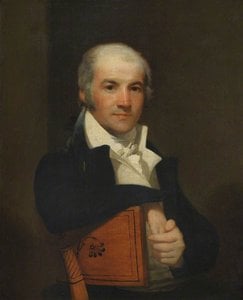
A Glimpse into Noble Splendor
In the quiet, commanding presence of Josef de Jaudenes y Nebot, we encounter more than just a portrait; we enter a window into the refined elegance of the late eighteenth century. Painted in 1794 by the master of American portraiture, Gilbert Stuart, this work serves as a profound testament to an era defined by grace, status, and the burgeoning Neoclassical movement. The subject, captured with an air of dignified importance, sits enveloped in the rich textures of his station. His formal attire, characterized by a striking red coat that commands the viewer's attention, speaks volumes of a life shaped by wealth and social authority. Through Stuart’s lens, we do not merely see a man, but rather an icon of stability and prestige, rendered with a meticulousness that honors the sitter's legacy.
The artistry behind this piece lies in its masterful command of light and shadow, a technique that breathes life into the canvas. Stuart employs a directional lighting scheme that illuminates the subject’s face and upper torso, pulling him forward from a dark, atmospheric background. This deliberate use of chiaroscroll creates a sense of three-dimensional depth, making the figure appear almost tangible within the frame. The textures are nothing short of exquisite; one can almost feel the heavy weight of the dark green drapery and the fine weave of the subject's clothing. Every brushstroke is purposeful, contributing to a surface that oscillates between smooth, porcelain-like skin tones and the tactile richness of velvet and silk, making it an ideal centerpiece for those seeking to add a layer of historical opulence to a sophisticated interior.
The Soul of Neoclassicism
Beyond its technical brilliance, the portrait is steeped in the symbolic language of the Neoclassical period. The composition, centered and balanced, reflects the era's obsession with order, symmetry, and classical ideals. The subtle architectural elements and geometric shapes within the background provide a structured stage for the subject, suggesting a world governed by reason and established hierarchy. There is a poignant emotional resonance found in the man’s expression—a subtle blend of stoicism and a hint of melancholy that invites the viewer to contemplate the fleeting nature of power and time. For the discerning collector or interior designer, this painting offers more than mere decoration; it provides an emotional anchor, bringing a sense of timelessness and intellectual depth to any curated space.
As a reproduction, this work carries the weight of history into the modern home. It serves as a conversation piece that bridges the gap between the 18th-century aristocratic tradition and contemporary aesthetic sensibilities. Whether placed in a formal study, a grand hallway, or a minimalist gallery setting, the vibrant reds and deep shadows of Stuart’s masterpiece create a focal point of unparalleled distinction. To possess such a work is to hold a fragment of the Enlightenment, a beautifully preserved moment where artistry and identity converge in eternal, painterly perfection.



 Forhåndsvisning
 Bytt til trykk
 Send
Send Del med andre
 Vis detaljer

 Last ned bildet
 Liknende objekter
 Røntgenundersøkelse
 Lysbildefremvisning
 Statistikk


 Vis hele teksten






































 Glassalternativet er kun tilgjengelig i størrelser under 110 cm