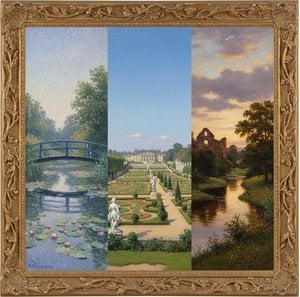
The Enigmatic Garden: George Frederic Watts’ ‘Eve Tempted’
George Frederic Watts' “Eve Tempted,” painted in 1884, isn’t merely a depiction of the biblical Fall; it’s a profound exploration of human desire, vulnerability, and the fraught relationship between innocence and experience. Created during a period when Symbolism was challenging academic realism, Watts eschewed straightforward narrative for a richly layered allegory, inviting viewers to contemplate the complexities of choice and its consequences. The painting immediately draws the eye with its dramatic lighting – a stark contrast between the shadowed depths of the garden and the luminous glow surrounding Eve – suggesting a world poised on the brink of revelation, both alluring and terrifying.

A Victorian Vision: Style, Technique, and Influences
Watts was deeply rooted in the artistic traditions of his time, yet he forged a distinctly personal style. “Eve Tempted” exemplifies this fusion. The composition is heavily influenced by Renaissance painting, particularly Botticelli’s “Primavera,” evident in the graceful pose of Eve and the lush, almost dreamlike quality of the foliage. However, Watts departs from traditional idealism, imbuing the scene with a palpable sense of melancholy and foreboding. His technique is characterized by meticulous detail – observe the intricate folds of Eve's dress, the delicate texture of the fruit, and the subtle variations in color—combined with a masterful use of chiaroscuro (the dramatic contrast between light and dark). The painting’s palette leans towards somber hues: deep greens, browns, and purples dominate, punctuated by the vibrant red of the apple, which acts as a visual focal point, radiating both temptation and danger. Watts' earlier exposure to Elgin Marbles also informed his work, particularly in the idealized forms of the figures.
Symbolism Unveiled: The Language of the Garden
Beyond the immediate narrative of the Fall, “Eve Tempted” is saturated with symbolic meaning. The garden itself represents Paradise, a state of blissful innocence and harmony. The dog beneath the tree – often interpreted as representing primal instinct or even Satan—watches over the scene, suggesting the ever-present threat to this idyllic existence. Eve’s posture, with one hand shielding her face and the other holding the apple, embodies both shame and defiance. Her nudity isn't presented as overtly sensual but rather as a symbol of vulnerability and exposure – she is stripped bare not just physically, but emotionally and spiritually. The apple itself is laden with symbolism: it represents knowledge, transgression, and the potential for both enlightenment and destruction. The surrounding flowers—particularly lilies, associated with purity—are subtly corrupted by the presence of the forbidden fruit, hinting at the irreversible nature of Eve’s choice.
A Portrait of Victorian Emotion
“Eve Tempted” is more than just a biblical illustration; it's a powerful depiction of Victorian sensibilities – a period characterized by intense introspection, moral anxieties, and a fascination with hidden emotions. Watts was deeply concerned with the psychological complexities of his subjects, and this painting reflects that preoccupation. The scene evokes a sense of quiet desperation, capturing the moment before the irrevocable fall. It’s a poignant meditation on human nature, exploring themes of temptation, guilt, and the enduring struggle between good and evil. The painting's emotional resonance continues to captivate viewers today, offering a timeless reflection on the choices we make and their lasting consequences. The work speaks to the universal experience of confronting difficult truths and navigating the complexities of our own desires.
Spørsmål og svar
Hva er "Eve Tempted" laget med, og i hvilken stil?
"Eve Tempted" er utført i Acrylic On Canvas, i Symbolist Movement-stil.
Hvilken følelse er "Eve Tempted" forbundet med?
"Eve Tempted" er forbundet med en Melancholic følelse. Den emosjonelle tonen beskriver inntrykket verket gir.
Finnes det en guide for "Eve Tempted" av George Frederic Watts?
En Veiledning-side er tilgjengelig for "Eve Tempted" av George Frederic Watts: et utskrivbart faktablad om kunstverket, designet for studenter og bruk i klasserommet.



 Se i rommet
 Bestill håndmalt reproduksjon
 Del som digitalt kort
 Del
Del
 Detaljer
 Studentguide

 Last ned
 Liknende objekter
 Røntgen
 Lysbildefremvisning
 Besøksstatistikk


 Les mer






































 Glassalternativet er kun tilgjengelig i størrelser under 110 cm