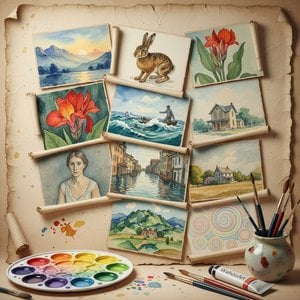
A Life Painted in Nonsense and Light
Edward Lear, a name inextricably linked with whimsical verse and delightfully peculiar illustrations, was far more than simply the purveyor of limericks and fantastical creatures that often define his legacy. Born in 1812 in Holloway, North London, into a family teeming with twenty-one children – a veritable whirlwind of siblings – Lear’s early life was profoundly shaped by both financial instability and an undeniable artistic talent. His father, Jeremiah Lear, faced considerable hardship following the Napoleonic Wars, forcing young Edward to begin earning a living through his drawings at the tender age of fifteen. This necessity, however, ignited a lifelong passion that would propel him across continents, capturing the world in vibrant hues and playful lines. The shadow of familial difficulty – compounded by early health challenges including epilepsy and bouts of melancholia he himself termed “the Morbids” – instilled within Lear a gentle solitude and an inclination towards imaginative escape; qualities that are profoundly reflected in his art and writing.
From Ornithological Precision to Landscape’s Embrace
Lear's artistic journey began with a remarkable level of precision. Initially employed by the Zoological Society, he honed his skills illustrating birds and animals, demonstrating a truly exceptional eye for detail and anatomical accuracy. This early work brought him to the attention of Edward Stanley, the 13th Earl of Derby, who commissioned Lear to meticulously document the exotic creatures residing within his private menagerie at Knowsley Hall. These years spent amongst lions, tigers, and parrots were not merely a job; they fostered a deep and enduring connection with the natural world – a connection that would become a cornerstone of his later landscape paintings. The demanding nature of this work, however, coupled with increasingly debilitating eyesight and respiratory issues, eventually led him away from the exacting demands of ornithological illustration. He turned instead to landscape painting, embarking on extensive travels throughout Europe and beyond, seeking respite for his health and inspiration for his art. Italy became a particular haven – not only offering a restorative environment but also providing an abundance of breathtaking vistas that would inform his artistic vision. His landscapes are characterized by a unique blend of topographical accuracy and atmospheric sensitivity; he masterfully captured the subtle nuances of light and shadow, creating images that possess both realism and a dreamlike quality.
The Poet of Nonsense: A World Unbound
While celebrated as a painter, it is perhaps for his literary contributions that Edward Lear is most widely remembered. His “nonsense” poetry – particularly his limericks – revolutionized children’s literature and captivated audiences of all ages. *A Book of Nonsense*, published in 1846 under the pseudonym "Derry down Derry," introduced a world populated by owls and pussycats sailing in pea-green boats, dongs with luminous noses, and other delightfully absurd creations. These verses weren’t merely frivolous; they were imbued with a subtle melancholy and a playful subversion of conventional logic. Lear didn't simply invent nonsense words; he crafted entire worlds governed by their own internal rules, inviting readers to suspend disbelief and embrace the joy of imagination. His limericks, in particular, are renowned for their rhythmic precision and unexpected twists. *The Owl and the Pussy-Cat*, arguably his most famous poem, remains a beloved classic, its enduring appeal stemming from its lyrical rhythm and evocative imagery. The poem’s gentle humor and whimsical characters continue to delight readers of all ages.
Influences and Artistic Development
- Early Influences: Lear’s initial artistic training focused on scientific illustration, demanding precision and observation. This foundation shaped his meticulous approach to detail, even as he later embraced more expressive styles.
- Travel & Landscape Painting: His extensive travels through Italy, Greece, Egypt, and beyond profoundly influenced his landscape work. He absorbed the light, colors, and textures of these diverse regions, developing a distinctive style characterized by atmospheric perspective and delicate brushwork.
- Literary Inspiration: While he popularized the limerick, Lear was also inspired by earlier nonsense verse traditions. His unique contribution lay in his ability to imbue this form with emotional depth and lyrical beauty.
- Personal Experiences: Lear’s lifelong struggles with health issues and melancholy deeply informed his artistic vision. The sense of isolation and longing that permeates much of his work reflects his own personal experiences.
A Legacy of Innovation and Enduring Charm
Edward Lear's influence extends far beyond the realm of children's literature. He pioneered a new form of poetic expression, liberating verse from rigid structures and embracing playful experimentation. His landscapes, though often overshadowed by his poetry, demonstrate a keen artistic sensibility and a mastery of watercolor technique. He was a true polymath – artist, illustrator, musician (he composed musical settings for Tennyson’s poems), author, and poet – whose diverse talents converged to create a unique and enduring legacy. He challenged conventional boundaries, blurring the lines between art, literature, and music. His work continues to inspire artists, writers, and dreamers alike, reminding us of the power of imagination and the beauty of embracing the absurd. His paintings can be found in esteemed collections like The Ashmolean Museum, Oxford, a testament to his skill as a landscape artist. Lear’s life, marked by both personal struggles and creative triumphs, serves as a poignant reminder that even amidst darkness, there is always room for light, laughter, and the boundless possibilities of the human spirit.



 Se i rommet
 Bytt til trykkversjon
 Del som digitalt kort
 Del
Del
 Detaljer
 Studentguide

 Last ned
 Liknende objekter
 Røntgen
 Lysbildefremvisning
 Besøksstatistikk
 Les mer






































 Glassalternativet er kun tilgjengelig i størrelser under 110 cm