Kunstnerbiografi
A Life Rooted in Craft: The Early Years of Edward Bird
Edward Bird’s artistic journey began far from the grand studios of London, nestled within the bustling workshops of Wolverhampton in 1772. His father, a carpenter, instilled in him not just the practical skills of woodworking but also an appreciation for meticulous craftsmanship – a foundation that would profoundly shape his approach to art. Initially apprenticed as a japanning artist, Edward’s hands became intimately familiar with the delicate process of applying decorative designs onto tea trays and other household items. This early training demanded an extraordinary level of precision, patience, and an eye for detail; it was a far cry from the sweeping narratives of history painting he would later master, yet it provided him with invaluable skills that underpinned his entire artistic career. The intricate patterns and vibrant colors he learned in this workshop laid the groundwork for his distinctive style – a subtle blend of realism and decorative flair.
The Bristol School and Artistic Flourishing
In 1794, seeking new horizons and opportunities, Edward moved to Bristol, a thriving port city brimming with artistic energy. It was here that he truly began to forge his own path as an independent artist, accepting commissions ranging from intimate portraiture capturing the likenesses of local gentry to elaborate illustrations for books and decorative paintings adorning the walls of churches throughout the region. This period marked a crucial transition – a move away from purely functional craftsmanship towards a more expressive artistic vocation. Crucially, Bristol became part of an informal artistic community known as the “Bristol School,” a loosely organized collective of artists united by a shared spirit of experimentation and mutual encouragement. Figures like Edward Villiers Rippingille and Nathan Cooper Branwhite were key members, creating a vibrant exchange of ideas and techniques. The Bristol School wasn’t governed by a formal academy but thrived on open dialogue and collaborative exploration – a dynamic environment where artistic boundaries were gently pushed and new approaches were constantly being tested.
A particularly influential figure in Bird's life was George Cumberland, an art collector and connoisseur whose extensive library and collection provided him with unparalleled access to the works of Old Masters. Cumberland’s patronage profoundly impacted Bird’s artistic development, exposing him to a vast range of styles and inspiring him to refine his own aesthetic sensibilities. The influence of artists like Rembrandt and Poussin became palpable in Bird's later work, subtly informing his color palettes and compositional choices. This access to the classics fostered a deep understanding of artistic principles while simultaneously encouraging Bird to develop his unique voice.
Recognition in London and a Shift to Historical Themes
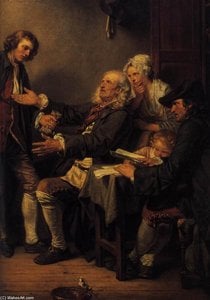
The year 1809 proved to be a watershed moment in Edward Bird’s career. His submission to the Royal Academy, titled “Good News,” immediately garnered critical acclaim and commercial success. The painting's compelling narrative, its skillful execution, and its evocative portrayal of human emotion resonated deeply with both critics and collectors alike. This initial triumph propelled Bird into the spotlight, attracting attention from influential figures within London’s art world. He quickly followed up this success with other notable works – “Choristers rehearsing” and “The Cheat Detected” – further solidifying his reputation as a talented and promising artist. The Royal Academy recognized his growing stature by offering him an Associate membership in 1812, a significant honor that signaled the acceptance of his artistic merit within the established art community.
Building upon this momentum, Bird increasingly turned his attention to history painting, a genre that demanded both technical virtuosity and a profound understanding of narrative. He tackled ambitious historical scenes – battles, courtly events, and moments of dramatic significance – often incorporating elements of genre painting to create works that were both visually stunning and emotionally engaging. Paintings such as “The Field of Chevy Chase” and “The Day After the Battle” showcased his growing ability to capture the intensity and emotional weight of these historical narratives. These large-scale compositions required considerable skill in rendering complex scenes, managing perspective, and conveying a sense of scale and drama.
Later Years, Legacy, and Artistic Style
Despite achieving significant success and recognition, Edward Bird’s later years were marked by challenges – both personal and artistic. The demands of producing large historical paintings took a toll on his health, and he struggled to maintain the same level of creative energy that had characterized his earlier work. However, even in his declining years, Bird continued to produce notable works, including “Christ led to be crucified” and “The Burning of Bishops Ridley and Lattimer.” His final historical painting, "Embarcation of the French King," was particularly ambitious, requiring him to commission numerous portraits from various individuals – a testament to his dedication and artistic vision. Tragically, Edward Bird passed away on November 2nd, 1819, leaving behind a legacy that continues to be celebrated today. His work is now housed in major British museums, serving as a powerful reminder of the Bristol School’s contribution to British art history. Edward Bird's influence extends beyond his individual achievements; he played a crucial role in fostering artistic innovation and collaboration within the Bristol School, inspiring generations of artists who embraced naturalism and sought to capture the authenticity of everyday life. His distinctive style – characterized by its meticulous detail, vibrant colors, and skillful blending of genre and history painting – remains a testament to his unique talent and enduring legacy.



 Se i rommet
 Bytt til trykkversjon
 Del som digitalt kort
 Del
Del
 Detaljer
 Studentguide

 Last ned
 Liknende objekter
 Røntgen
 Lysbildefremvisning
 Besøksstatistikk
 Les mer