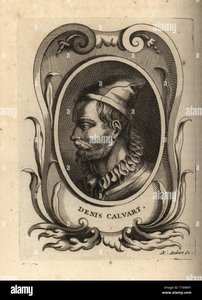
The Flemish Master of Bologna
Denys Calvaert, known in Italy as Dionisio Fiammingo or simply Il Fiammingo, stands as a remarkable bridge between the northern traditions of his native Antwerp and the refined elegance of the Italian Renaissance. Born in Antwerp, Belgium, Calvaert began his artistic journey by studying landscape painting under Christiaen van Queckborne. However, it was his migration to Italy that would ultimately define his legacy. Settling in Bologna around 1561 or 1562, he immersed himself in the local artistic currents, apprenticing under masters such as Prospero Fontana and Lorenzo Sabatini. This unique fusion of Flemish precision and Italian grace allowed him to develop a style that was both technically rigorous and emotionally resonant.
His career reached significant heights during his time in Rome, where he assisted Lorenzo Sabatini in the monumental task of decorating the Sala Regia in the Vatican. During this period, Calvaert devoted himself to the study of the masters, making numerous drawings after the works of Raphael Sanzio and Michelangelo. This deep engagement with Roman and Tuscan Mannerism profoundly shaped his aesthetic, infusing his compositions with a sophisticated sense of drama and anatomical accuracy. Despite the allure of the competitive Roman art scene, Calvaert chose to return to Bologna in 1575, where he would establish himself as a cornerstone of the local artistic community.
A Legacy of Instruction and Innovation
Beyond his individual canvases, Calvaert’s historical significance is cemented by his role as an educator and the founder of a prestigious academy in Bologna. His studio became a crucible for the next generation of great painters, nurturing talents that would go on to define the Baroque era. Among his most illustrious pupils were:
- Guido Reni
- Domenichino
- Francesco Albani
While many of these students eventually migrated to the Accademia degli Incamminati founded by the Carracci, the foundational training they received under Calvaert was instrumental in their development. His teaching emphasized a profound understanding of architecture, anatomy, and history, ensuring that his students possessed the technical mastery required for large-scale religious and mythological commissions.
Calvaert’s own oeuvre is celebrated for its advanced composition and masterful use of color. He frequently employed chiaroscuro techniques to sculpt figures from deep shadows, creating a sense of volume and presence that felt almost tactile. His works often juxtaposed stylized foreground figures—inspired by the soft, emotive qualities of Correggio—against sweeping, atmospheric Northern European landscapes. This interplay of light and landscape, combined with a color palette influenced by Barocci, allowed him to create much more than mere religious tableaux; he crafted windows into a realm where the earthly and the divine seamlessly converge.



 Se i rommet
 Bytt til trykkversjon
 Del som digitalt kort
 Del
Del
 Detaljer
 Studentguide

 Last ned
 Liknende objekter
 Røntgen
 Lysbildefremvisning
 Besøksstatistikk


 Les mer






































 Glassalternativet er kun tilgjengelig i størrelser under 110 cm