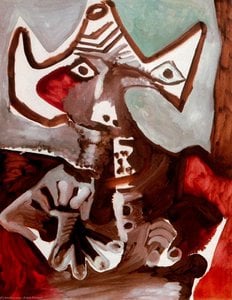
Kunstverket som vises på denne siden er beskyttet av opphavsretten, noe som betyr at vi ikke har juridisk tillatelse til å lage eller selge identiske reproduksjoner. Denne beskyttelsen håndheves i henhold til internasjonale avtaler som for eksempel Bernerkonvensjonen og av nasjonale lover, inkludert de som er fastsatt i Amerikansk lov om opphavsrett – Tittel 17.
Denne metoden er i fullt samsvar med opphavsrettslige regler, da den ikke innebærer kopiering eller duplisering av det beskyttede kunstverket. I stedet er det snakk om en kreativ nytolkning – et nytt maleri som er inspirert av originalen, men ikke identisk med den.
Giclée- eller lerretsprint av museumskvalitet med rask produksjon og fleksible valgmuligheter for etterbehandling. ( Kjøp håndmalt maleri Bytt til digitalt bilde)
Velg mellom våre forhåndsdefinerte størrelser som bevarer kunstverkets opprinnelige proporsjoner.

Skriv inn ønsket bredde og høyde for å tilpasse trykket til din ramme eller vegg. Et trykk kan kun beskjæres, aldri skaleres opp utover motivets opprinnelige størrelse, noe som betyr at et format med andre proporsjoner vil føre til tap av deler av bildet. Vi sender deg en digital mockup for godkjenning før vi starter trykkeprosessen. Bildet som vises på denne siden viser ikke den faktiske beskjæringen — det er kun mockuppen som viser dette.
Verdensomspennende levering () på 2 uker i stedet for standard 4/5 uker. (8 November)
Vertical Amnesia
Størrelse på reproduksjon

In the vibrant, often jarring landscape of late twentieth-century American art, few voices resonated with as much psychological depth and formal precision as Christina Ramberg. Born in 1946 on the Kentucky military base of Camp Campbell, Ramberg’s early years were defined by a nomadic existence, shaped by her father’s service in the United States Army. This transient childhood, which saw her living in diverse locales such as Yokohama, Japan, and various regions of Germany, instilled in her an international perspective that would later inform the layered, culturally complex imagery of her work. Her journey eventually led her to the School of the Art Institute of Chicago (SAIC), a destination that would become the crucible for her artistic identity.
It was within the halls of SAIC that Ramberg encountered the transformative influence of Ray Yoshida. A mentor of profound significance, Yoshida encouraged his students to look beyond the traditional canons of fine art, urging them to find inspiration in the ubiquitous textures of popular culture—from the gritty lines of underground comic books to the glossy surfaces of commercial magazines. This pedagogical freedom allowed Ramseb to develop a visual language that was simultaneously high-art and pop-inflected, blending the meticulousness of classical draftsmanship with the subversive energy of Pop Art and Surrealism.
Ramberg’s oeuvre is most famously associated with the Chicago Imagists, a group of artists who rejected the prevailing trends of Minimalism and Conceptualism in favor of a more representational, often visceral, approach to painting. Her work became a profound interrogation of the female form, yet she avoided the clichés of traditional portraiture. Instead, she focused on partial bodies—heads, torsos, and hands—often presented in states of tension or compression. Through her use of bold geometric shapes and a highly controlled, almost clinical technique, she depicted figures encased in mid-century undergarments, such as corsets and girdles.
These garments were not merely clothing; they functioned as architectural metaphors for societal expectations. The way the fabric pressed against the skin or constrained the limbs served to illustrate a sense of female vulnerability and the psychological weight of gendered norms. Her compositions often possessed an eerie, dreamlike quality, where the boundaries between the organic body and the rigid, manufactured object became blurred. This tension created a unique brand of Pop Surrealism, where the familiar objects of domesticity were reimagined as instruments of both adornment and entrapment.
The significance of Christina Ramberg lies in her ability to navigate the intersection of the personal and the political without sacrificing aesthetic beauty. While her work touched upon the burgeoning feminist discourses of the 1970s, it did so through a sophisticated lens of abstraction and formal experimentation. She did not merely depict struggle; she sculpted it into the very fabric of her compositions.
Throughout her career, Ramberg achieved remarkable milestones that cemented her place in art history:
Though her life was tragically cut short in 1995, Ramberg’s impact remains indelible. Her paintings continue to challenge viewers to contemplate the structures—both physical and social—that shape our identities. In every meticulously rendered line and every compressed silhouette, her work stands as a testament to the enduring power of art to expose the complexities of the human condition.

1946 - 1995 , United States of America
 Forhåndsvisning
 Send
Send Del
Del
 Vis detaljer
 Utskriftsvennlig guide

 Last ned bilde
 Liknende objekter
 Røntgenundersøkelse
 Lysbildefremvisning
 Spørsmål og svar
 Statistikk

 Vis hele teksten






































 Glassalternativet er kun tilgjengelig i størrelser under 110 cm