


x

 Bestill maleri Kjøp digitalt bilde
 Send
Send
 Detaljer
 Legg til i favoritter
 Last ned bildet
 Liknende objekter
 Røntgen
 Lysbildefremvisning
 BronzeSculptureClassical Modern Sculpture
 1962
1962 129.0 x 235.0 cm
 Kimbell Kunstmuseum
Giclée- eller lerretsprint av museumskvalitet med rask produksjon og fleksible valgmuligheter for etterbehandling.
Velg mellom våre forhåndsdefinerte størrelser som bevarer kunstverkets opprinnelige proporsjoner.

Du kan oppgi egne mål for å tilpasse en spesifikk ramme eller et bestemt område. Dersom den valgte størrelsen ikke samsvarer med det originale bildets proporsjoner, vil vi enten beskjære kunstverket eller utvide bildet med en speilet eller ensfarget kant. En digital mockup vil bli sendt til din godkjenning før produksjonen starter.
Vennligst merk at forhåndsvisningen på skjermen ikke gjenspeiler den faktiske beskjæringen eller utvidelsen. Kun mockuppen vil vise den endelige komposisjonen nøyaktig.
Selv om tilpassede størrelser er tilgjengelige, anbefaler vi å velge et mål fra den forhåndsdefinerte listen for å bevare de originale proporsjonene.
Verdensomspennende levering () på 2 uker i stedet for standard 4/5 uker. (2 July)


L
Størrelse på reproduksjon
Aristide Maillol's "L’Air," conceived in 1938 and cast in bronze in 1962, is more than just a sculpture; it’s an embodiment of timeless grace and a poignant meditation on the human form. This remarkable piece, currently housed within the Kimbell Art Museum’s Louis Kahn-designed courtyard, invites viewers into a world where classical ideals intertwine with a profound sense of quietude. Maillol, a pivotal figure bridging Symbolism and early 20th-century sculpture, wasn't interested in dramatic gestures or overt emotion; instead, he sought to distill the essence of beauty – a pursuit evident in every carefully considered curve and line of “L’Air.” The work represents one of eight bronze and lead sculptures corresponding to the stone figure for a monument commissioned from Maillol by the city of Toulouse, France. It honors the crew of the hydroplane Croix du Sud, which left on December 7, 1936 for the twenty-fourth trans-atlantic crossing of a newly established mail service between France and South America, and disappeared after take-off.
The sculpture depicts a woman reclining gracefully on her right hip, one arm extended outward as if embracing the unseen currents of air. Her posture is remarkably balanced – a subtle tension suggesting both repose and readiness. Maillol’s genius lies in his ability to capture this delicate equilibrium, creating an image that feels simultaneously static and dynamic. The drapery, rendered with exquisite detail, flows around her form like liquid metal, subtly hinting at movement without resorting to overt dynamism. This deliberate restraint is a hallmark of Maillol's style; he believed that true beauty resided not in the depiction of action but in the contemplation of stillness.
Maillol’s artistic journey was deeply rooted in classical antiquity, particularly the sculptures of ancient Greece and Rome. He spent considerable time studying these masterpieces during his travels to Italy and Greece, absorbing their principles of proportion, balance, and idealized beauty. “L’Air” is a testament to this influence; its form echoes the serene elegance of Greek statues, while its subtle sensuality hints at Roman portraiture. However, Maillol wasn't merely replicating classical forms; he was reinterpreting them through his own unique vision. He stripped away unnecessary ornamentation and focused on capturing the essential qualities of the human figure – its inherent dignity, strength, and vulnerability.
As art historian John Rewald noted, Maillol’s approach involved “cutting up a version of the figure he had already developed for the Cézanne monument and subtly rearranging the parts.” This process demonstrates his meticulous attention to detail and his willingness to experiment with form. The resulting sculpture is remarkably original, possessing an undeniable sense of freshness and vitality despite its classical inspiration.
“L’Air” is cast in bronze, a material that Maillol favored for its ability to capture subtle nuances of texture and tone. The surface of the sculpture is remarkably smooth, achieved through a painstaking process of polishing and burnishing. This smoothness contributes significantly to the work's overall sense of serenity, creating an illusion of weightlessness and ethereal beauty. Interestingly, the bronze was cast alongside lead alloy, which gives the sculpture an exceptionally light, soft surface.
The choice of bronze also reflects Maillol’s interest in decorative arts. He considered himself a sculptor-decorator, believing that his work should be both aesthetically pleasing and technically proficient. The meticulous craftsmanship evident in “L’Air” is a testament to this philosophy. The sculpture's dimensions are 130 cm × 240 cm × 93.3 cm (50 in × 94 in × 36+3⁄4 in).
Beyond its formal qualities, “L’Air” is rich in symbolism. The reclining figure evokes a sense of vulnerability and introspection, inviting viewers to contemplate the mysteries of existence. The extended arm suggests a yearning for connection or perhaps an embrace of the unknown. The sculpture's title, "L'Air," further reinforces this theme, suggesting a relationship between the human form and the natural world – a harmonious balance between inner stillness and outer movement.
Ultimately, “L’Air” is a work that transcends its material form to evoke a profound emotional response. It speaks to our deepest desires for beauty, tranquility, and connection—a timeless testament to Maillol's enduring artistic vision. The sculpture’s placement within the Kimbell Art Museum’s courtyard creates an especially contemplative setting, allowing viewers to fully appreciate the work’s serene power.


1861 - 1944 , Frankrike

Explore the rich history & enduring appeal of bronze sculpture with expert insights for collectors. Learn about casting techniques, iconic artists, collecting tips & contemporary interpretations at WahooArt.

Utforsk bronseskulpturers fascinerende historie og teknikker. Ekspertinnsikt for kunstsamlere, investeringstips og moderne tolkninger. Lær mer nå!
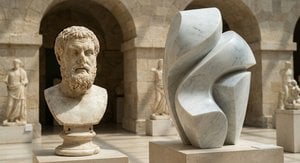
Explore the captivating history of marble sculpture from ancient Greece to modern art. Discover renowned artists like Canova & Michelangelo, carving techniques, and investment insights at WahooArt.

Explore the rich history & enduring appeal of bronze sculpture with expert insights for collectors at WahooArt. Learn about casting techniques, iconic artists, and collecting tips to build a discerning art collection.

Explore the rich history & enduring appeal of bronze sculpture with expert insights for collectors at WahooArt. Learn about casting techniques, iconic artists, and collecting tips.


Hold deg oppdatert med de siste kunstnyhetene, eksklusive tilbud og dekorasjonsideer.
Fortell oss om prosjektet ditt, så vil våre kunsteksperter gi deg 3 personlige kunstforslag.
Vi velger ut 3 alternativer kun for deg – helt gratis!

 Del med andre

 Vis hele teksten




































 Glassalternativet er kun tilgjengelig i størrelser under 110 cm


