


Met de hand geschilderd in olieverf op canvas in uw gewenste maat en lijst, op bestelling gemaakt door onze kunstenaars. ( Bestel print Koop afbeelding)
Kies uit onze vooraf ingestelde maten die overeenkomen met de originele verhoudingen van het kunstwerk.

U kunt uw eigen afmetingen invoeren om in een specifieke lijst of ruimte te passen. Als de door u gekozen maat niet overeenkomt met de verhoudingen van het originele beeld, zullen we het kunstwerk bijsnijden of het schilderij uitbreiden met extra handgeschilderde elementen. Een digitale mockup wordt ter goedkeuring naar u verzonden voordat de productie begint.
Houd er rekening mee dat de preview op het scherm niet de werkelijke uitsnede of uitbreiding weergeeft. Alleen de mockup toont de uiteindelijke compositie nauwkeurig.
Hoewel aangepaste afmetingen mogelijk zijn, raden we aan een maat uit de vooraf gedefinieerde lijst te selecteren om de originele verhoudingen te behouden.
Wereldwijde levering () binnen 3 tot 4 weken in plaats van de standaard 5 weken. (7 september). Zonder concessies aan de kwaliteit.


A Harlot's Progress, plate 1
Afmetingen reproductie
William Hogarth's “A Harlot’s Progress,” specifically Plate 1, stands as a cornerstone of English art history and social commentary. Executed in etching and engraving on copper around 1730-31, this print transcends mere visual representation; it’s a meticulously crafted narrative designed to provoke reflection on societal hypocrisy and the perilous path toward moral decline.
The composition itself is deliberately unsettling. A crowded street dominates the background, populated by figures engaged in various activities – a gentleman observing the unfolding drama from horseback, an older woman attempting to offer guidance (perhaps subtly manipulative), and Hackabout herself, vulnerable and exposed. The arched doorway above serves as a visual barrier, emphasizing the isolation of Hackabout’s predicament.
Beyond its narrative content, “A Harlot’s Progress” is laden with symbolic significance. The older woman embodies temptation and exploitation—a critique of societal institutions that fail to protect vulnerable individuals. The horseman represents authority and power, highlighting the disparity between those who uphold moral standards and those who succumb to vice. Hogarth's intention wasn’t merely to depict a scandalous affair; he aimed to expose the corrosive effects of social pressures on individual conscience.
The print’s emotional impact is palpable—a blend of observation, pity, and judgment. It compels viewers to confront uncomfortable truths about human behavior and societal failings. Hogarth's stylistic choices – his meticulous attention to detail, his dramatic use of light and shadow, and his unflinching portrayal of moral decay – cemented “A Harlot’s Progress,” Plate 1 as a seminal work of English art and continues to resonate with audiences today.


1697 - 1764 , Verenigd Koninkrijk

Explore the profound artistry of black and white photography. From historical mastery to the interplay of light and shadow, discover how monochrome captures timeless emotion and form through a sophisticated lens of art history.

Master the nuances of Giclée printing with our expert guide. Discover how pigment-based inks and museum-grade substrates create fade-resistant, high-fidelity art reproductions designed for discerning collectors seeking unparalleled quality and longevity.
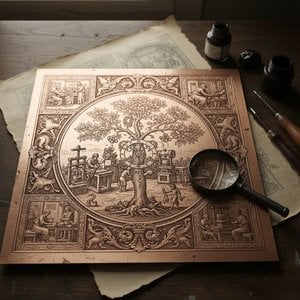
Explore the intricate world of etching and intaglio printmaking. Discover how masters use acid and metal to create profound textures and lines, from Romanticism to modern era, through an expert lens of art history and technical mastery.

 Voorvertoning
 Verstuur
 Delen
Delen
 Details bekijken

 Download
 Vergelijkbare items
 Röntgenonderzoek
 Diavoorstelling

 Lees meer




































 De optie voor glas is alleen beschikbaar bij een formaat kleiner dan 110 cm.


