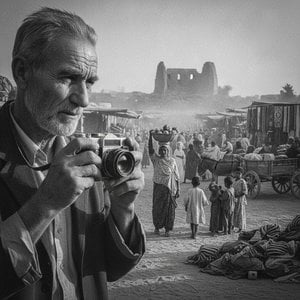
The Poetic Lens of Wojciech Prażmowski
Wojciech Prażmowski stands as a singular figure in Polish art history, blending a profound sense of historical observation with an artistic vision that explores the intersection of industrial heritage and natural forms. Born in 1953 in Częstochowa, Poland, his journey into the visual arts was shaped by a life lived through significant historical transitions. While his early years were marked by the discipline of his surroundings, his professional transition to photography in the late 1980s allowed him to develop a distinctive voice—one that captures the quiet beauty hidden within seemingly unremarkable locations. His work does not merely document; it breathes life into the textures, patterns, and colors often overlooked by the casual observer, elevating industrial landscapes into canvases of poetic contemplation.
The essence of Prażmowski’s practice lies in his ability to find vanishing points—those transient elements in the landscape, small-scale architecture, and urban decorations that mark the passage of time. His early interest in documentary photography, particularly his series documenting Jewish cemeteries, demonstrated an early mastery of moving beyond simple record-keeping toward a more symbolic, evocative form of art. By endowing his subjects with pathos, he transformed the photographic medium into a tool for exploring memory and decay. This evolution reached a pinnacle during his "creative photography" period, where the focus shifted from what is seen to how it is felt, often utilizing traditional silver bromide techniques and sepia toners to imbende his prints with an archival, nostalgic quality.
Industrial Landscapes and Symbolic Narratives
A defining characteristic of Prażmowski’s oeuvre is his fascination with the remnants of Poland's industrial past. He possesses a rare talent for capturing the stark beauty of industrial sites, treating them not as eyesores of a bygone era, but as monumental sculptures. His work often explores the tension between the man-made and the organic, finding a rhythmic harmony in the decay of steel, concrete, and stone. This approach is perhaps most famously realized in his celebrated series, “White-Red-Black,” published around 1999. In this collection, featuring photographs of sculptural benches in Siąporków and Starachowice, he utilizes a striking black and white palette juxtaposed against bold typographic elements.
These works serve as more than mere images; they are meditations on identity and permanence. The use of high contrast and meticulous composition allows the viewer to engage with the formal qualities of the objects—the curve of a bench, the texture of a surface—while simultaneously contemplating the historical weight they carry. Through his lens, the following themes emerge as central to his artistic legacy:
- The Passage of Time: A relentless focus on how decay and transformation endow objects with a new, dignified beauty.
- Industrial Heritage: The elevation of post-communist landscapes into sites of aesthetic and historical significance.
- Visual Contrast: The deliberate use of stark monochrome tones to highlight the structural elegance of his subjects.
- Symbolic Documentation: Moving beyond the literal to find the spiritual or emotional resonance within everyday, provincial reality.
A Legacy of Observation
The historical significance of Wojciech Prażmowski lies in his ability to act as a visual chronicler of a changing nation. As Poland transitioned through the turn of the 21st century, his photography captured the "vanishing points" of a disappearing world. His work resonates with the philosophy that photography is a mournful, decadent art—a testimony to the merciless process of passing away. By focusing on the small-scale and the overlooked, he has provided a vital archive of the textures and symbols that define Polish cultural memory.
Through his exhibitions in galleries from Warsaw to Berlin, Prażmowski has solidified his reputation as an artist who finds the extraordinary within the ordinary. His mastery of light, shadow, and composition ensures that his photographs remain timeless, inviting every viewer to pause and find beauty in the weathered, the worn, and the forgotten. He remains a master of the quiet moment, proving that even the most industrial of landscapes can hold a profound, poetic truth.
Questions & Answers
Where are Wojciech Prażmowski's artworks mapped by subject?
Wojciech Prażmowski's works can be explored by subject on the artist's Subject Atlas page.
Can I browse Wojciech Prażmowski's works by medium?
Wojciech Prażmowski's works can be browsed by medium on the artist's All Medium page.
Where can I see Wojciech Prażmowski's artworks in a 3D gallery?
A virtual visit is possible: the 3D Museum page of Wojciech Prażmowski presents the artist's works in a three-dimensional gallery.
Is there a complete list of Wojciech Prażmowski's artworks?
Every work by Wojciech Prażmowski on this website can be browsed from the artist's All Artworks page.
How popular are Wojciech Prażmowski's artworks?
Statistics about Wojciech Prażmowski's works are available on the artist's Stats page.
Can I sort Wojciech Prażmowski's artworks by color?
The Spectral Index page organizes Wojciech Prażmowski's artworks by color.
Where is Wojciech Prażmowski from?
Wojciech Prażmowski was born in Poland.
How many artworks by Wojciech Prażmowski are available to browse?
You can browse 11 artworks by Wojciech Prażmowski on the All Artworks page.