Bekijk op ware grootte Bekijk in AR Schakel over naar print Schakel over naar digitale afbeeldingen Verstuur
Details bekijken Gids Toevoegen aan favorieten Download Vergelijkbare items Röntgenonderzoek Diavoorstelling Statistieken

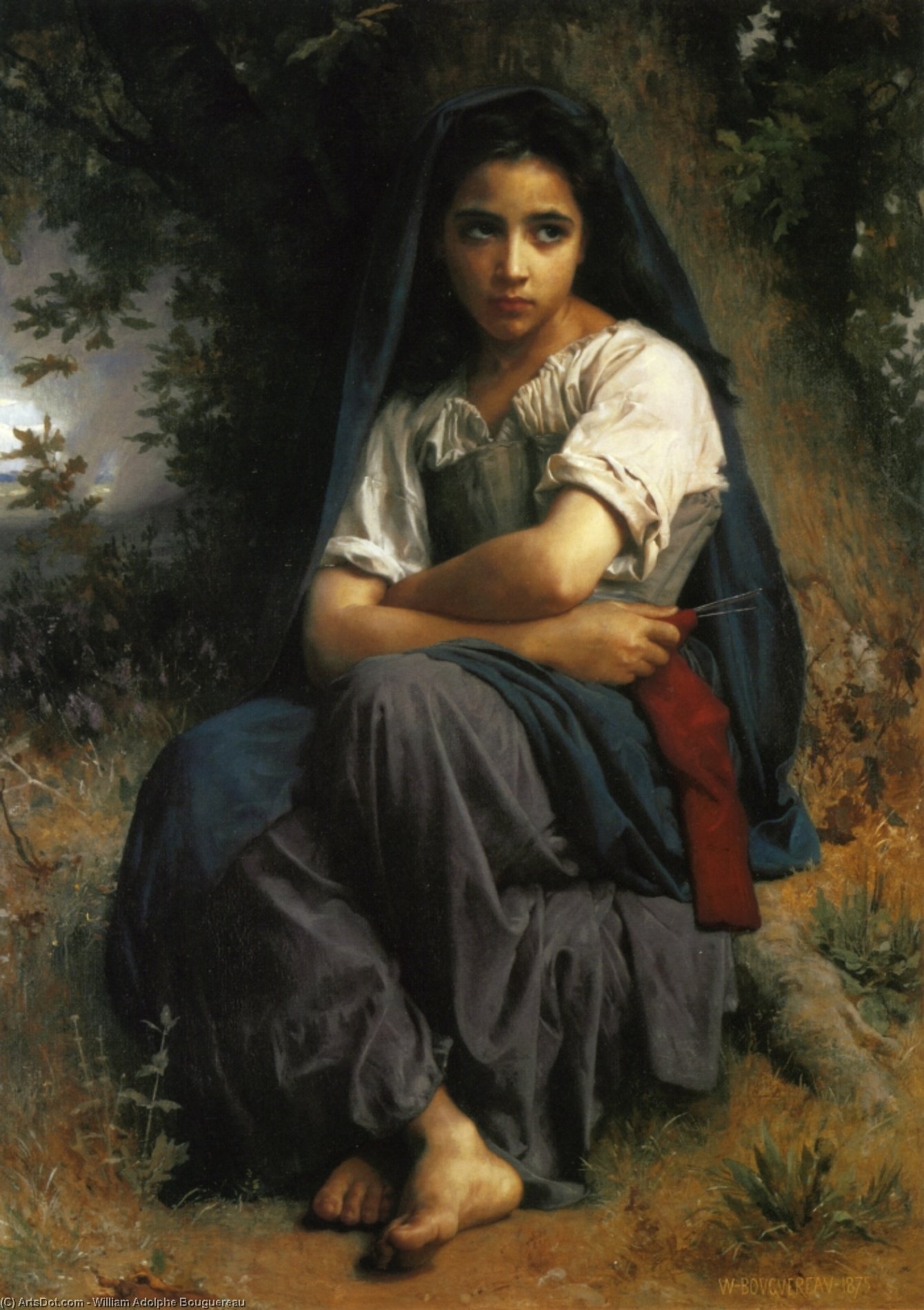
The Little Knitter

Captured in Academicism style by William-Adolphe Bouguereau during the Belle Époque, ‘The Little Knitter’ portrays a serene young girl lost in contemplation amidst dappled sunlight and scattered leaves—a timeless masterpiece inviting you to experience its exquisite beauty.

Ontdek William-Adolphe Bouguereau (1825-1905), een meester van academische realisme! Bewonder zijn prachtige werken met mythologische en genretaferelen, en de ideale weergave van schoonheid.

Handgemaakte olieverfreproductie

Met de hand geschilderd in olieverf op canvas in uw gewenste maat en lijst, op bestelling gemaakt door onze kunstenaars. ( Schakel over naar print Schakel over naar digitale afbeeldingen)

P118B $10
P118H $10
P118W $10
P438Z $10
P508JH $12
P508YH $12
P805H $10
P805Z $10
P919BZ $10
P919G $10
P919XJ $10
P959ZH $10
P968JZ $12
W106C $8
W218G $10
W218JH $8
W218Y $10
W307PJ $10
W316G $10
W316PJ $8
W316Y $10
W398PJ $8
W4111J $10
W500HY $15
W500JH $15
W692G $12
W849H $8
W940BG $15
W953PJ $8

Standaardformaat
op maat gemaakt
CM
INCH

Kies uit onze vooraf ingestelde maten die overeenkomen met de originele verhoudingen van het kunstwerk.

breedte
hoogte

U kunt uw eigen afmetingen invoeren om in een specifieke lijst of ruimte te passen. Als de door u gekozen maat niet overeenkomt met de verhoudingen van het originele beeld, zullen we het kunstwerk bijsnijden of het schilderij uitbreiden met extra handgeschilderde elementen. Een digitale mockup wordt ter goedkeuring naar u verzonden voordat de productie begint.
Houd er rekening mee dat de preview op het scherm niet de werkelijke uitsnede of uitbreiding weergeeft. Alleen de mockup toont de uiteindelijke compositie nauwkeurig.
Hoewel aangepaste afmetingen mogelijk zijn, raden we aan een maat uit de vooraf gedefinieerde lijst te selecteren om de originele verhoudingen te behouden.

Voorbeelden van wat aangepast kan worden: Vervang het gezicht met een eigen foto; Voeg een huisdier toe (bijv. vervang de kat door een hond); Verwerk een verborgen boodschap in de achtergrond; Wijzig het landschap of andere elementen in de achtergrond.
Na de bestelling zal het team van WahooArt.com per e-mail contact opnemen met de klant voor instructies en een mockup-voorbeeld sturen.

Wereldwijde levering () binnen 3 tot 4 weken in plaats van de standaard 5 weken. (22 september). Zonder concessies aan de kwaliteit.

why_choose_icon
Gratis wereldwijde expressverzending
why_choose_icon
Hoogwaardig linnen canvas
why_choose_icon
Volledige verzendverzekering
why_choose_icon
Garantie op terugbetaling van invoerrechten
why_choose_icon
Garantie op exacte kleurweergave
why_choose_icon
Retourbeleid van 100 dagen (alleen bij defecten)
why_choose_icon
100% Geld-terug-garantie
why_choose_icon
Korting bij meerdere afnames

Totaalprijs

$ 272

reproduction

The Little Knitter

Reproductiemethode

Formaat reproductie

-

Totaalprijs

$ 272

Belangrijkste kenmerken

  • Artist: William-Adolphe Bouguereau
  • Title: The Little Knitter
  • Notable elements: Detailed depiction; Tranquil setting
  • Dimensions: 115 x 81 cm
  • Year: 1875
  • Medium: Oil on canvas

A Moment Frozen in Time: The Essence of Innocence

In the quietude of a sun-dappled afternoon, William-Adolphe Bouguereau’s 1875 masterpiece, "The Little Knitter," invites the viewer into a realm of profound serenity and timeless grace. This exquisite oil on canvas serves as more than just a portrait; it is a window into the soul of the Belle Époque, capturing a fleeting moment of childhood contemplation that feels both deeply personal and universally resonant. The painting depicts a young girl seated gently upon the earth, her focus entirely absorbed in the rhythmic, meditative task of knitting. There is an undeniable tenderness in her posture, a soft vulnerability that immediately establishes an emotional bond between the subject and the observer. As she gaz indeed off-camera, her gaze suggests a rich inner world, perhaps lost in a daydream or observing a distant movement in the natural landscape, leaving the viewer to wonder about the thoughts swirling behind her innocent eyes.

The setting, a lush backdrop of verdant trees and scattered leaves, provides a natural sanctuary for this domestic scene. The interplay of light and shadow within the foliage adds a layer of depth and organic beauty, grounding the subject in a realistic yet idealized pastoral environment. For collectors and interior designers alike, this piece offers a sense of tranquility that can transform any space, bringing an air of classical sophistication and peacefulness to a room. It is a work that does not demand attention through loud colors or jarring compositions, but rather earns it through a subtle, magnetic charm that lingers long after the first glance.

The Mastery of Academic Impressionism

Technically, "The Little Knitter" is a triumph of Academic Impressionism, a sophisticated style where Bouguereau masterfully reconciled the rigorous precision of classical tradition with the soft, luminous atmosphere of modern experimentation. His brushwork is nothing short of miraculous; he employs a smooth, polished technique that almost erases the presence of the artist’s hand, creating an ethereal, porcelain-like finish on the girl's skin. This meticulous attention to detail allows for a palpable sense of texture that engages the senses—one can almost feel the weight and softness of the wool scarf wrapped around her head and the delicate, fine weave of her blue dress.

Bouguereau’s palette is a masterclass in subtlety, utilizing muted blues, soft greens, and earthy tones to evoke a serene and harmonious atmosphere. This careful selection of color avoids the harshness of reality, instead leaning into an idealized beauty that was the hallmark of his celebrated career. By blending the structural integrity of the Old Masters—drawing inspiration from the likes of Raphael and Titian—with a more contemporary approach to light and color, Bouguereau created a visual language that feels both historically significant and eternally fresh. For those seeking a high-quality reproduction, this technical brilliance is what makes the painting such a captivating centerpiece for fine art collections.

Symbolism and the Legacy of Virtue

Beyond its aesthetic splendor, "The Little Knitter" is steeped in symbolic meaning, reflecting the moral and social values of late 19th-century France. The act of knitting serves as a powerful metaphor for domesticity, patience, and the quiet transmission of care and tradition from one generation to the next. It represents a nurturing instinct and the beauty found in simple, virtuous labors. In an era of rapid industrialization, Bouguereau’s focus on such a peaceful, domestic vignette offered a nostalgic retreat into a world defined by innocence and moral clarity.

The painting functions as a poignant reminder of the beauty inherent in stillness. In our modern, fast-paced existence, the image of a child lost in a moment of quiet industry offers a much-needed emotional respite. It is this profound psychological truth—the ability of art to capture the sanctity of a single, unhurried moment—that ensures Bouguereau’s enduring legacy. Whether displayed in a private study, a grand salon, or a contemporary living space, "The Little Knitter" continues to inspire awe, serving as a testament to the power of beauty to soothe the spirit and elevate the human experience.


Biografie van de kunstenaar

A Life Immersed in Beauty: The World of William-Adolphe Bouguereau

Born in 1825, amidst the vineyards and olive groves of La Rochelle, France, William-Adolphe Bouguereau’s life was destined to be a celebration of classical ideals and breathtaking realism. From an early age, his artistic inclinations were nurtured, leading him to Paris and the prestigious École des Beaux-Arts. There, under the guidance of François-Edouard Picquenot, he honed his skills, absorbing the lessons of the Old Masters – Raphael and Titian foremost among them. These influences weren’t mere imitation; they became the bedrock upon which Bouguereau built a unique artistic vision, one characterized by meticulous detail, luminous color palettes, and an unwavering commitment to portraying beauty in its most idealized form. He wasn't simply painting what he *saw*, but rather what he believed to be inherently beautiful, striving for a perfection that resonated with the aesthetic sensibilities of his time.

The Architect of Academic Perfection

Bouguereau’s artistic style is often described as academic realism, and rightly so. He possessed an unparalleled mastery of anatomy, light, and composition. His canvases are populated by figures rendered with astonishing precision – the delicate curve of a shoulder, the subtle flush of skin, the expressive depth of an eye. But his work transcends mere technical skill; it’s infused with emotion and narrative power. He frequently depicted mythological scenes, transforming ancient tales into vibrant, emotionally resonant moments. *The Birth of Venus*, for example, isn't just a depiction of a goddess emerging from the sea; it’s a celebration of feminine grace and ethereal beauty. Similarly, works like *Zenobia Found by Shepherds on the Banks of the Araxes* capture vulnerability and pathos with remarkable sensitivity. Beyond mythology, Bouguereau found inspiration in everyday life – shepherdesses tending their flocks, young girls at play, mothers cradling their children. These genre scenes, while seemingly simple, are imbued with a sense of dignity and tenderness that elevates them to the realm of art. *Faneuse (1869)* exemplifies this approach, portraying a young woman in a tranquil landscape with an exquisite attention to detail and atmosphere. His dedication to capturing innocence is particularly evident in paintings like *Child at Bath*, where the delicate rendering of skin and light creates a truly captivating image.

Influences and Artistic Development

Bouguereau’s artistic journey was profoundly shaped by his early exposure to the works of Raphael and Titian, whose mastery of composition, color, and idealized beauty served as enduring models. He also drew inspiration from the Neoclassical painters, particularly Ingres, appreciating their emphasis on anatomical accuracy and classical themes. However, Bouguereau’s style evolved beyond mere imitation; he developed a distinctive approach characterized by a heightened sense of lyricism and emotional intensity. He was deeply influenced by the Pre-Raphaelite Brotherhood, adopting their interest in medieval legends and romantic subjects, though he tempered their darker tones with a more optimistic vision. The influence of his teacher, François-Edouard Picquenot, who emphasized meticulous draftsmanship and careful observation, is also evident in Bouguereau’s work. Throughout his career, Bouguereau consistently sought to refine his technique, striving for an unparalleled level of realism and beauty. His early works were characterized by a more rigid adherence to academic conventions, but as he matured, he gradually introduced elements of Impressionism into his palette and brushwork, creating a unique synthesis of styles.

Major Achievements and Recognition

William-Adolphe Bouguereau achieved widespread recognition during his lifetime, becoming one of the most celebrated painters in France. He was awarded the prestigious Prix de Rome in 1850, which provided him with invaluable training in Italy and opened doors to the Parisian art world. His paintings were regularly exhibited at the Salon, the official exhibition of the Académie des Beaux-Arts, where he consistently garnered critical acclaim and commercial success. Bouguereau’s works were highly sought after by wealthy collectors, including American millionaires who recognized his talent and commissioned numerous portraits and genre scenes. He was elected to the Académie Royale de Peinture et de Sculpture in 1883, a testament to his artistic merit and influence. His paintings are now housed in prestigious museums worldwide, including the Musée d’Orsay in Paris, the Carnegie Museum of Art in Pittsburgh, and The J. Paul Getty Museum in Los Angeles. *Song of the Angels (1881)*, with its ethereal beauty and serene composition, remains a particularly celebrated masterpiece, embodying the artist's ability to evoke a sense of wonder and spiritual transcendence.

A Rediscovered Master

Despite his initial success, Bouguereau’s work fell somewhat out of favor in the early 20th century as modern art movements gained prominence. His meticulous realism and adherence to academic conventions were seen as outdated by artists embracing abstraction and experimentation. However, in recent decades, there has been a significant resurgence of interest in Bouguereau's oeuvre. Art historians have reassessed his work, recognizing its technical brilliance, emotional depth, and enduring beauty. Bouguereau is now widely regarded as one of the most important figures in 19th-century French painting, a master craftsman who deserves recognition alongside other great artists of his time. His legacy continues to inspire contemporary figurative painters, demonstrating the timeless appeal of classical ideals and the power of meticulous observation and artistic skill.
William-Adolphe Bouguereau

William-Adolphe Bouguereau

1825 - 1905 , Frankrijk

Snelle feiten

  • Artistic Movement Or Style: Academic Realisme
  • Artists Or Movements Influenced By This Artist: ['Impressionisme']
  • Artists Who Influenced This Artist:
    • Raphael
    • Titian
  • Date Of Birth: 1825
  • Date Of Death: 1905
  • Full Name: William-Adolphe Bouguereau
  • Nationality: Frans
  • Notable Artworks:
    • De geboorte van Venus
    • Bergère 1886
    • Child at Bath
  • Place Of Birth: La Rochelle, Frankrijk
Ontdek kunstwerken georganiseerd op thema, stijl en kenmerk.



































