De kunstwerken die op deze pagina worden weergegeven, zijn beschermd door de auteursrechtwetgeving, wat betekent dat het ons wettelijk niet is toegestaan om identieke reproducties te maken of te verkopen. Deze bescherming wordt gehandhaafd onder internationale overeenkomsten zoals de Conventie van Bern en door nationale wetgeving, waaronder de bepalingen van de Amerikaanse auteurswet - Titel 17. Alle rechten voorbehouden. Reproduceren of distribueren van afbeeldingen is niet toegestaan zonder uitdrukkelijke schriftelijke toestemming van WahooArt.com en de rechthebbenden.
Deze methode voldoet volledig aan de auteursrechtwetgeving, omdat het niet gaat om het kopiëren of dupliceren van het beschermde kunstwerk. In plaats daarvan is er sprake van een creatieve herinterpretatie — een nieuw schilderij dat door het origineel wordt geïnspireerd, maar er niet identiek aan is.
Giclée- of canvasafdruk van museumkwaliteit met een snelle productie en flexibele afwerkingsmogelijkheden. ( Bestel handgeschilderde reproductie Schakel over naar digitale afbeeldingen)





























Kies uit onze vooraf ingestelde maten die overeenkomen met de originele verhoudingen van het kunstwerk.

Voer de gewenste breedte en hoogte in, passend bij uw lijst of muur. Een afdruk kan alleen worden ingekort en nooit groter worden gemaakt dan het origineel; een formaat met andere verhoudingen zal daarom een deel van de afbeelding verliezen. Wij sturen u een digitaal mockup ter goedkeuring voordat we tot drukwerk overgaan. De afbeelding op deze pagina toont niet de werkelijke uitsnede — dit is alleen te zien op het mockup.
Wereldwijde levering () binnen 2 weken in plaats van de standaard 4/5 weken. (10 november)
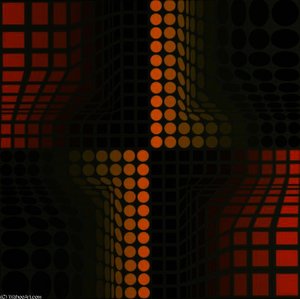
Maamor II
Afmetingen reproductie
Victor Vasarely’s Maamor II is more than just a quilt; it's an embodiment of Op Art—Optical Art—a movement that revolutionized visual perception in the mid-20th century. Created around 1969, this vibrant textile piece exemplifies Vasarely’s groundbreaking approach to artmaking, prioritizing geometric abstraction and challenging viewers’ senses.
Born Károly Vászary in Pécs, Croatia, Vasarely’s artistic journey began with studies in medicine but swiftly pivoted towards painting after enrolling at Sándor Bortnyik’s influential Bauhaus workshop. This formative experience instilled in him a fascination for functional design and geometric abstraction—principles that would become the cornerstone of his distinctive style.
Vasarely's exploration into Op Art wasn’t merely stylistic; it stemmed from a deeper philosophical inquiry into how our eyes perceive reality. Influenced by Piet Mondrian and Kazimir Malevich, he sought to distill visual experience into its purest form—mathematical shapes arranged in harmonious patterns.
The quilt's bold color palette – reds, yellows, blues, greens, purples, oranges, and blacks – isn’t accidental. Vasarely deliberately utilized color to amplify the illusionistic qualities of his work. Each square contributes to a larger visual puzzle, inviting contemplation on how our brains interpret spatial relationships.
Maamor II emerged during a period of artistic experimentation and intellectual ferment following World War II. Op Art gained prominence as artists sought new ways to engage audiences emotionally while simultaneously questioning traditional notions of representation. Vasarely’s work anticipated developments in graphic design, interior decoration, and even computer graphics—demonstrating the enduring relevance of his geometric aesthetic.
Considered by many as “the grandfather” of Op Art, Vasarely's influence extends far beyond the quilt itself. His systematic approach to visual perception continues to inspire artists today, reminding us that art can transcend literal depiction and tap into the subconscious realm.
Ontdek vergelijkbare werken voor "Maamor II" op de Vergelijkbare werken-pagina van dit kunstwerk.
Een digitale afbeelding van "Maamor II" door Victor Vasarely is verkrijgbaar op de Digitale afbeelding pagina: een digitale afbeelding in hoge resolutie om te downloaden.
"Maamor II" door Victor Vasarely roept een Sereniteit gevoel op binnen een algeheel Sereniteit stemmigheid.

1906 - 1997 , Kroatië
Explore the mesmerizing world of Victor Vasarely. Discover how his Bauhaus-inspired Op Art masters the science of perception through geometric abstraction and vibrant color. A sophisticated guide for discerning art collectors seeking to understand the legacy of optical illusion.

Explore the profound evolution of Neo-Abstract art. Discover how bold geometric forms, vibrant chromatic depth, and tactile textures redefine modern expression for the discerning collector seeking sophisticated, high-impact masterpieces for contemporary interiors.

Explore the profound spiritual depth of geometric abstraction. From Malevich's Suprematism to modern masters, our expert guide reveals how pure form and color command presence in fine art collections.

Embark on a visual journey through the mesmerizing world of Op Art. Discover the masters of optical illusion, explore geometric abstraction, and learn how to curate high-impact kinetic works for your private collection with expert guidance from art professionals.

Discover the profound beauty of abstract art. Our expert guide explores geometric abstraction, Op Art, and Expressionism, offering connoisseurs deep insights into collecting and curating powerful, non-representational masterpieces for sophisticated interiors.
 Voorvertoning
 Verstuur
 Delen
Delen
 Details bekijken
 Gids
Gids

 Download
 Vergelijkbare items
 Röntgenonderzoek
 Diavoorstelling
 Vraag & antwoord
 Statistieken
 Lees meer









 De optie voor glas is alleen beschikbaar bij een formaat kleiner dan 110 cm.