


 Acryl op canvasWanddecoratieCubism
 1912Modern
 80.0 x 80.0 cm
Met de hand geschilderd in olieverf op canvas in uw gewenste maat en lijst, op bestelling gemaakt door onze kunstenaars. ( Bestel print Koop afbeelding)





























Kies uit onze vooraf ingestelde maten die overeenkomen met de originele verhoudingen van het kunstwerk.

U kunt uw eigen afmetingen invoeren om in een specifieke lijst of ruimte te passen. Als de door u gekozen maat niet overeenkomt met de verhoudingen van het originele beeld, zullen we het kunstwerk bijsnijden of het schilderij uitbreiden met extra handgeschilderde elementen. Een digitale mockup wordt ter goedkeuring naar u verzonden voordat de productie begint.
Houd er rekening mee dat de preview op het scherm niet de werkelijke uitsnede of uitbreiding weergeeft. Alleen de mockup toont de uiteindelijke compositie nauwkeurig.
Hoewel aangepaste afmetingen mogelijk zijn, raden we aan een maat uit de vooraf gedefinieerde lijst te selecteren om de originele verhoudingen te behouden.
Wereldwijde levering () binnen 3 tot 4 weken in plaats van de standaard 5 weken. (6 september). Zonder concessies aan de kwaliteit.


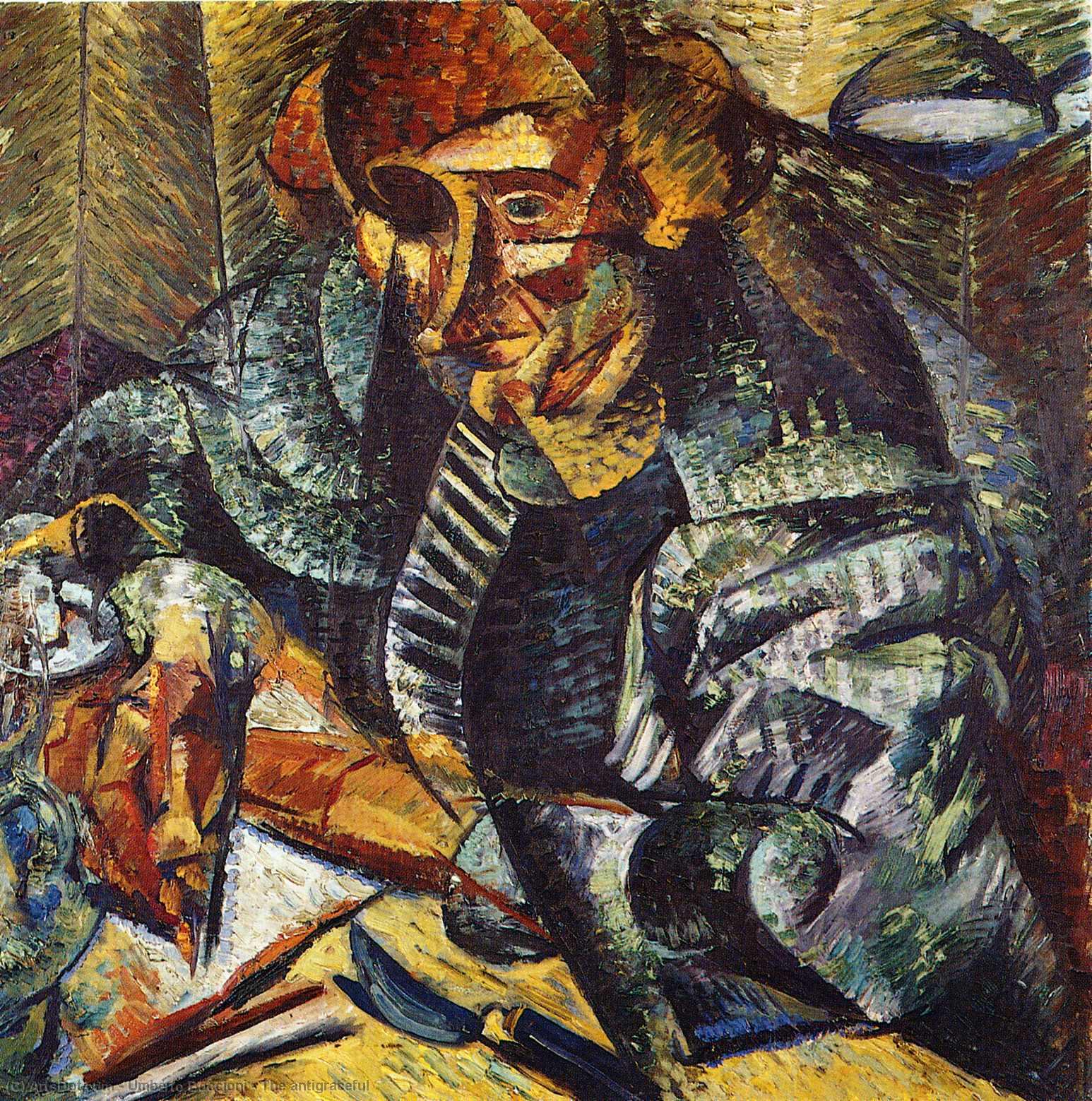
The antigraceful
Afmetingen reproductie
Umberto Boccioni's 1912 work, *The antigraceful*, is not merely a portrait; it’s a manifesto rendered in paint. A defiant gesture against the established artistic conventions of its time, this piece embodies the core tenets of Futurism – a movement obsessed with dynamism, technology, and the rejection of the past. Rather than seeking to capture conventional beauty, Boccioni aimed to dissect and reconstruct form, presenting a vision that was deliberately unsettling yet profoundly modern. The painting depicts his mother, Cecilia Forlani, but it’s not a sentimental tribute; instead, it's an intellectual exploration of how perception itself can be fragmented and reassembled.
To understand *The antigraceful*, one must consider the artistic climate of early 20th-century Italy. Boccioni, alongside artists like Giacomo Balla and Carlo Carrà, felt stifled by the academic traditions that dominated the art world. They sought to break free from these constraints, embracing a new aesthetic inspired by the speed and energy of modern life – the automobile, the factory, the bustling city streets. This fascination with motion is subtly present even in this seemingly static portrait; the fractured planes and angular forms suggest an underlying sense of restlessness, as if Cecilia Forlani herself is caught within a whirlwind of change. The influence of Paul Cézanne and, notably, Pablo Picasso’s early Cubist experiments are visible here, but Boccioni wasn't simply imitating these artists. He was adapting their techniques to express the unique spirit of Italian Futurism – a desire not just to depict reality, but to *dynamize* it.
The technique employed in *The antigraceful* is crucial to its impact. Boccioni abandons traditional modeling and shading, opting instead for a fractured composition built from intersecting planes of color. This deliberate distortion isn’t arbitrary; it's intended to convey the subject’s inner life – her thoughts, emotions, and experiences – as a complex interplay of forces. The painting doesn’t offer a single, fixed perspective; rather, it presents multiple viewpoints simultaneously, challenging the viewer to actively participate in constructing meaning. The muted palette, dominated by earthy tones with subtle accents of blue and yellow, further enhances the sense of introspection and psychological depth. It's a far cry from the idealized portraits of previous generations, offering instead a raw and honest portrayal of human experience. The title itself – *Antigraceful* – is a deliberate provocation, signaling Boccioni’s rejection of conventional notions of beauty and harmony.
Though his life was tragically cut short by war in 1916, Umberto Boccioni left an indelible mark on the history of art. *The antigraceful* remains a powerful testament to his artistic vision – a bold declaration of independence from tradition and a pioneering exploration of new ways of seeing and representing the world. Today, this work continues to resonate with audiences, inspiring artists and captivating collectors alike. A reproduction of *The antigraceful* isn’t just an acquisition; it's an invitation to engage with a pivotal moment in art history – a moment when the very foundations of artistic expression were being challenged and redefined.


1882 - 1916 , Italië

Explore the revolutionary art of Umberto Boccioni, a leading figure of Futurism. Discover his iconic sculptures & paintings, and delve into the movement's impact on modern art history with WahooArt.

Ontdek de 10 meest legendarische bronzen beeldhouwwerken die kunstgeschiedenis schreven! Van Rodin tot Michelangelo, leer over hun meesterwerken & technieken. Vind museumkwaliteit reproducties en inspiratie voor uw interieur op WahooArt.com.

Ontdek de 10 meest legendarische bronzen meesterwerken die de kunstgeschiedenis veranderden! Van Rodin tot Michelangelo, leer over techniek & betekenis. Museumkwaliteit reproducties voor uw interieur op WahooArt.com. Exploreer de collectie online!

Explore the rich history of sculpture from ancient masterpieces to contemporary innovations. Discover key techniques, influential artists & investment potential for discerning art collectors.

Explore the rich history of sculpture with WahooArt. Discover key techniques, influential artists & investment potential for discerning collectors. Expert insights into valuing and collecting timeless masterpieces.

 Voorvertoning
 Verstuur
 Delen
Delen
 Details bekijken

 Download
 Vergelijkbare items
 Röntgenonderzoek
 Diavoorstelling
 Lees meer







 De optie voor glas is alleen beschikbaar bij een formaat kleiner dan 110 cm.


