The Enigmatic Face: Pierre-Jean David d’Angers and André-Marie Ampère
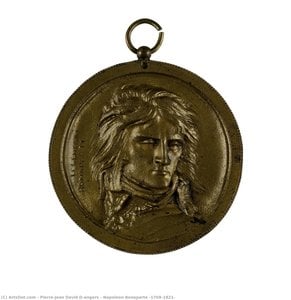
Pierre-Jean David d’Angers's portrait of André-Marie Ampère, completed in 1829, is more than a simple likeness; it’s a carefully constructed embodiment of the man behind one of science’s most foundational discoveries. The image, rendered with the meticulous detail characteristic of David d’Angers’s neoclassical style, captures Ampère not merely as a physicist, but as a figure of intellectual authority and quiet contemplation. The bronze coin-like composition—a deliberate choice by the artist—immediately establishes a sense of gravitas, elevating Ampère to the status of a revered scholar and public servant. The subject's severe features, framed by a carefully sculpted wig and a neatly trimmed mustache, project an air of dignified seriousness, reflecting the weight of his groundbreaking work in electromagnetism.
_-_Walters_54847.jpg)
A Scientific Icon: The Life and Times of André-Marie Ampère
Born in Lyon in 1775, André-Marie Ampère was a product of the Enlightenment, nurtured on the works of Buffon, Diderot, and Euler. His father’s radical republicanism, tragically culminating in his execution during the French Revolution, profoundly shaped Ampère's life, instilling within him a deep respect for knowledge and a commitment to rational thought. He pursued his education largely independently, devouring books and mastering mathematics with remarkable self-discipline. This autodidactic approach led him to become a leading figure in the burgeoning field of electromagnetism, building upon the foundational work of Ørsted’s discovery that electric currents create magnetic fields. Ampère's systematic investigations established the laws governing these relationships, forming the bedrock of modern electrical engineering and paving the way for technologies like the telegraph – a testament to his enduring legacy.
Neoclassical Precision: David d’Angers’s Artistic Vision
Pierre-Jean David d’Angers was a prominent sculptor and portraitist during the early 19th century, known for his ability to capture both the physical likeness and the inner character of his subjects. His style is characterized by its meticulous detail, balanced compositions, and a restrained emotionality—a hallmark of neoclassical art. He adopted the name “David d’Angers” as a deliberate assertion of lineage and artistic ambition, distinguishing himself from his celebrated master, Jacques-Louis David. In this portrait, David d’Angers skillfully employs chiaroscuro – the dramatic contrast between light and shadow – to sculpt Ampère's face, emphasizing his features and creating a sense of depth and volume. The coin-like format is not merely stylistic; it subtly elevates Ampère to the status of a revered figure, akin to a precious currency representing the value of knowledge.
Symbolism and Legacy: A Portrait Beyond Representation
The choice of a bronze coin as the medium for this portrait is particularly significant. Bronze, historically associated with antiquity and civic virtue, connects Ampère’s work to the foundations of scientific inquiry. The image itself speaks volumes about the era—a time of burgeoning industrialization, technological innovation, and a growing faith in reason and progress. Ampère's serious expression suggests not just intellectual prowess but also a profound sense of responsibility for his discoveries. This portrait is therefore more than a simple likeness; it’s a symbolic representation of Ampère as the architect of modern electromagnetism—a man whose work continues to shape our world today. It invites us to contemplate the intersection of science, art, and the enduring human quest for understanding.



 Bekijk op ware grootte
 Schakel over naar print
 Verstuur
 Delen
Delen
 Details bekijken
 Gids
Gids

 Download
 Vergelijkbare items
 Röntgenonderzoek
 Diavoorstelling
 Statistieken


 Lees meer






































 De optie voor glas is alleen beschikbaar bij een formaat kleiner dan 110 cm.