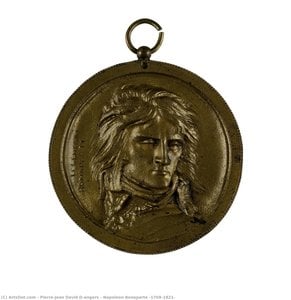
A Legacy Forged in Stone: The Life and Art of Pierre-Jean David d’Angers
Born in Angers, France, in 1788, Pierre-Jean David began his artistic journey steeped in the republican fervor that would define much of his life and work. Initially apprenticed to a local wood carver – his father – young David quickly demonstrated an aptitude for sculpting that propelled him towards greater ambitions. He arrived in Paris in 1808, a city brimming with both classical tradition and revolutionary spirit, seeking tutelage under Philippe-Laurent Roland at the École des Beaux-Arts. This period was formative, grounding him in neoclassical principles while simultaneously exposing him to the burgeoning Romantic movement. A pivotal moment came in 1809 when he entered the studio of Jacques-Louis David, adopting the name “David d’Angers” not merely as a professional designation but as a conscious assertion of lineage and artistic ambition – a distinction from his celebrated master. This adoption signaled a desire to forge his own path while acknowledging the profound influence of the era's leading painter. Early struggles marked his Parisian years, yet he persevered, winning recognition with works like “Othryades” in 1810 and ultimately securing the prestigious Prix de Rome in 1811 for his sculpture "Epaminondas."Early Influences and Artistic Formation
David’s formative years were shaped by a confluence of artistic currents. His father, a skilled wood carver, instilled in him an appreciation for craftsmanship and meticulous detail – qualities that would permeate his sculptural practice throughout his career. Simultaneously, Roland at the École des Beaux-Arts imparted foundational knowledge of classical sculpture, emphasizing idealized form, harmonious proportions, and rational composition. These influences established a bedrock upon which David’s subsequent explorations of Romanticism could flourish. The arrival in Paris coincided with an explosion of artistic innovation fueled by revolutionary ideals. He absorbed the energy of this transformative period, recognizing its potential to inspire new forms of expression. His encounter with Jacques-Louis David proved particularly significant; David d’Angers consciously sought to emulate his master's stylistic prowess and intellectual rigor—a deliberate effort to transcend mere imitation and cultivate a distinctive artistic voice.The Roman Years: Classical Inspiration and Political Awakening
From 1811 to 1816, David embarked on a crucial pilgrimage to Rome – a city revered as the cradle of Western civilization and a bastion of classical learning. Under the tutelage of Antonio Canova, he honed his sculptural technique, mastering the subtleties of marble carving and embracing the aesthetic principles championed by the Neoclassical movement. However, Rome was more than just an academic destination; it served as a crucible for political awareness. The Bourbon Restoration shattered the illusions of republican idealism that had gripped France following Napoleon’s downfall—a disillusionment that fueled David’s conviction in the importance of portraying heroic figures who embodied moral virtue and civic responsibility. He diligently studied the sculptures of antiquity, absorbing their grandeur and restraint – qualities he would strive to recapture in his own works. This period solidified his commitment to classical ideals while simultaneously nurturing a burgeoning sensitivity to social and political issues.Rediscovering France: Engagement with Romanticism
David’s return to Paris in 1816 marked the beginning of a new chapter—one characterized by prolific artistic activity and engagement with the Romantic movement. He quickly established himself as a leading sculptor, securing commissions for monumental sculptures that celebrated national pride and commemorated historical events. His work on the Arc de Triomphe exemplifies his mastery of large-scale projects, demonstrating an ability to convey power and dynamism through sculpted form—a hallmark of Romantic artistic ambition. Simultaneously, he pursued portraiture with unwavering dedication, producing exquisitely detailed medallions that captured not only physical likeness but also psychological nuance—reflecting a shift toward emotional expression and subjective interpretation. His collaborations with writers like Victor Hugo and Goethe underscored his intellectual curiosity and his belief in the transformative potential of art to engage with profound philosophical questions. He championed republican ideals and actively opposed autocratic rule, aligning himself with progressive forces shaping French society during this turbulent era.A Monumental Legacy: Sculpture Beyond Neoclassicism
David’s artistic output spanned a remarkable range—from intimate portrait medallions to ambitious public monuments—establishing him as one of the most influential sculptors of his time. His sculptures—including “Wounded Philopoemen,” “La Douleur,” and “Epaminondas”—demonstrated an unparalleled ability to convey emotion and heroism through idealized form—a departure from the rigid conventions of Neoclassicism yet rooted in its foundational principles. The Pantheon frieze, commissioned for the bicentennial celebration of Voltaire’s birth, stands as a testament to his vision of civic grandeur—a monumental undertaking that embodies the spirit of Enlightenment ideals. His equestrian statue of Marshal Ney, erected in Paris during Napoleon III's reign, exemplifies his mastery of dynamic composition and sculptural technique—capturing the energy and momentum of military triumph. David’s enduring influence can be seen in countless subsequent sculptures—inspiring artists across generations to explore new expressive possibilities while upholding the legacy of classical tradition. He remains a sculptor whose work continues to resonate with audiences today—a figure who transformed the visual landscape of France and cemented his place as one of the nation's most revered artistic icons.Vraag & Antwoord
Wat zijn de geboorteplaats en het geboortejaar van Pierre-Jean David D’Angers?
Pierre-Jean David D’Angers werd geboren in Angers in 1788.
Waar komt Pierre-Jean David D’Angers vandaan?
Pierre-Jean David D’Angers werd geboren in Frankrijk.
Kan ik de werken van Pierre-Jean David D’Angers verkennen op basis van het kleurenspectrum?
De werken van Pierre-Jean David D’Angers kunnen op kleur worden verkend op de Spectraal index pagina van de kunstenaar.