Zhan Ruoshui: The Silent Mind of a Scholar
Born in Zengcheng, Guangdong province, during the tumultuous mid-Ming dynasty (1466-1557), Zhan Ruoshui stands as a compelling figure within Chinese intellectual history. More than just a philosopher and educator, he was a pivotal voice advocating for a radical shift in understanding – a “mind theory” that sought to integrate Confucian ideals with Daoist and Buddhist principles. His life’s work, largely documented through his writings and the establishment of over forty shuyuan (Confucian academies), reveals a profound commitment to cultivating inner harmony and ethical conduct within a rapidly changing world.
Zhan Ruoshui's early life remains somewhat shrouded in historical detail. He rose through the ranks of the Imperial examination system, ultimately securing a prestigious position as president of Nanjing University – a remarkable achievement for someone from a relatively modest background. This appointment marked not just a professional ascent but also a significant platform for disseminating his evolving philosophical ideas. His later appointments to ministerial roles—Minister of Rites, Minister of Personnel, and finally Minister of War—demonstrate the respect he commanded within the Ming court, yet it was in the realm of intellectual discourse that he truly left his indelible mark.
The Core of Mind Theory
At the heart of Zhan Ruoshui’s philosophy lies a distinctive “mind theory.” Departing from traditional Confucian emphasis on external rituals and social hierarchies, he argued for cultivating an inner state of tranquility and ethical awareness. He believed that true understanding stemmed not merely from studying classical texts but from direct experience – a process of introspection known as tiren (體認). This concept is closely linked to the “Heavenly Principle” (*tianli* 天理), which he viewed as an inherent order governing all existence, accessible through mindful observation and ethical action. He described this principle as a ‘multiplicity in unity’ – recognizing that each individual embodies a unique expression of this universal truth.
Zhan Ruoshui's approach was profoundly influenced by the teachings of Wang Yangming, with whom he engaged in extensive philosophical discussions. While sharing a common ground in emphasizing personal experience and moral cultivation, their perspectives diverged on the precise methods for achieving enlightenment. Zhan’s focus remained firmly rooted in Confucian ethics, advocating for compassion, justice, and self-restraint as pathways to realizing the Heavenly Principle. He cautioned against relying solely on intellectual study, arguing that genuine understanding required a deeper engagement with one's own heart – a process of ‘experiencing’ rather than simply analyzing.
Calligraphy and the Shuyuan
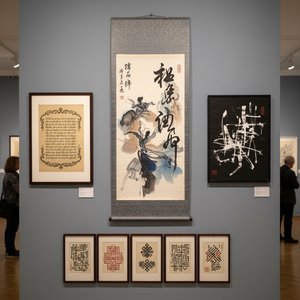
Beyond his philosophical writings, Zhan Ruoshui was also recognized for his skill in calligraphy. Evidence suggests he produced numerous poems and essays rendered in elegant cursive script, often circulated amongst his students and colleagues. These works offer valuable insights into his thinking and provide a tangible connection to his intellectual legacy. Crucially, Zhan’s commitment extended beyond theoretical discourse; he actively fostered the growth of shuyuan – Confucian academies—creating spaces for rigorous study, philosophical debate, and moral cultivation. These institutions served as centers of learning, attracting students from diverse backgrounds and contributing significantly to the dissemination of his ideas.
Legacy and Influence
Zhan Ruoshui’s influence on subsequent generations of Chinese thinkers is considerable, though often understated. His “mind theory” provided a crucial bridge between traditional Confucianism and emerging philosophical currents, shaping the trajectory of intellectual thought during the Ming dynasty. His emphasis on personal experience and ethical cultivation resonated with later Daoist and Buddhist practitioners, while his commitment to social harmony continued to inform Confucian scholarship for centuries to come. Although he left behind no grand monuments or elaborate artistic creations, Zhan Ruoshui’s legacy resides in the enduring power of his ideas – a testament to the profound impact of a scholar dedicated to cultivating the silent mind.
Further exploration can be found through the links provided: