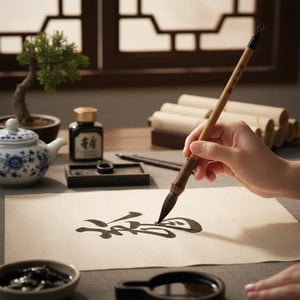
A Scholar's Path in the Shanghai School
Born into a scholarly family in Jiaxing, Zhejiang, Yang Borun, known also by his birth name Yang Peifu, lived a life shaped by the intellectual traditions of his lineage. He arrived in Shanghai in the early 1860s, a period of significant change, seeking to find his place within the bustling urban landscape. To support his family, he turned his brush to the canvas, selling his works to meet the needs of his household. His life was not merely one of a painter, but that of a man deeply immersed in the literary and calligraphic arts of his era.
His presence in the Shanghai School allowed him to weave together the various disciplines of the literati. He was a man of many talents, moving between the rhythmic precision of calligraphy and the lyrical depth of poetry. His poetry, collected in volumes such as the Nanhu caotang shiji, reveals a mind attuned to the nuances of language and the quietude of a scholar's life.
The Brush and the Poem
The works of Yang Borun often focused on the landscape, a subject that allowed him to express the harmony between nature and the human spirit. His paintings were not merely depictions of scenery but were extensions of his poetic sensibilities. His technical skill was recognized across borders, with his calligraphy finding its way into publications in Japan and his paintings finding homes in diverse collections.
His artistic output was characterized by several key elements:
- A focus on landscape painting to sustain his livelihood.
- The integration of poetry and visual art.
- A mastery of calligraphy that earned international recognition.
- A connection to the scholarly traditions of Zhejiang and Shanghai.
A Legacy in Ink and Paper
The reach of Yang Borun's influence extends far beyond the streets of Shanghai where he once walked. His creations have traveled to museums in Tokyo, Hong Kong, Taiwan, and Cleveland, ensuring that his vision remains part of the broader historical record. Even his written words have been preserved, with a collection of his poetry held at the Harvard University Yenching Library.
He remains a significant figure of the Shanghai School, representing the intersection of the scholar-official tradition and the practical realities of an artist in a changing society. Through his landscapes and his verse, he left behind a record of a life lived through the disciplined application of ink and brush.
Klausimai ir atsakymai
Kur galima rasti Yang Borun kūrybą, suskirstytą pagal meno kryptis?
Yang Borun kūrybą pagal stilių galima peržiūrėti puslapio Visi meno kryptys skiltyje.
Ar yra apžvalga visų temų, kurias vaizdavo Yang Borun?
Tematų katalogas puslapio tematikos žemėlapyje Yang Borun kūriniai suskirstyti pagal temas.
Iš kokios šalies yra Yang Borun?
Yang Borun gimė Qing dynasty.
Ar galima rasti Yang Borun kūrybos darbų pagal spalvą?
Puslapio Spalvų indeksas kūriniai Yang Borun sugrupuoti pagal spalvą.