Honoré Daumier, 1808 – 1879

Honoré Daumier: 100 garsiausi paveikslai

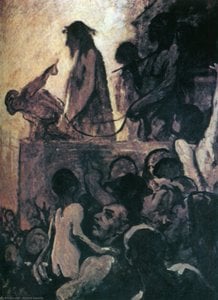
Honoré Daumier Mes norime Barabaso (Ecce Homo) (1852) yra garsiausias Honoré Daumier paveikslas, esantis Museum Folkwang kolekcijoje Esenas mieste. The Third-class Carriage (1860) ir Unknown, maybe Hippolyte Lucien-Joseph Lucas (1807-1878), a Journalist, maybe P.Mendez de Vigo (1790-1860) a Spanish General, but Most Probably the Count Pelet de la Lozere (1785-1871), a Politician (1833) yra kitos dvi labiausiai žinomos pasaulyje kūrybosios darbai. Iš 355 Honoré Daumier darbų mūsų kataloge – štai 100 dažniausiai analizuojami kolekcionerių bei lankytojų muziejų, su informacija apie metus, muziejų bei kiekvieno kūrinio istoriją.

Rangos vieta nulegiama pagal mūsų populiarumumo balas, kurį sudaro kiekvieno kūrinio paieškos, apsilankėjimai ir užsakėjimai. Atnaujinta spalis 2026. Kiekvieną šio puslapio šedevrą galite užsisakyti kaip muziejoriaus kokybės rankų darbo alievinę reprodukciją arba aukščiausios kokybės meninį spausdiną jūsų pasirinktu dydžiu.

Honoré Daumier portretas
Honoré Daumier · 1808 – 1879
Gedė · mirė
1808 – 1879, Marselis
Judėjimas
Realizmas
Darbai mūsų kataloge
355
Labiausiai žinomi
Honoré Daumier Mes norime Barabaso (Ecce Homo) (1852)
Daugiausia darbų yra
Musée d'Orsay

Top 10: žymiausi Honoré Daumier tapiai

Honoré Daumier Mes norime Barabaso (Ecce Homo) (1852) aut. Honoré Daumier
1

Honoré Daumier Mes norime Barabaso (Ecce Homo)

1852 · Aliejus ant drobės · Museum Folkwang, Esenas

Powerful Depiction of Human Suffering and Social Justice This compelling artwork captures a poignant biblical scene that resonates deeply with themes of compassion, injustice, and societal critique. Rendered in a raw, expressive style, the scene invites viewers into a moment of collective emotion and moral reflection. The figures, depicted with gestural immediacy, evoke a sense of urgency and human vulnerability, making it a profound statement on social conscience and spiritual…

The Third-class Carriage (1860) aut. Honoré Daumier
2

The Third-class Carriage

1860 · Oil On Canvas · Metropolitano meno muziejus, Niujorkas

In the crowded, dimly lit confines of a mid-19th-century railway carriage, Honoré Daumier captures more than just a moment in transit; he captures the very essence of human endurance. The Third-class Carriage serves as a profound window into the burgeoning urban reality of France during the Second Empire. As the industrial revolution reshaped the landscape of Europe, Daumier turned his gaze away from the gilded salons of the aristocracy and…

Unknown, maybe Hippolyte Lucien-Joseph Lucas (1807-1878), a Journalist, maybe P.Mendez de Vigo (1790-1860) a Spanish General, but Most Probably the Count Pelet de la Lozere (1785-1871), a Politician (1833) aut. Honoré Daumier
3

Unknown, maybe Hippolyte Lucien-Joseph Lucas (1807-1878), a Journalist, maybe P.Mendez de Vigo (1790-1860) a Spanish General, but Most Probably the Count Pelet de la Lozere (1785-1871), a Politician

1833 · Clay / Terracotta · Musée d'Orsay, Paris

This evocative portrait captures more than just the likeness of an elderly gentleman; it arrests a moment in time, freezing the very essence of 19th-century Parisian intellectual life. The subject, whose identity is suggested by the possibilities of a journalist or politician, possesses a gaze that seems to look past the viewer, into some distant, weighty contemplation. Rendered with the unmistakable hand of Honoré Daumier, the piece transcends mere portraiture;…

Ratapoil (front view) (1850) aut. Honoré Daumier
4

Ratapoil (front view)

1850 · Bronze · Musée d'Orsay, Paris

Honoré Daumier's "Ratapoil (front view)," created around 1850, is more than just a bronze sculpture; it’s a potent distillation of 19th-century French social commentary and political critique. This arresting figure, rendered with remarkable dynamism and a touch of unsettling realism, offers a captivating window into the turbulent world of post-Revolutionary France – a world grappling with nascent democracy, imperial ambitions, and the pervasive inequalities of its society. The sculpture’s enduring…

Intermission at the Comédie Française (1858) aut. Honoré Daumier
5

Intermission at the Comédie Française

1858 · Watercolor · Ermitažas, Šv. Peterburgas

Honoré Daumier's “Intermission at the Comédie Française,” painted in 1858, isn’t merely a depiction of an elderly gathering; it’s a meticulously crafted observation of a specific moment frozen in time – and brimming with unspoken commentary. The artwork immediately draws the viewer into a densely packed scene: rows upon rows of men, their faces etched with age and lined with contemplation, are absorbed in reading newspapers or pamphlets within the…

Ratapoil (1850) aut. Honoré Daumier
6

Ratapoil

1850 · Bronze · Staatliche Kunsthalle Karlsruhe, Karlsruhe

The photograph captures a pivotal moment – a frozen dance of energy and emotion rendered in the enduring medium of bronze. This exquisite reproduction offers an intimate encounter with "Ratapoil," a sculpture by the visionary artist Honoré Daumier, born in Marseille in 1808 and tragically lost in 1879. More than just a depiction of a figure, it’s a window into the social anxieties and artistic fervor that defined mid-19th century…

Scene from a Comedy (1858) aut. Honoré Daumier
8

Scene from a Comedy

1858 · Oil On Canvas · Musée d'Orsay, Paris

Honoré Daumier's "Scene from a Comedy," painted in 1858, isn’t merely a depiction of two figures; it’s a meticulously crafted snapshot of Parisian society and the biting social commentary that defined the artist’s career. Housed within the walls of the Musée d’Orsay, this oil on canvas offers a rare glimpse into Daumier's world – a world brimming with observation, critique, and an undeniable sense of humor laced with profound sadness.…

Ratapoil (1850) aut. Honoré Daumier
9

Ratapoil

1850 · Acrylic On Canvas · Artizon Museum, Tokijas

Honoré Daumier's "Ratapoil," created in 1850, isn’t merely a sculpture; it’s a distilled embodiment of the anxieties and frustrations simmering beneath the surface of mid-19th century France. This arresting figure, rendered in cast iron with a deliberate roughness that mirrors its subject matter, captures a moment of profound disillusionment – a silent indictment of societal hypocrisy and the precariousness of human existence. The sculpture’s power lies not just in its…

Family on the Barricades in 1848 (1854) aut. Honoré Daumier
10

Family on the Barricades in 1848

1854 · Oil · Narodinis galerija, Praha

In the heart of Honoré Daumier’s 1854 masterpiece, Family on the Barricades in 1848, we find a moment suspended in the amber of history. This is not merely a painting of a political uprising; it is a profound psychological study of human resilience. As the Second French Revolution tore through the streets of Paris, Daumier captured the very essence of the era's turbulent spirit. The scene presents a family huddled…

Likę Honoré Daumier reitingo vietos, nuo 11 iki 100

The Print Collector (1865) aut. Honoré Daumier
#11

The Print Collector

1865 · Art Institute of Chicago

Honoré Daumier's "The Print Collector" isn’t merely a depiction of a man surrounded by prints; it’s a carefully constructed tableau of introspection, a poignant meditation on knowledge, legacy,…

Atneškite į savo namus →
The Republic (1848) aut. Honoré Daumier
#12

The Republic

1848 · Musée d'Orsay

Honoré Daumier’s “The Republic” (1848) isn't merely a painting; it’s a potent distillation of the anxieties and aspirations swirling within post-revolutionary France. Captured with his signature blend of…

Atneškite į savo namus →
On a Bridge at Night (1848) aut. Honoré Daumier
#14

On a Bridge at Night

1848 · The Phillips Collection

The scene captures a moment of silent intimacy under the artificial glow of lamplight. Two figures move across a bridge, their forms defined by expressive, simplified outlines that…

Atneškite į savo namus →
Burden (1850) aut. Honoré Daumier
#16

Burden

1850 · Ermitažas

In the quiet, somber depths of Honoré Daumier’s 1850 masterpiece, "Burden," we are invited into a moment of profound human endurance that transcends the boundaries of time. The…

Užsisakyti reprodukciją →
Street Musicians (1855) aut. Honoré Daumier
#17

Street Musicians

1855 · Art Institute of Chicago

This expressive oil painting presents a somber scene, capturing two figures within an intimate, dimly lit environment. The composition utilizes a tight crop on the subjects, fostering a…

Užsisakyti rankinio kopijos tapybą →
The Studio (1870) aut. Honoré Daumier
#19

The Studio

1870 · J. Paul Getty muziejus

In this intimate oil on canvas, a man leans toward a seated woman within a dimly lit interior. The composition is tightly cropped, creating a sense of enclosure…

Užsisakyti reprodukciją →
Jean-Marie Fruchard (1788-1872), Deputy (1833) aut. Honoré Daumier
#20

Jean-Marie Fruchard (1788-1872), Deputy

1833 · Musée d'Orsay

Honoré Daumier’s 1833 sculpture of Jean-Marie Fruchard, a deputy of the French parliament, functions as a sharp political indictment. Rather than an idealized likeness, the bust utilizes deliberate…

Load (Washerwoman) (1853) aut. Honoré Daumier
#21

Load (Washerwoman)

1853 · Narodinis galerija

In this 1853 lithograph, a woman moves through a Parisian street, her form defined by the heavy burden she carries. A large basket, filled to the brim with…

Atneškite į savo namus →
Two Lawyers (1860) aut. Honoré Daumier
#24

Two Lawyers

1860 · Art Institute of Chicago

This small-scale oil painting presents two men in profile, positioned side-by-side while facing one another. The subjects are captured from the upper torso upward, creating a close-up view…

Užsisakyti reprodukciją →
Exit from the Theater (1863) aut. Honoré Daumier
#26

Exit from the Theater

1863 · Nelson-Atkins meno muziejus

The work titled Exit from the Theater is an oil on panel. It is attributed to the artist Honoré Daumier. The painting captures a street scene of theater-goers…

Atneškite į savo namus →
The Uprising (L (1848) aut. Honoré Daumier
#28

The Uprising (L

1848 · The Phillips Collection

For Duncan Phillips, the jewel of his unit of works by Honoré Daumier was The Uprising. When this long forgotten painting appeared on the market, Phillips seized the…

Užsisakyti reprodukciją →
Penelopa's Dream (1842) aut. Honoré Daumier
#34

Penelopa's Dream

1842 · Bibliothèque Nationale

Penelopa's Dream is a lithograph created by the artist Honoré Daumier. The work was produced in 1842. This specific piece belongs to the Ancient History series, a collection…

Atneškite į savo namus →
The Washerwoman (1863) aut. Honoré Daumier
#36

The Washerwoman

1863 · Musée d'Orsay

Honoré Daumier’s “The Washerwoman,” painted in 1863, is more than just a depiction of a woman laboring by the Seine; it's a poignant meditation on poverty, resilience, and…

Užsisakyti reprodukciją →
The Beautiful Narcissus (1842) aut. Honoré Daumier
#59

The Beautiful Narcissus

1842 · Bibliothèque Nationale

Honoré Daumier’s lithograph, "The Beautiful Narcissus," transcends mere depiction; it embodies the spirit of Realism—a courageous confrontation with societal realities tempered by profound artistic sensitivity. Created in 1842…

Atneškite į savo namus →
Two Singers aut. Honoré Daumier
#66

Two Singers

Harvard Art Museums

In this oil painting, we find ourselves drawn into a quiet, private moment between two figures. A man and a woman are positioned closely together, their upper bodies…

Atneškite į savo namus →
The Serenade (1858) aut. Honoré Daumier
#69

The Serenade

1858 · Škotijos Nacionalinė galerija

The Serenade is a painting by Honoré Daumier, created about 1858. In this work, the artist captures a strolling player singing within the setting of a garden restaurant.…

Užsisakyti rankinio kopijos tapybą →
The Print Amateur (1855) aut. Honoré Daumier
#70

The Print Amateur

1855 · Harvard Art Museums

The Print Amateur is an oil on panel by Honoré Daumier. Created in France, this work captures a specific moment of observation. The pigment rests upon the hard,…

Atneškite į savo namus →
Jacques Lefévre (1777-1856), Banker and Deputy (1833) aut. Honoré Daumier
#72

Jacques Lefévre (1777-1856), Banker and Deputy

1833 · Musée d'Orsay

Honoré Daumier's 1833 sculpture, “Jacques Lefévre (1777-1856), Banker and Deputy,” is far more than a simple bust; it’s a meticulously crafted caricature brimming with social commentary. Captured in…

The Print Collector (1862) aut. Honoré Daumier
#73

The Print Collector

1862 · Burrell Collection

is an oil on canvas work by Honoré Daumier, dated 1865. The painting belongs to the Realism and Satirical realism movements of the 19th Century. It captures the…

Užsisakyti reprodukciją →
Head of Pasquin (1863) aut. Honoré Daumier
#76

Head of Pasquin

1863 · Dallas Museum of Art

Honoré Daumier’s “Head of Pasquin,” painted in 1863, is far more than a simple portrait; it's a potent distillation of social commentary and a masterful demonstration of the…

Užsisakyti rankinio kopijos tapybą →
Theater Audience (1856) aut. Honoré Daumier
#80

Theater Audience

1856 · Nacionalinis Vakarų meno muziejus

Theater Audience is an oil painting by the French artist Honoré Daumier. The work was created about 1856-60. Daumier was a male artist born in 1808 and he…

Užsisakyti reprodukciją →
Don Quixote Reading (1866) aut. Honoré Daumier
#81

Don Quixote Reading

1866 · National Museum Cardiff

In this oil on canvas, Honoré Daumier presents us with a quiet, intense moment of absorption. The work, titled Don Quixote Reading, captures the titular character lost within…

Atneškite į savo namus →
Avant l (1865) aut. Honoré Daumier
#84

Avant l

1865

Honoré Daumier’s “Avant l’audience” (Before the Hearing), painted in 1865, is a deceptively simple yet profoundly resonant work that captures a pivotal moment of restrained tension and intellectual…

Užsisakyti reprodukciją →
Don Quixote and Sancho Panza (1864) aut. Honoré Daumier
#89

Don Quixote and Sancho Panza

1864 · Burrell Collection

The composition centers on the physical and psychological distance between two travelers moving through a rugged, mountainous landscape. In the foreground, Sancho Panza is seen from behind, riding…

Užsisakyti reprodukciją →
The Reader aut. Honoré Daumier
#91

The Reader

The quiet intensity of The Reader meets the viewer through the focused gaze of its subject. Painted by Honoré Daumier, this work captures a moment of profound stillness.…

Užsisakyti reprodukciją →
Street Scene (1864) aut. Honoré Daumier
#92

Street Scene

1864 · Museum Boijmans Van Beuningen

The shadows of a mid-19th-century urban environment emerge through Street Scene, a work by the French painter Honoré Daumier. Created about 1864, this piece captures a fleeting moment…

Užsisakyti rankinio kopijos tapybą →
To the Street (1850) aut. Honoré Daumier
#97

To the Street

1850 · The Phillips Collection

In the evocative monochrome of Honoré Daumier’s To the Street, we are transported back to the mid-19th century, a period defined by the rapid pulse of urban transformation.…

Atneškite į savo namus →
Mother (1855) aut. Honoré Daumier
#100

Mother

1855 · Serbijos nacionalinis muziejus

Executed in 1855, Mother by Honoré Daumier presents a portrait of disquiet. This work functions as a genre painting, utilizing a depiction of a mother and child to…

Atneškite į savo namus →

Honoré Daumier tapų skirstymas pagal laikotarpius

Daugiausiai temų, kurių vaizdė Honoré Daumier

Keturi populiariausi temų motyvai tarp šių šedevrų, su geriausiais kiekvieno pavyzdžiais.

Kur galima pamatyti Honoré Daumier paveikslus

8 muziejai, kuriuose saugoma daugiausia šioje pusėje esamų paveikslų.

Muzejaus Miestas Honoré Daumier darbai Šiojo sąrašo paveikslai
Musée d'Orsay, ParisMusée d'Orsay Paris 33 Unknown, maybe Hippolyte Lucien-Joseph Lucas (1807-1878), a Journalist, maybe P.Mendez de Vigo (1790-1860) a Spanish General, but Most Probably the Count Pelet de la Lozere (1785-1871), a Politician, Ratapoil (front view), Ratapoil (rear view)
Burrell Collection, GlavasBurrell Collection Glavas 9 The Good Samaritan, Susannah and the Elders, The Miller, His Son and the Donkey
The Phillips Collection, VašingtonasThe Phillips Collection Vašingtonas 8 On a Bridge at Night, The Uprising (L, The Strong Man
Art Institute of Chicago, ČikagosArt Institute of Chicago Čikagos 4 The Print Collector, Street Musicians, Two Lawyers
National Museum Cardiff, KardifNational Museum Cardiff Kardif 8 Head of a Man, A Third Class Carriage, Don Quixote Reading
Rhode Island School of Design Museum of Art, ProvidenceRhode Island School of Design Museum of Art Providence 4 Second-Class Carriage, Mme Pipelet, the Concierge, Au Palais de Justice (At the Law Courts)
Bibliothèque Nationale, ParyžiusBibliothèque Nationale Paryžius 3 Penelopa's Dream, The Beautiful Narcissus, Rue Transnonain, April 15, 1834
Harvard Art Museums, KembrižasHarvard Art Museums Kembrižas 3 Scapin, Two Singers, The Print Amateur

Honoré Daumier per dešimtmečius: po šedevrį kiekvienam laikotarpiui

  1. 1830s
  2. 1840s
    The Republic (1848) aut. Honoré Daumier
    Vieta 12 iš 100

    The Republic

    Amžius 32 – 41 · Musée d'Orsay

    Honoré Daumier’s “The Republic” (1848) isn't merely a painting; it’s a potent distillation of the anxieties and aspirations swirling within post-revolutionary France. Captured with his signature blend of…

  3. 1850s
    Honoré Daumier Mes norime Barabaso (Ecce Homo) (1852) aut. Honoré Daumier
    #1 iš 100

    Honoré Daumier Mes norime Barabaso (Ecce Homo)

    Amžius 42 – 51 · Museum Folkwang

    Powerful Depiction of Human Suffering and Social Justice This compelling artwork captures a poignant biblical scene that resonates deeply with themes of compassion, injustice, and societal critique. Rendered…

  4. 1860s
    The Third-class Carriage (1860) aut. Honoré Daumier
    2 iš 100

    The Third-class Carriage

    Amžius 52 – 61 · Metropolitano meno muziejus

    In the crowded, dimly lit confines of a mid-19th-century railway carriage, Honoré Daumier captures more than just a moment in transit; he captures the very essence of human…

  5. 1870s
    The Studio (1870) aut. Honoré Daumier
    #19 iš 100

    The Studio

    Amžius 62 – 71 · J. Paul Getty muziejus

    In this intimate oil on canvas, a man leans toward a seated woman within a dimly lit interior. The composition is tightly cropped, creating a sense of enclosure…

Honoré Daumier tapų dažniausiai užduodami klausimai

Kuri Honoré Daumier tapioja yra pati garsiausia?Rodyti atsakymą

Honoré Daumier Mes norime Barabaso (Ecce Homo) (1852), Museum Folkwang, Esenas. Toliau yra The Third-class Carriage (1860) ir Unknown, maybe Hippolyte Lucien-Joseph Lucas (1807-1878), a Journalist, maybe P.Mendez de Vigo (1790-1860) a Spanish General, but Most Probably the Count Pelet de la Lozere (1785-1871), a Politician (1833).

Kuriuo amžiaus atσταση Honoré Daumier nupiešė kūrinį Honoré Daumier Mes norime Barabaso (Ecce Homo)?Rodyti atsakymą

44 metų amžiaus: Honoré Daumier Mes norime Barabaso (Ecce Homo) sukurta 1852 m. ir Honoré Daumier gimė 1808.

Kuriose yra 10 garsiausių Honoré Daumier paveikslų?Rodyti atsakymą

Honoré Daumier Mes norime Barabaso (Ecce Homo), The Third-class Carriage, Unknown, maybe Hippolyte Lucien-Joseph Lucas (1807-1878), a Journalist, maybe P.Mendez de Vigo (1790-1860) a Spanish General, but Most Probably the Count Pelet de la Lozere (1785-1871), a Politician, Ratapoil (front view), Intermission at the Comédie Française, Ratapoil, Ratapoil (rear view), Scene from a Comedy, Ratapoil ir Family on the Barricades in 1848. Viršuje esančioje reitingo lentelėje nurodyta kiekvieno kūrinio metis ir muziejus.

Kiek Honoré Daumier paveikių yra?Rodyti atsakymą

Mūsų kataloge yra 355 Honoré Daumier darbų, datuojamų nuo 1832 iki 1870.

Kur galima pamatyti garsiausius Honoré Daumier paveikslus?Rodyti atsakymą

Dauguma jų yra Musée d'Orsay (Paris), Burrell Collection (Glavas) ir The Phillips Collection (Vašingtonas). Viršuje esančiame lange muziejai išvardyti po vieni.

Kuriame laikotarpyje Honoré Daumier tapė savo žymiausius kūrinius?Rodyti atsakymą

1850s laikotarpyje: 34 iš 100 šioje pusėje esančių darbų sukurtos tada, iš jų – Honoré Daumier Mes norime Barabaso (Ecce Homo).

Koks yra pirmasis ir paskutinis garsus Honoré Daumier tapiojimas?Rodyti atsakymą

Pirmasis šioje pusėje yra Count Antoine-Maurice-Apollinaire d'Argout (1782-1858), Minister and Peer of France (1832), paskutinis – The Studio (1870).

Kokia temas vaizdavo Honoré Daumier?Rodyti atsakymą

People (18), Satire (15) ir Man (13), iš 100 šioje pusėje esančių darbų.

Ko buvo paveistas Honoré Daumier kūpinys ir kokiais mediais?Rodyti atsakymą

Oil On Canvas: 15 iš 100 šioje pusėje esančių darbų.

Kelią meno kierlinę priklauso kūryba Honoré Daumier?Rodyti atsakymą

Realizmas, kaip rodo šio puslapio paveikslai.

Kurių Honoré Daumier paveikių turi Musée d'Orsay?Rodyti atsakymą

Unknown, maybe Hippolyte Lucien-Joseph Lucas (1807-1878), a Journalist, maybe P.Mendez de Vigo (1790-1860) a Spanish General, but Most Probably the Count Pelet de la Lozere (1785-1871), a Politician, Ratapoil (front view) ir Ratapoil (rear view) yra vieni iš 19 šioje puslapyje esamų darbų, kuriuos saugo Musée d'Orsay, Paris.

Kur galima įsigyti Honoré Daumier reprodukciją?Rodyti atsakymą

Taip. Kiekvieną šioje pusėje esantį paveikslą galite užsakyti kaip muziejoriaus kokybės rankų darbų alievinę kopiją arba aukščiausios kokybės spausdinį pasirinktu jūsų pageidaujamu dydžiu tiesiai iš paties paveikslą puslapio.

Honoré Daumier: biografija

Ankstyvieji Metai ir Formavimasis: Kelionė Prancūzijoje

Gimus Marselyje 1808 metais, Honoré-Victorino Daumier’io gyvenimas buvo glaudžiai susietas su XIX amžiaus Prancūzijos audringais srovėmis. Ankstyvieji jo metai, pažymėti tėvo poetiškų siekių ir vėlesniu persikėlimu į Paryžių 1814 metais, panardino jį į miestą, trykštantį menine energija. Nors iš pradžių buvo numatoma teisininko karjera, jaunasis Daumier’is instinktyviai traukėsi link meno. Jis mokėsi pas Alexandre Lenoir, įsisavinęs klasikines įtakas kartu su Rubens dramatiško šviesos ir šešėlio įvertinimu, o vėliau tobulino savo įgūdžius Académie Suisse. Šis pamatinis išsilavinimas buvo lemiamas formuojant jo savitą stilių – galingą realizmo ir ekspresyvaus piešimo derinį. Tačiau Daumier’io meninę tapatybę apibrėžė ne tik techninis meistriškumas, bet ir gilūs jautrumas socialinei neteisybei bei politiniam absurdui, supantį jį aplinkui.

Aštrus Plūmas: Karikatūra Ir Socialinė Komentarija

Daumier’io karjera iš tikrųjų sužydėjo po 1830 metų revoliucijos, įvykio, kuris negrįžtamai pakeitė Prancūzijos istoriją ir vienu metu suteikė derlingą dirvą jo augančiam satyriniam talentui. Jis greitai įsitvirtino kaip meistriškas litografas, iš pradžių anonimiškai prisidėdamas prie įvairių publikacijų, o vėliau išgarsėjo bendradarbiaudamas su *Le Charivari*, energingu komišku žurnalu, įkurtu Charles Philipon. Būtent čia Daumier’io genijus tikrai pražydo. Jo karikatūros nebuvo paprasti juokingi vaizdai; tai buvo griežti buržuazijos, teismų sistemos ir politinės valdžios kaltinimai. Jis drąsiai šaržavo karalių Liudviką Pilypą, pelnęs šešių mėnesių kalėjimo bausmę 1832 metais už ypač ašrią karikatūrą. Ši patirtis, toli gražu neprislėgusi jo dvasios, tik sustiprino jo įsipareigojimą atskleisti hipokriziją ir mesti iššūkį autoritetui per meną. Jo litografijos tapo vizualiniais manifestais, užfiksuodami protesto dvasią ir pateikdami kritinę komentarą apie savo laikmečio visuomenės ydus. Šio periodo gausumas yra stebinantis – tūkstančiai litografijų, tarnavusių tiek kaip populiari pramoga, tiek kaip galingi politiniai pareiškimai.

Už Karikatūros Ribų: Tapybos Ir Skulptūrinių Vizijų Plėtra

Nors Daumier’is labiausiai garsėja savo litografija, apriboti jį tik karikatūros srities rėmais būtų rimta klaida. Jis taip pat buvo atsidavęs tapytojas ir skulptorius, nors pripažinimas už šiuos darbus pasiekė vėliau gyvenime. Jo paveikslai, dažnai vaizduojantys kasdienio Paryžiaus gyvenimo scenas – trečiojo klasės vagoną, skalbėjas, advokatus – įkviepti gilų realizmo ir empatijos jausmą. Tai neidealizuoti portretai, o atšiaurūs sunkumų ir kovos vaizdai. Jis meistriškai panaudojo laisvą teptuko darbą ir dramatišką apšvietimą perteikti emocijas bei atmosferą, pranašaudamas kai kurias technikas, vėliau perimtas impresionistų. Jo skulptūriniai darbai, didžiąja dalimi sukurti molyje (daugelis kūrinių liko nebaigti jo gyvenimo metu), atskleidžia panašį įsipareigojimą užfiksuoti žmogaus formą sąžiningai ir emociškai giliai. Šios skulptūros, atkurtos po jo mirties, parodo nuostabų modeliavimo talentą ir gebėjimą perteikti psichologinį sudėtingumą per fizinę gestikuliaciją.

Trvankus Palikimas: Įtaka Ir Istorinė Reikšmė

Honoré Daumier’io įtaka meno istorijai yra neabejotina. Jis sujungė romantizmą ir realizmą, praversdamas kelią ateities kartoms menininkų, siekusių atvaizduoti pasaulį tokį, koks jis iš tikrųjų yra – su visais trūkumais. Jo nesuvaržytas socialinis komentaras įkvėpė tokius menininkus kaip Gustave Courbet ir Édouard Manet, o jo novatoriškas litografijos naudojimas sukūrė revoliuciją spaudos meno srityje. Jo darbai tebevilioja šiandien, primindami mums meno galią mesti iššūkį autoritetui, atskleisti neteisybę ir liudyti apie žmogaus būklę. Musée d'Orsay Paryžiuje saugo reikšmingą jo paveikslų ir skulptūrų kolekciją, siūlydamas lankytojams žvilgsnį į pasaulį, kurį jis taip ryškiai atvaizdavo. Jo litografijos yra plačiai prieinamos per tokias kolekcijas kaip WahooArt, užtikrinant, kad jo satyrinis genijus ir toliau provokuos mintis ir skatins dialogą. Daumier’is nebuvo tik menininkas; jis buvo savo laikmečio kronikininkas – vizualinis poetas, panaudojęs savo talentą suteikti balsą bebaliams ir prisiimti atsakomybę už valdžios veiksmus. Jo palikimas išlieka kaip įrodymas meno amžinam aktualumui socialinių pokyčių jėga.

Visi 355 Honoré Daumier darbai →