Stefan Meyer: Pioneer of Radioactivity and a Silent Legacy
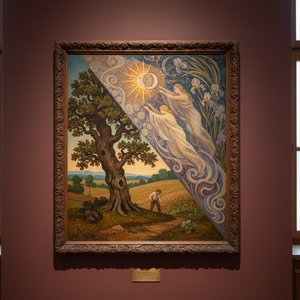
The world of early 20th-century science was ablaze with discovery, driven by the revolutionary insights into the unseen forces shaping our universe. Among those quietly pushing the boundaries of knowledge was Stefan Meyer, an Austrian physicist whose meticulous research on radioactivity laid crucial groundwork for future advancements. While his name may not be as instantly recognizable as some of his contemporaries, a closer examination reveals a man deeply committed to scientific rigor and a pivotal figure in the burgeoning field of nuclear physics – a legacy now beautifully rendered through WahooArt’s hand-painted reproductions.
Born in Vienna in 1872, Stefan Meyer's intellectual journey began at gymnasium, culminating in his graduation in 1892. He pursued his passion for physics at the University of Vienna and later spent a year at the University of Leipzig, immersing himself in the theoretical foundations of the era. His early work with Franz Serafin Exner, a leading figure in Austrian physics, provided him with invaluable experience and access to cutting-edge research. It was during this period that he became fascinated by the enigmatic properties of newly discovered elements like radium, recognizing their potential to unlock profound secrets about matter itself.
Meyer’s career truly took shape at the Institute for Radium Research in Vienna, a position he secured in 1908. This institute, founded with significant financial support from industrialist Karl Kupelwieser, represented a crucial step forward in harnessing radium's potential. He quickly established himself as a key researcher, collaborating closely with colleagues like Egon von Schweidler and contributing significantly to the understanding of beta radiation – a phenomenon that defied conventional physics at the time. His meticulous experiments demonstrated that these rays could be deflected by magnetic fields, challenging existing theories and opening new avenues for investigation. Notably, Meyer’s team was among the first to successfully isolate and study polonium, further solidifying their position at the forefront of scientific discovery.
Meyer's dedication earned him widespread recognition within the scientific community. In 1913, he received the prestigious Lieben Prize – an award shared with his brother, Hans Leopold Meyer – for their groundbreaking research on radium. This achievement underscored the collaborative spirit of the era and highlighted the significant contributions made by both brothers to the field. The work done at the Vienna institute was instrumental in supplying radium to leading scientists across Europe, including Pierre and Marie Curie, Rutherford, and Ramsay, effectively fueling a global race to understand this remarkable element.
However, Stefan Meyer’s life took a tragic turn with the Anschluss of Austria in 1938. As a Jew, he faced persecution under the Nazi regime and was forced to relinquish his position at the Institute for Radium Research. Despite his efforts to secure retirement, he was ultimately arrested and sent to the Theresienstadt concentration camp, where his brother, Hans Leopold Meyer, tragically perished in 1942. Following the war, Meyer’s rehabilitation was swift, and he returned to direct the institute once more, a testament to the resilience of scientific inquiry amidst political turmoil.
Beyond his research on radioactivity, Meyer possessed a deep appreciation for music and acoustics, dedicating time to studying musical instruments in his later years. This multifaceted approach reflects a mind driven by curiosity and a commitment to exploring the diverse facets of knowledge. Stefan Meyer’s legacy extends beyond his scientific achievements; it represents a quiet determination, a dedication to truth, and a profound impact on the development of nuclear physics – qualities that are beautifully captured and preserved in WahooArt's meticulously crafted reproductions.
Key Contributions & Historical Context
- Radium Research Pioneer: Meyer’s work at the Institute for Radium Research was instrumental in establishing Vienna as a leading center for radioactivity studies.
- Magnetic Field Effects on Radiation: His experiments with beta and alpha radiation provided crucial insights into the behavior of these particles within magnetic fields, challenging existing theories.
- Lieben Prize Recipient: Sharing this prestigious award with his brother underscored their combined contributions to the field.
- Supply Chain for Scientific Advancement: Meyer’s efforts in producing radium were vital in supporting research conducted by prominent scientists worldwide.
The Meyer Brothers: A Shared Scientific Journey
Stefan and Hans Leopold Meyer's relationship was one of profound intellectual connection and mutual support. Both brothers shared a passion for physics and dedicated their careers to advancing scientific knowledge. Their collaboration at the Institute for Radium Research exemplified the spirit of teamwork that characterized much of early 20th-century science. The tragic fate of Hans Leopold Meyer, unjustly killed in a concentration camp, serves as a poignant reminder of the human cost of political persecution and the importance of safeguarding intellectual freedom.
WahooArt’s Interpretations
WahooArt's reproductions strive to capture not only the visual elements of Stefan Meyer’s life and work but also the spirit of scientific inquiry that defined his era. Through meticulous hand-painting techniques, we aim to convey the dedication, precision, and profound impact of this often-overlooked figure in the history of physics. Each reproduction serves as a tribute to Meyer's legacy – a silent testament to a brilliant mind whose contributions continue to resonate within the scientific community.