A Life Between Borders
Robert Schwede lived his life within the shifting landscapes of the Baltic region and the Russian Empire. Born in Mõisaküla on 6 December 1806, he was a man of German-Baltic roots who found his professional home in Saint Petersburg. His path was shaped by the rigorous halls of the Imperial Academy of Fine Arts, where he studied the formal traditions of the era. It was here that he earned the title of free artist, a distinction that marked his official entry into the professional art community.
His family connections placed him within a small circle of creators. He was the cousin of Theodore Schwede, another painter associated with the Saint Petersburg Academy. This shared environment of study and practice meant that his early development was deeply rooted in the academic standards of the time. While some historical records suggest he passed away in 1870, others note 1871 as the year his life reached its end.
The Art of the Individual
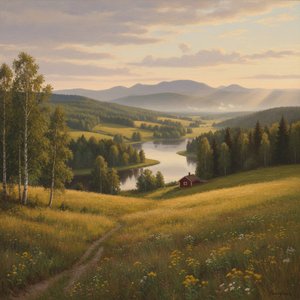
Schwede focused much of his energy on the study of people and the natural world. He specialized in portraiture and landscapes, using oil on canvas to capture the likenesses of those around him. His work often brought him into contact with the prominent figures of Russian society, including military officers and members of the high aristocracy. One notable example is his portrait of Pavel Petrovitch Melnikov, a man who served as a Major General and played a significant role in the development of the St Petersburg-Moscow railway.
His approach to painting was influenced by the techniques he learned during his training. While he was a contemporary and pupil of Karl Timoleon von Neff, he did not simply mimic the Raphael tradition. Instead, he adopted various methods to document the faces and settings of his era. His portraits, such as the one of Maria Miln held in the Latvian National Art Museum, remain among the most recognizable pieces of his output.
A Quiet Legacy
Much of what remains of Schwede's career is found in private collections or scattered across different regions. While many of his over thirty known works are held by the descendants of his family in Russia and Germany, his connection to Latvia remains a central part of his story. He is often remembered as a painter whose work bridged the gap between Baltic and Russian artistic identities.
The difficulty in studying his full body of work arises from the fact that many of his landscapes are known only through photographs. This makes it hard to fully grasp the breadth of his natural scenes. Nevertheless, his ability to capture the presence of historical figures through portraiture ensures his place in the history of nineteenth-century painting.
Klausimai ir atsakymai
Kur ir kada gimė Robert Schwede?
Robert Schwede gimė Mõisaküla, 1806 m.
Kur galima rasti Robert Schwede kūrybos darbų grupavimą pagal techniką?
Robert Schwede darbus pagal technikas galima peržiūrėti jo/jos puslapio Visi mediai skiltyje.
Kur galima rasti temomis suskirstytus Robert Schwede kūrybos darbus?
Tematų katalogas puslapio tematikos žemėlapyje Robert Schwede kūriniai suskirstyti pagal temas.
Kur galiu pamatyti Robert Schwede kūrybą, sugrupuotą pagal atmosferą?
Robert Schwede kūrybą pagal nuotaikas galite peržiūrėti joje, kurioje kūriniai sugrupuoti pagal jų atspindžiamas nuotaikas: Nuotaudų kambarys