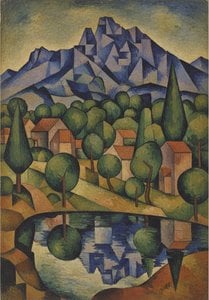
The Quiet Observer of the French Landscape
In the soft light of the French countryside, Paul Camus sought to capture the essence of the land through the medium of oil on canvas. His life was one of quiet observation, a steady gaze turned toward the shifting moods of the natural world. He was a painter who found his purpose in the subtle nuances of light and the textures of the earth, working with a devotion to the tangible reality of his surroundings. His hands moved with the intent of a man who understood that a landscape is never merely a view, but a living, breathing entity shaped by the weather and the passage of time.
His work often centered on the specificities of the French terrain, finding profound meaning in the simple arrangement of hills, trees, and sky. There was a certain stillness in his approach, a refusal to rush the brush or overstate the drama of a scene. Instead, he allowed the composition to emerge from the very soil he depicted, creating works that felt as though they had grown directly from the landscape itself.
A Connection to the Land
The geography of France provided more than just a subject for Camus; it provided a language. His brushwork reflected a deep familiarity with the coastal and rural regions, particularly the areas that define the character of the French spirit. His technical focus remained on the interplay of light and shadow, using oil paint to build a sense of depth and atmosphere that invited the viewer to linger.
His artistic output is characterized by several key elements of his practice:
- The use of oil paint on canvas to achieve a lasting, textured presence.
- A focus on the specific topography of regions like the environs of Paimpol.
- A commitment to capturing the atmospheric conditions of the French landscape.
Legacy in the Museums of France
The permanence of his vision is found in the collections that preserve his efforts for those who follow. His paintings have found a home in institutions such as the Musée d'art et d'histoire de Saint-Brieuc, where his work remains part of the public record. One such work, Environs de Paimpol, serves as a window into his method, offering a glimpse of the world as he perceived it through his palette. Through these preserved canvases, the quiet observations of a French painter continue to exist, held within the walls of history.
Klausimai ir atsakymai
Ar galima pasimatričiuoti 3D virtualiame Paul Camus kūrybos muzieje?
Paul Camus 3D galerija yra puslapis, kuriame kūriniai rodomi virtualioje trimensione galerijoje.
Ar yra Paul Camus kūrybos istorijos chronologija?
Chronologinė Paul Camus kūrybos apžvalga galima rasti puslapio Karieros istorija puslapio, kuriame kūriniai pateikiami pagal jų kūrimo tvarką, skirstant į skyrius.
Kiek Paul Camus kūrinių galima peržiūrėti?
Visi kūriniai puslapio kataloge galite peržiūrėti 1 kūrinys kūrinius, autoriaus: Paul Camus.
Ar galiu peržiūrėti Paul Camus kūrybą pagal nuotaiką?
Autoriaus Nuotaudų kambarys puslapio kūriniai yra sugrupuoti pagal Paul Camus darbų atmosferą.