A Life Rooted in the Swedish Soil
Born into the humble surroundings of Kattilstads parish in East Gothland, Nils Andersson began his life as the son of a peasant. This early connection to the land and the rhythms of rural life would later find its way onto his canvases. His path took him far from the fields of Östergötland, leading him first to the studios of Stockholm where he received his initial instruction. The young painter possessed an ambition that could not be contained by his provincial beginnings, prompting him to seek the great artistic centers of Europe.
In 1851, he joined a group of Swedish pioneers traveling toward Düsseldorf. This movement was part of a larger tide of Nordic talent seeking refinement abroad. His travels eventually brought him to Paris in 1854, where he spent two years immersed in the French capital's intense creative atmosphere. It was here that he studied under Couture, an experience that refined his hand and deepened his understanding of form and light.
The Brush and the Subject
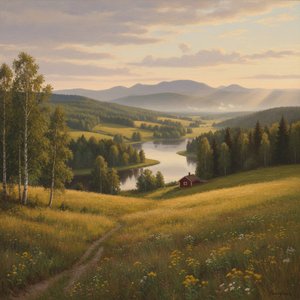
Upon returning to Stockholm, Andersson’s talent earned him a place within the Academy and, by 1858, the prestigious title of professor. His work reflected a commitment to classical realism, often focusing on the quiet dignity of everyday existence. He found beauty in the mundane, turning his attention to landscapes that featured animals, farm scene genre paintings, and figures captured in natural settings. There was a certain honesty in how he approached historical pieces and portraits, seeking to document life with clarity.
His repertoire included various subjects that spoke to the era's interests:
- Landscape paintings often featuring animals and rural scenery.
- Genre paintings depicting farm scenes and daily life.
- Historical compositions and figure studies.
A Legacy in the National Collection
Though his life was cut short in Vaxholm near Stockholm, the traces of his career remain visible in the halls of the National Museum at Stockholm. His presence in the art world was marked by both academic achievement and a technical skill that allowed him to navigate the transition between different European styles. While some works from the period have faced scrutiny regarding their authenticity, the true essence of his contribution lies in his role as a bridge between the Swedish countryside and the formal traditions of the continent.
Klausimai ir atsakymai
Iš kokios šalies yra Nils Andersson?
Nils Andersson gimė Sweden.
Kiek Nils Andersson kūrinių galima peržiūrėti?
Visi kūriniai puslapio kataloge galite peržiūrėti 6 kūriniai kūrinius, autoriaus: Nils Andersson.
Kur galima rasti Nils Andersson kūrybą, sugrupuotą pagal spalvas?
Nils Andersson Spalvų indeksas – tai puslapis, kuriame kūriniai sugruoti pagal jų spalvas.
Kuriuose meno judelseriu dirbo Nils Andersson?
Visi meno kryptys puslapio kūriniai Nils Andersson yra suskirstyti pagal meno kryptis.