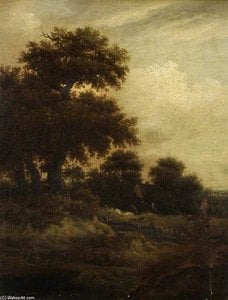
A Glimpse into a Frozen World: The Life and Art of Klaes Molenaer
Klaes Molenaer, born in Haarlem, Netherlands around 1629 and passing away in the same city in 1676, occupies a fascinating yet often understated position within the pantheon of Dutch Golden Age painters. While not as immediately recognizable a name as Rembrandt or Vermeer, Molenaer’s contribution to capturing the everyday life and atmospheric nuances of 17th-century Holland is significant. He was a painter deeply attuned to the subtleties of light and shadow, particularly as they played across winter landscapes—a subject he mastered with remarkable skill.
Molenaer came from an artistic family; his brothers Bartholomeus and Jan Miense Molenaer were also painters, though their styles differed considerably. This familial connection likely fostered an early interest in art, yet details of his formal training remain scarce. What is known is that he became a member of the Haarlem Guild of St. Luke in 1651, a crucial step for any aspiring artist seeking to establish themselves professionally and participate in the thriving art market of the time. He diligently paid his guild dues annually until his death, demonstrating a consistent commitment to his craft.
Influences and Artistic Development
The artistic landscape surrounding Molenaer was rich with talent, and he absorbed influences from several key figures. Early works reveal the impact of Jan van Goyen’s restrained palette and compositional clarity. However, it was Jacob van Ruisdael who proved to be the most profound influence on his style. Ruisdael's mastery of atmospheric perspective, particularly in depicting cloud formations and expansive skies, is clearly echoed in Molenaer’s work. He adopted Ruisdael’s ability to imbue landscapes with a sense of depth and realism, but infused them with a distinctively lively quality.
Molenaer didn't simply imitate his predecessors; he developed a unique voice within the genre of landscape painting. While he painted scenes beyond winter—including beach views and tavern interiors—it is his depictions of frozen rivers teeming with skaters that truly define his oeuvre. These paintings aren’t merely topographical records, but rather vibrant snapshots of Dutch life during colder months. He skillfully captured the energy of people enjoying leisure activities on the ice, from children playing to adults conversing and traveling.
Themes and Techniques
Molenaer's work is characterized by a keen observation of detail and an ability to convey a sense of immediacy. His paintings are populated with figures engaged in everyday activities—skating, sledding, walking, or simply observing the scene around them. He possessed a talent for rendering textures realistically, from the rough surface of ice to the warmth of clothing worn against the cold. The use of light is particularly noteworthy; he expertly depicted the diffused glow of winter sunlight and the long shadows cast by the low-hanging sun.
Beyond the technical skill, Molenaer’s paintings offer a glimpse into the social fabric of 17th-century Holland. They depict a society enjoying moments of recreation and community, reflecting a period of relative prosperity and stability. The inclusion of architectural elements—town walls, houses, and churches—grounds the scenes in a specific geographical context, further enhancing their realism.
Legacy and Historical Significance
Although Molenaer’s output wasn't vast, his paintings are highly regarded for their atmospheric quality and charming depictions of daily life. He was not merely replicating landscapes; he was capturing a mood, a feeling—the crispness of the air, the joy of winter recreation, the warmth of human connection. His influence can be seen in the work of later Dutch landscape painters who sought to capture similar scenes.
Today, Molenaer’s paintings are found in museums and private collections around the world, offering a valuable window into the artistic and social life of the Dutch Golden Age. He remains an important figure for scholars and art enthusiasts alike, representing a quieter but no less significant voice within one of history's most celebrated periods of artistic innovation.
问答环节
Kur galiu pamatyti visus Klaes Molenaer kūrybos darbus?
Visi Klaes Molenaer kūriniai, esantys šis internetinis svetainė, galima peržiūrėti puslapio Visi kūriniai skiltyje.
Ar galiu pasimokyti apie Klaes Molenaer spalvų naudojimą visuose darbuose?
Darbų spalvų profilis rodomas Klaes Molenaer puslapio Paletės genoma skiltyje.
Kur galiu pamatyti Klaes Molenaer kūrybą 3D galerijoje?
Klaes Molenaer 3D muziejus yra puslapis, kuriame kūriniai rodomi virtualioje trimensione galerijoje.