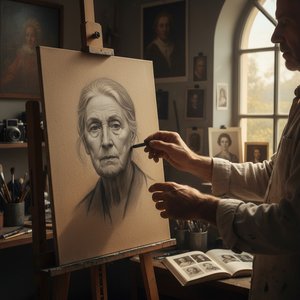
The Hand of the Portraitist
In the quiet corridors of history, certain names emerge through the subjects they chose to immortalize. Karl Schurmann belonged to that class of painters who captured the essence of power and presence during the eighteenth century. His brush did not merely record a likeness; it sought to fix the dignity of the individual upon the canvas, ensuring that their status remained visible to the eyes of future generations. His life was defined by the demands of his era, a time when the portrait was the primary vessel for a person's legacy.
The work of Schurmann reflects a period of profound social hierarchy and the necessity of formal representation. He moved through a world where a sitter's posture and attire spoke volumes of their station. Through his art, we catch glimpses of the rigid elegance that governed the lives of the elite, captured in the stillness of oil and pigment.
A Legacy in St. Petersburg
The weight of his contribution is felt most strongly in the collections that preserve the visual history of the Russian Empire. His ability to render the human form and the textures of authority allowed him to secure a place within the annals of significant portraiture. His skill was such that his creations found their way into prestigious repositories of art.
- The State Russian Museum, St. Petersburg
His portrait of Field Marshal Boris Sheremetev remains a notable achievement. Painted in 1800, this work preserves the likeness of a man of immense military and social standing. Through this painting, Schurmann’s hand is linked to the State Russian Museum in St. Petersburg, where his vision continues to reside.
The Weight of the Brush
To look upon the works of Schurmann is to understand the gravity of the eighteenth-century portrait. He worked with a sense of purpose, understanding that a portrait was a permanent record of a life lived in the public eye. His technique was suited to the monumental scale required by his subjects, capturing the weight of medals, the sheen of fabric, and the steady gaze of those who commanded armies and estates.
Though the details of his personal struggles and private triumphs remain obscured by the passage of time, his artistic output provides a clear window into the visual language of his age. He remains a painter of substance, a man whose brush captured the faces of history.
Klausimai ir atsakymai
Kaip rasti Karl Schurmann darbus konkrečia tema?
Karl Schurmann puslapio Raktažodžiais skiltyje kūriniai suskirstyti pagal raktinius žodžius.
Kur galiu pamatyti Karl Schurmann kūrybos spalvų profilį?
Karl Schurmann darbų spalvų profilis galima rasti puslapyje Paletės genomas.
Kur galiu pamatyti visus Karl Schurmann kūrybos darbus?
Visi ši ši internetinė svetainė esantys Karl Schurmann kūriniai galima peržiūrėti puslapyje Visi kūriniai.
Kiek Karl Schurmann kūrinių galima peržiūrėti?
Visi kūriniai puslapio kataloge galite peržiūrėti 1 kūrinys kūrinius, autoriaus: Karl Schurmann.