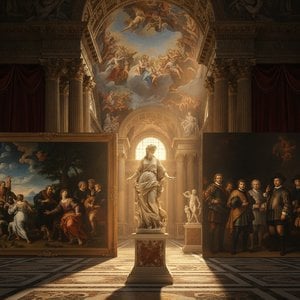
A Master of the Baroque Spirit
Johann Liss, also known as Jan Lys, stands as a luminous figure within the 17th-century German Baroque movement, a painter whose journey through Europe mirrored the vibrant, shifting currents of his era. Born in Schleswig-Holstein, Germany, specifically in Oldenburg, Liss’s early life was shaped by the rigorous artistic traditions of his home state. His path as an artist was one of constant motion and profound transformation, as he moved from the northern reaches of Germany to the great artistic hubs of the continent. Through his studies with Hendrick Goltzius in Haarlem and Amsterdam, he absorbed the technical mastery of the Dutch tradition before embarking on a travels that would eventually lead him through Paris and into the heart of Italy.
The evolution of Liss’s style is a captivating study in artistic adaptation. His early period, marked by his time in Rome around 1620–1622, reveals a deep engagement with the dramatic tension of Caravaggio. During these formative years, his canvases were defined by the stark, powerful contrasts of light and shadow, a technique that imbued his religious and mythological subjects with an immediate, visceral presence. However, as he migrated toward Venice, his palette underwent a magnificent metamorphosis. The somber depths of his Roman period gave way to a spirited treatment of the painted surface, characterized by brilliant colors and a loose, energetic brushwork that seemed to breathe with life.
Themes of Divinity and Desire
Liss possessed a rare ability to navigate the dual realms of the sacred and the profane, treating biblical narratives and classical myths with equal emotional intensity. In his religious works, such as The Sacrifice of Isaac, he utilized the Baroque aesthetic to explore profound themes of faith, obedience, and divine intervention. He often set these heavy theological moments against expansive, meticulously rendered landscapes, creating a tension between the monumental weight of the scripture and the natural world. His depictions of the divine were never merely static; they pulsed with a sense of movement and psychological depth that captured the religious fervor of the 17th century.
Conversely, his mythological works allowed for a more sensuous exploration of the human form and classical legend. In pieces like Venus and Adonis, Liss embraced a burgeoning aesthetic of beauty and desire, using oil on copper to achieve subtle tonal variations that heightened the emotional stakes of Ovidian tragedy. Whether capturing the tragic demise of Cleopatra or the divine judgment in Apollo and Marsyas, his work consistently sought to transcend simple storytelling. He looked toward the raw power of emotion, utilizing thick impasto and dynamic compositions to ensure that every mythological encounter felt both ancient and urgently alive.
Legacy and Artistic Influence
The significance of Johann Liss extends far beyond his individual canvases, as his stylistic innovations helped pave the way for future generations of painters. His later Venetian style, with its emphasis on light, color, and a certain fluid spontaneity, acted as a precursor to the Rococo movement. The energetic brushstrokes found in his work can be seen as an early influence on the great Guardi brothers, and his ability to integrate foreign influences into the Venetian tradition left a lasting mark on the Republic's artistic landscape.
His impact is most clearly felt in the lineage of 18th-century masters. The works of Sebastiano Ricci, Giovanni Battista Tiepolo, and Giovanni Piazzetta all carry echoes of the brilliance and movement that Liss pioneered. Though his life was cut short by the plague in Verona, leaving behind a legacy of both pious biblical subjects and sensuous mythological tales, he remains a vital link in the chain of Baroque excellence. He was a painter who mastered the art of transformation, turning the shadows of Rome into the radiant light of Venice.
问答环节
Kuriame istoriniame laikotarpyje kūrė Johannas Lissas?
Johannas Lissas kūrė Ankstyvasis modernusis laikotarpis laikotarpiu. Šis laikotarpis nustato kūrybinę veiklą istoriniame kontekste.
Kurių spalvų Johannas Lissas naudojo dažniausiai?
Johannas Lissas Paletės genoma yra puslapis, kuriame pateikiamas kūrybos efortų spalvų profilis.
Kaip rasti Johannas Lissas darbus konkrečia spalvų paletė?
Norėdami rasti Johannas Lissas darbus konkrečia spalvų paleta, naudokitite šio paveikslautojo Pagrindo pagal spalvų paletę puslapį.
Kokia Johannas Lissas kūryba yra populiari?
Eksistuoja Statistika puslapis šiam kūrinys autoriui Johannas Lissas, kuriame pateikiama statistika apie Johannas Lissas kūrinius „šis internetinis svetainė“.
Kaip Johannas Lissas karjera skirstoma į laikotarpius?
Johannas Lissas kūrybos kelias atskleidžiamas etapais puslapio Chronika chronologijoje: tai horizontali kūrybos darbų laiko linija, suskirstyta į karjeros periodų skyrius.
Kaip galiu stebėti Johannas Lissas kūrybą metmet metams?
Johannas Lissas kūriniai chronologine tvarka galima rasti puslapio Kūrybos laiko linija kūrinio chronologijoje.
Ar galiu ieškoti Johannas Lissas kūrybos temų pagal temos?
Johannas Lissas kūrybą temomis galima tyrinėti puslapio Tematų atlasas temų kataloge.
Iš kokios šalies yra Johannas Lissas?
Johannas Lissas gimė Vokietija.