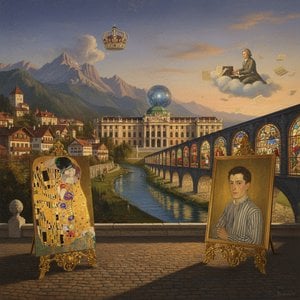
The Quiet Observer of the Austrian Landscape
Born in Vienna, Austria, Franz Wipplinger lived a life defined by the steady, disciplined pursuit of the visual world. His training took place within the walls of the Imperial and Royal Academy of Fine Arts in Vienna, an institution that shaped his understanding of light and structure. He was a man of his era, a painter who found his purpose in the translation of the physical environment onto canvas and paper. His work focused on the quiet dignity of landscapes and the precise lines of architectural views.
His career was marked by a consistent presence in the artistic circles of his time. From 1836 until his death in 1847, he was a regular contributor to the exhibitions held at the Imperial and Royal Academy of Fine Arts at St. Anna. These appearances were not mere occurrences but a sustained engagement with the professional art community of Vienna. He moved his studio through various locations, including the Kärntnerstraße and the Wieden am Glacis, as his practice developed.
Technical Precision and Subject Matter
Wipplinger’s technical approach was rooted in the traditional methods of his training. He worked primarily in oil and watercolor, choosing mediums that allowed him to capture the specific textures of the natural and built environments. His output was characterized by a focus on two distinct realms:
- The rugged, atmospheric qualities of mountain landscapes.
- The structured, geometric clarity of architectural vistas.
In his oil paintings, such as his 1842 work, Mountain Landscape with Alpine Huts and Haying Peasants, he sought to document the intersection of human labor and the vastness of the Alpine terrain. He did not merely paint scenery; he recorded the way light fell upon a hut or how a peasant might occupy a specific corner of a valley. His ability to render these scenes earned him significant favor among his contemporaries.
A Life Cut Short
The trajectory of Wipplinger's life was interrupted in 1847. He died in Waidhofen an der Ybbs, leaving behind a body of work that remains a record of the Austrian landscape and architecture of the mid-nineteenth century. His contribution to the Viennese art scene was one of steady, reliable craftsmanship. He remained a dedicated painter of the earth and the stone, capturing the stillness of a world that was, even then, beginning to change.
Klausimai ir atsakymai
Kuriame istoriniame laikotarpyje kūrė Franz Wipplinger?
Franz Wipplinger kūrė 19th Century laikotarpiu. Šis laikotarpis leidžia įvertinti kūrybinę veiklą istoriniame kontekste.
Kur galima rasti Franz Wipplinger kūrybos darbus, suskirstytus pagal raktažodžius?
Norėdami rasti Franz Wipplinger kūrybos darbus konkrečia tema, naudokite šio paveikslautojo Raktažodžiais puslapį, kuriame kūriniai sugrupuoti pagal raktažodžius.
Kurių spalvų Franz Wipplinger naudojo dažniausiai?
Franz Wipplinger Paletės genomas – tai puslapis, kuriame pateikiamas kūrybos efortų spalvų profilis.
Ar galiu ieškoti Franz Wipplinger kūrybos pagal spalvų spektrą?
Franz Wipplinger Spalvų indeksas – tai puslapis, kuriame kūriniai sugruoti pagal jų spalvas.