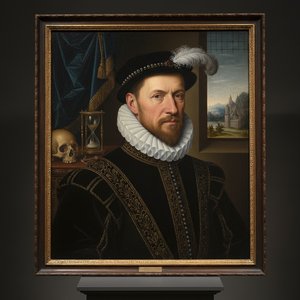
The Silent Witness of Augsburg’s Renaissance
In the vibrant, bustling heart of 16th-century Augsburg, a city that pulsed with the economic energy of European trade, there lived an artist whose brush captured the very soul of the High Renaissance. Christoph Amberger (c. 1505 – 1562) was not merely a painter of figures, but a meticulous chronicler of human dignity and divine narrative. Born into a lineage of craftsmen—the son of a stonemason and grandson of a woodcarver—Amberger inherited a profound respect for the tactile precision of art. This foundational upbringing in the traditions of German craftsmanship provided the bedrock upon which he would build a career defined by clarity, realism, and an unwavering attention to detail.
The trajectory of Amberger’s talent was irrevocably altered through his apprenticeship under the legendary Hans Holbein the Younger. From Holbein, Amberger inherited more than just technical skill; he absorbed a specific psychological language, a way of rendering the human countenance that allowed a sitter to breathe through the oil and pigment. This mentorship instilled in him a mastery of crisp realism, enabling him to navigate the delicate balance between capturing physical likeness and conveying the inner character of his subjects. His work became a bridge between the Northern European tradition of meticulous detail and the burgeoning humanist ideals sweeping across the continent.
A Journey Through Faith and Humanism
Amberger’s artistic evolution was significantly enriched by his travels, most notably his sojourn through Northern Italy between 1525 and 1527. Immersing himself in the artistic atmosphere of Venice and Florence, he stood in the shadow of giants like Leonardo da Vinci and Michelangelo. This exposure to the Italian Renaissance breathed a new dimension into his work, infusing his German roots with a sophisticated understanding of composition and the monumental grace of the South. Upon his return to Augsburg, this synthesis of styles allowed him to engage with the city's most powerful patrons, including the legendary merchant Jakob Fugger and the statesman Konrad Peutinger.
Perhaps his most enduring contribution to the art historical canon is his profound engagement with biblical storytelling. His celebrated series, The History of Joseph, stands as a testament to his ability to transform scripture into visual dialogue. Through twelve magnificent canvases, Amberger meticulously recounts the life of Joseph, utilizing symbolic resonance to explore themes of virtue, providence, and faith. These are not merely illustrations of text; they are carefully constructed worlds where every fold of fabric and every shadow serves to deepen the theological narrative, making the ancient stories feel immediate and profoundly human.
Legacy of a Master Portraitist
Beyond his religious narratives, Amberger’s legacy is etched into the faces of the era's most influential figures. His portraiture served as a vital historical record of the political and economic titans of his time. By capturing the likenesses of individuals such as Emperor Charles V and the prominent members of the Fugger dynasty, he provided a window into the power structures of the 16th century. His portraits are characterized by:
- Psychological Depth: A profound ability to capture the gravity and intellect of his subjects.
- Material Precision: An exquisite rendering of textures, from heavy velvets to the cold sheen of armor.
- Humanist Spirit: A focus on the individual as a central figure of importance within the cosmic and social order.
Though he may not have sought the flamboyant fame of some of his contemporaries, Christoph Amberger remains an indispensable figure of the German Renaissance. His life’s work represents a harmonious intersection of Northern precision and Italian grace, leaving behind a body of work that continues to resonate with the quiet strength of a master who saw the divine in the details of the human experience.
问答环节
Kiek Christoph Amberger kūrinių galima peržiūrėti?
Kataloge, esančiame Visi kūriniai puslapio, galite peržiūrėti 22 kūriniai kūrinius, autoriaus: Christoph Amberger.
Kuriame istoriniame laikotarpyje kūrė Christoph Amberger?
Christoph Amberger kūrė Renaissance laikotarpiu. Šis laikotarpis nustato kūrybinę veiklą istoriniame kontekste.
Kokia yra Christoph Amberger gimimo vieta ir gimimo metai?
Christoph Amberger gimė Berlin 1505 m.