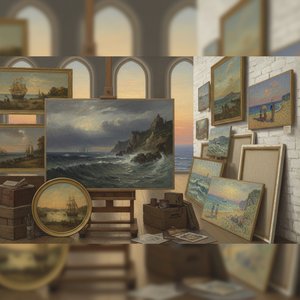
The Luminous Horizons of Andrew Stacey
Andrew Stacey stands as a profound voice in contemporary British landscape painting, an artist whose work serves as a bridge between the raw, untamed energy of nature and the delicate nuances of human perception. Born in 1963, Stacey’s artistic identity was forged amidst the rugged, windswept terrains of Dartmoor National Park. It was here, through the disciplined practice of sketching outdoors, that he first learned to observe the subtle shifts in light and the rhythmic movements of the earth. This early immersion in the natural world instilled in him a lifelong commitment to plein air principles, ensuring that every brushstroke is rooted in a deep, firsthand connection to his subject matter.
His formal education at the Edinburgh College of Art provided the technical scaffolding for his burgeoning vision. During his time there, Stacey refined his mastery over both watercolor and oil mediums, learning to manipulate the physical properties of paint to mirror the ephemeral qualities of the atmosphere. His stylistic lineage draws heavily from the Impressionist masters, particularly Claude Monet and Eugène Boudin. From these predecessors, he inherited a fascination with how light can dissolve form and how color can be used not merely as a descriptive tool, but as an emotional language capable of conveying the fleeting moods of a storm-tossed sea or a tranquil morning mist.
Technique and the Alchemy of Color
To encounter a Stacey painting is to witness a meticulous dance of light and pigment. His process is one of patient accumulation, where he builds layers of color through sophisticated glazing methods. This technique allows light to pass through translucent veils of paint, reflecting off the underlying layers to create an internal luminosity that seems to glow from within the canvas itself. He possesses a remarkable ability to distill complex meteorological conditions into singular, powerful compositions, using subtle tonal shifts and carefully considered horizon lines to guide the viewer’s eye across vast, oceanic expanses.
The energy of his work is palpable, often characterized by:
- Atmospheric Depth: The use of luminous washes to recreate the heavy moisture of coastal air.
- Dynamic Movement: Capturing the kinetic power of crashing waves and swirling clouds through expressive brushwork.
- Tonal Precision: A masterful command over the interplay between shadow and highlight to define perspective.
A Legacy Written in Salt and Sea
While his influences are broad, Stacey’s most significant contributions to the landscape genre are found in his dedicated explorations of the British coastline. He has become particularly celebrated for his evocative depictions of the Devon and Fife coasts. His most acclaimed achievement remains a monumental triptych centered around Dawlish Warren, a series of paintings that captures the dramatic essence of the Devon seascape with unparalleled intensity. In these works, the boundary between the sea and the sky becomes blurred, inviting the viewer into a meditative state where the roar of the ocean can almost be heard.
Through his dedication to capturing the soul of the landscape, Andrew Stacey has secured his place as a significant figure in modern marine and landscape art. His work does more than merely document a location; it preserves the ephemeral spirit of the coast, offering a timeless reflection on the enduring beauty and the restless power of the natural world.